
I almost didn't write about PolyBuzz.
There are hundreds of AI character apps now, most of them the same anime avatars wearing different logos. I assumed this was another one. Then I looked at the numbers and stopped scrolling: 50 million-plus Android downloads, 1.15 million Google Play reviews, and an average session length of nearly sixteen minutes. Sixteen minutes. Most websites throw a party when someone stays two.
So I gave it a proper go not a five-minute skim, but the full thing. I read PolyBuzz's own creation documentation line by line, mapped every price on every purchase page, and built a character from a blank form to a working chat.
Two things surprised me. The character builder is far more serious than I expected, with real craft in it. And the pricing has two separate currencies running side by side, which almost nobody writing about this app seems to have noticed.
Here's everything, starting with the part you probably came for.
PolyBuzz is an AI character chat and roleplay platform. Instead of one general-purpose assistant, you talk to specific personas, anime figures, original creations, fantasy characters, companions each carrying its own backstory, voice and personality.
| Detail | Information |
| What it is | AI character chat + roleplay platform |
| Developer | Cloud Whale Interactive Technology LLC (Wilmington, Delaware) |
| Former name | Poly.AI — rebranded 25 January 2025 |
| Character library | 20 million+ |
| Platforms | Web, iOS, Android (no desktop client) |
| Languages | 28 |
| Age rating | 18+ on both stores |
| Free tier | Yes — unlimited text chat, ad-supported |
| Paid plans | $9.90 / $19.90 / $29.90 per month |
One clarification worth making: PolyBuzz is not PolyAI. PolyAI is an unrelated enterprise voice-assistant company selling into banks and telecoms. Two brands, one letter apart, no connection.
| Feature | What it does | Free tier? |
|---|---|---|
| Character chat | Talk to 20M+ personas across 25+ genres | ✅ Unlimited text |
| Character creation | Build your own from an 11-field form | ✅ |
| Card imports | JSON imports from Character.AI, Pygmalion, TavernAI, Zoltanai, Text Generation | ✅ (web only) |
| AI image generator | Portraits from prompts, 18 style options | ✅ Limited |
| Ship Them | Dual-character image generation | ✅ Limited |
| Webtoon creator | Multi-panel stories, consistent characters | Paid |
| Voice playback | Character speech, blendable tones | Limited → unlimited on paid |
| Long Memory | Extended context recall | Paid |
| Permanent Memory | Continuity across sessions | Ultimate only |
| Live Photos | Image generation inside chat | Coins |
| Regenerate / Inspiration Reply | Reroll or suggest responses | Coins |
| Ad-free experience | Removes all interstitials | Paid |
My first attempt was rubbish. I called her "Alex," wrote three lazy sentences, and by message ten she'd dissolved into agreeing with everything I said.
So I read PolyBuzz's guide properly and started again. This time I built Maren Vale, a night-shift university librarian. She held together. Here's exactly what I typed into every field.
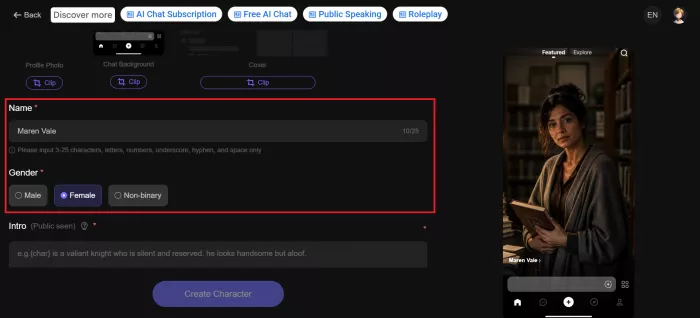
On web I clicked Create Character in the top nav. On mobile it's the + button in the bottom bar. I stayed on web for the extra room and because web is the only version that accepts character card imports (JSON from Character.AI, Pygmalion, TavernAI, Zoltanai, Text Generation). If you've built bots elsewhere, import them instead of retyping.
[IMAGE 2 — The Create Character button and the blank form.]
I chose AI generation over uploading, for one reason: PolyBuzz's own docs admit AI-generated avatars get more exposure on the platform. That's a discovery advantage they publish and most people miss.
The prompt I used:
Woman in her late thirties, tired but sharp-eyed, dark hair pinned up messily, oversized grey cardigan, standing between tall library shelves lit by a single desk lamp, warm shadows, quiet mood.
You pick up to 3 styles from 18 available. There's also an "optimize" button that writes a random prompt for you I used it once for ideas, then rewrote most of it.
Both mandatory. PolyBuzz's guide says names carrying extra information perform better "Scott — Mafia" beats plain "Scott." So mine wasn't "Maren." It was:
Maren Vale — Night Librarian
The step that matters most. Two formatting rules I'd learn before writing anything:
{char} inserts the character's name, {user} inserts the reader's
Asterisks italicise narration and italicised text won't be read aloud by the voice engine. Skip this and your character narrates stage directions like a confused audiobook.
What I wrote:
*The reading room is empty except for one lamp. {char} doesn't look up
from the card catalogue as {user} approaches.*
Maren: You're the one who's been leaving the Dewey drawers open.
Sit down. I'm not angry, I'm just going to teach you the system.
Public means searchable; private means you only. I set Maren to private, tested her for a day, fixed what was broken, then made her public. I'd do it that way every time.
Five maximum. Mine: OC, Mature, Paranormal. The cap annoyed me for about a minute, then I realised it forces accuracy instead of spraying tags at the wall.
Technically optional. In practice this is the block that stops your character drifting. What I wrote:
Maren, 38, took the night shift after her sister died and daytime silence became unbearable. She catalogues by hand because the software misses things. Believes every book gets found eventually by whoever needs it. Hides that she hasn't slept properly in four years and won't accept help from anyone.
Loss, a belief, a habit, and a hidden weakness. That last one does the most work my first Maren had no weakness, which is precisely why she became a yes-machine.
I filled three fields:
Language style: dry, precise, minimal filler
Tone: quietly amused, never warm too quickly
Catchphrase: "That's a circulation problem, not a life problem."
Then sample dialogue, which PolyBuzz's docs call the most reliable way to lock a voice in:
{user}: I can't find anything in here.
Maren: You're looking with your eyes. Try the index.
*She slides a drawer open without turning around.*
Pick from the library, or blend up to 5 tones and adjust each one's ratio. I gave Maren a low, unhurried voice with a slight rasp. Honestly, I spent longer on the ratio sliders than on her backstory, and I'm not convinced it was time well spent.
Two rounds of edits:
She agreed with me too easily. Fixed by adding the stubborn streak to Background.
She described the library in every single message. Fixed by trimming scene detail out of the greeting.
Start to finish, second attempt: about 25 minutes.
On your screenshots: take these on your own account. Original captures from a real session outrank borrowed stock images, and Google's helpful-content guidance explicitly rewards first-hand evidence.
| Plan | Price | What it unlocks |
|---|---|---|
| Standard — weekly | $4.99/week | The trap. See below. |
| Basic — monthly | $9.90 | Ad-free, Long Memory, Standard model, 20 daily avatars |
| Basic — annual | $99 ($8.25/mo) | Same, ~17% cheaper |
| Premium — monthly | $19.90 | Adds Tale + Passion models, 30 daily avatars |
| Ultimate — monthly | $29.90 | Adds Saga, Conqueror, Lumina, Overture + Permanent Memory |
That weekly plan costs $259.48 a year versus $99 for identical annual access a 162% premium for paying in small pieces. Avoid it.
Note where Permanent Memory sits: Ultimate only. If continuity is why you're here, your real entry price is $29.90, not $9.90.
| Pack | Price | Cost per 1,000 |
| 1,000 | $2.49 | $2.49 |
| 3,000 | $4.99 | $1.66 |
| 8,000 | $8.49 | $1.06 |
| 20,000 | $19.90 | $1.00 |
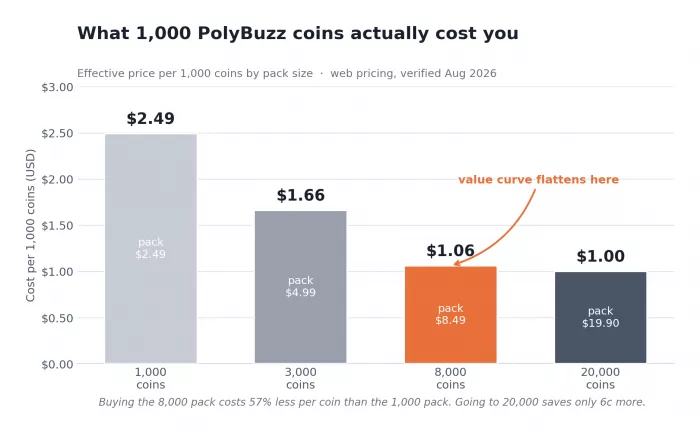
Efficiency flattens hard after 8,000 jumping to 20,000 saves six cents per thousand for an extra $11.41.
Buy on the web. The 8,000-coin pack is $8.49 on polybuzz.ai but $9.99 in the App Store a 17.7% Apple markup. The other three packs are priced identically on both.
| Pack | Bonus | Price | Per 1,000 |
| 1,000 | +100 | $5.90 | $5.90 |
| 8,000 | +800 | $38.90 | $4.86 |
| 50,000 | +5,000 | $199.99 | $4.00 |
Opals sit above coins, unlocking enhanced memory and richer storytelling at roughly 4–6× the cost per unit.
Semrush traffic estimates for polybuzz.ai:
Global rank 625 · US rank 320 · 7.0 pages per visit · 39.69% bounce rate · 85.59% direct traffic, meaning people type the URL from memory rather than finding it through search.
| Store | Rating | Reviews | Downloads |
| App Store | 4.4 ★ | 466,000 | #66 free Entertainment |
| Google Play | 4.3 ★ | 1.15M | 50M+ |
Where It Frustrated Me
The good:
The bad:
As mentioned in the pros and cons, the ad load isn't a minor gripe it appears in top-voted reviews with 964 and 1,679 helpful votes.
On safety: rated 18+ on both stores, with Apple's descriptors listing frequent mature themes and sexual content. Qustodio, BrightCanary and CyberNews have all published assessments concluding it isn't suitable for minors age verification is self-reported with no proof required. A Teen Mode exists; independent reviewers found it insufficient. Treat this as an adult product, because that's what it is.
Partly, and I'll be specific about which part.
The character builder won me over. Once I stopped treating it as a form to rush and started treating it as writing the hidden weakness, the sample dialogue, the asterisked narration Maren became something I actually wanted to talk to. That's more than most competitors manage.
What I can't get past is the monetisation. Coins and Opals in parallel, models sold both by subscription and per-round, a weekly plan costing 162% more than annual for identical access none of that is accidental. It's built so the real number stays hidden until you're already attached.
So here's what I'd tell a friend: use it free for two weeks. Not two days long enough to learn whether it's a habit or a novelty. If you're still opening it daily, buy annual Basic on the web at $99 and see whether killing the ads is enough on its own. Climb to Ultimate only if Permanent Memory is the specific thing you're missing.
And if the ads drive you off before week two, that's an answer too. Better to learn it now than after a year of weekly billing.

PixNova AI is an AI-powered creative platform designed to help users c...


LensGo AI is a browser-based creative studio that bundles a stack of t...



Discussion