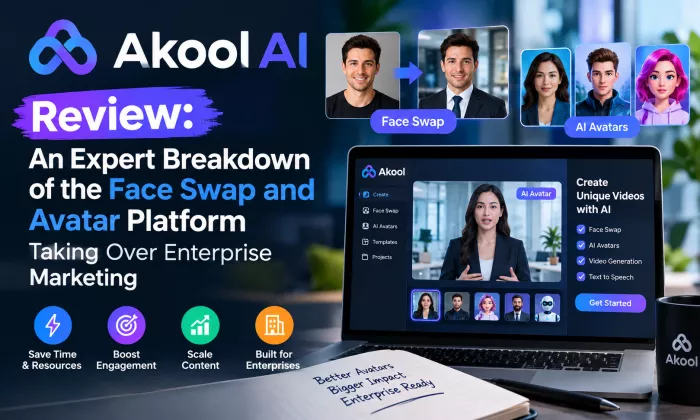
The problem nobody talks about in AI video tools is that most of them feel like toys even when they claim to be professional. You upload your face, generate something that looks decent on your screen, and then watch it fall apart the moment you try to use it in a real campaign. That gap between demo quality and production quality is where many tools die.
Akool is one of the few platforms that actually bridges that gap, and after spending time testing it thoroughly, I can see why it has grown from a small startup to processing content for household names like Coca-Cola and Amazon in just a few years.
Before diving into features, it helps to understand what Akool is actually built for. This is not a content creator tool for making TikToks. Akool targets enterprise marketing teams that need to produce high volumes of localized video content without hiring translators, reshoot crews, or actors for every market they enter.
The core capability is identity-preserving video generation. When you swap a face in a video, Akool maintains skin texture, lighting consistency, and facial structure in ways that most competitors still struggle with. For a brand running the same campaign across twenty countries, that matters more than any single impressive demo.
The face swap tool is where Akool genuinely stands out. You can process both images and videos, with output resolutions reaching 4K and 8K depending on your plan. The system handles multiple faces in a single frame without degrading, which is not guaranteed across all tools in this space.
One thing that impressed me during testing was how well the face swaps held up when the head turned or when lighting changed mid-video. Many AI face swap tools produce convincing results in controlled conditions but fall apart the moment you introduce movement or variable lighting. Akool handles these scenarios better than most alternatives I have tested.
The process itself is straightforward. You upload your source image or video, select the face you want to swap, and the system processes it. There is an optional adjustment for age and photo enhancement. For video face swaps, you need faces that are front-facing with decent quality to get the best results.
One feature that surprised me is the Live Camera capability launched in May 2025. This is not about pre-recorded videos. This is about real-time face swapping during Zoom calls, Teams meetings, or live streams.
You appear on screen as a hyper-realistic AI avatar that mirrors your movements and lip-syncs in real time. For businesses running international teams, this means someone can present in English while the avatar delivers in Japanese, German, or Spanish, all live.
Akool offers sixty-plus stock avatars that cover most common use cases. These are not the stiff cartoon figures you see in basic AI video tools. They are designed to look professional enough for corporate training videos, internal announcements, and customer-facing content.
The talking photo feature lets you upload any portrait and convert it into a speaking video with believable facial movement. You type your script, select a voice, and Akool generates the talking video. For internal communications where you want a CEO message without requiring filming, this saves significant time.
Custom avatars on enterprise plans let brands create digital versions of real executives or spokespersons.
The video translation feature is what attracted brands like Qatar Airways to Akool. It does more than dub audio. The system translates your script, preserves your original voice characteristics, and re-animates lip movements to match the new language.
The lip-sync accuracy is notably good, matching mouth movements to new language phonemes while keeping the original speaker identity. Supported languages range from thirty-plus on Pro plans up to one hundred seventy-five on Enterprise.
Videos need to be under sixty seconds, and results improve without background music.
Looking at verified user reviews from G2 and Trustpilot provides a clearer picture of how Akool performs in actual production environments rather than just in demo tests.
One user on G2 noted that face swaps work reasonably well, though lighting and complex shots sometimes require extra tweaks. Background changes can save time for simple product shots, but more complex scenes need manual adjustment. This matches my testing experience. The tool is powerful but not magic.
Another reviewer mentioned that Akool has transformed their marketing strategy, citing exceptional face realism and time savings. The ease of use appears consistently across positive reviews, with users noting the interface is intuitive for non-technical teams.
On the critical side, some users report that credit costs add up quickly for heavy usage.
A thirty-three-second video I generated during testing took fourteen minutes to process, which could be improved. There are also occasional AI artifacts, particularly with fingers in generated images.
Several users note the credit system lacks transparency, with task costs only becoming clear once inside the platform.
Akool operates on a credit-based system that can catch users off guard if they do not read the fine print.
The Free plan gives you one hundred credits to explore. The Pro plan starts at twenty-one dollars per month when billed annually and includes six hundred credits. The Pro Max plan at seventy-one dollars per month provides twenty-four hundred credits. The Studio plan at three hundred fifty dollars per month offers twelve thousand credits.
Here is what that actually means in practice. A face swap on an image costs four credits. A ten-second talking avatar video at 1080p costs ten credits. A ten-second face swap video costs ten credits. A four-minute video at 1080p would consume roughly two hundred forty credits.
Credits do not roll over month to month. If you buy a Pro plan with six hundred credits and only use two hundred, the remaining credits disappear at billing cycle end. For heavy users, this can make the real cost significantly higher than expected.
Akool is not the cheapest AI video tool, and it is not aimed at casual creators. It is infrastructure for enterprise marketing teams that need to produce high volumes of localized, personalized video content at a professional standard.
The face swap technology is genuinely best-in-class for enterprise use. The real-time avatar capability is innovative and practical. The translation tools provide real value for global campaigns.
At the same time, the credit-based pricing model requires careful planning, and the lack of post-render editing can disrupt workflows.
If you are an enterprise team focused on scalable video production and localization, Akool is worth serious consideration. For smaller teams or individual creators, the cost and limitations may outweigh the benefits.



PepHop AI is a web-based platform for interactive roleplay and dynamic...


Discussion