

Over the past few months, CrossMarket AI has been hard to ignore.
It shows up in conversations, in forwarded links, in Telegram groups, and sometimes in direct messages with a simple pitch. An AI system that trades across multiple markets and generates passive income.
At first, it sounds like just another entry in a crowded space. But what makes CrossMarket AI stand out is not what it claims. It is how little it explains.
That gap between visibility and clarity is what makes people start digging.
And once you start looking closer, the picture becomes less straightforward.
The platform presents a simple idea.
An artificial intelligence system monitors multiple financial markets at once. Stocks, crypto, forex, commodities. It identifies patterns between them and turns those patterns into profitable trades.
This concept is not fictional. Cross-market analysis exists. Institutional trading firms use similar ideas when studying how different assets influence each other.
But those systems are usually backed by detailed research, transparent methodologies, and teams that are publicly known.
CrossMarket AI skips that part entirely.
There are no technical documents, no explanation of how the system works, and no evidence of how it has performed over time. The entire pitch relies on the idea of AI without showing the mechanism behind it
If you strip the language down, CrossMarket AI describes itself using a set of features that appear in almost every automated trading platform.
It claims to:
Despite the lack of transparency, CrossMarket AI is clearly attracting users.
Traffic estimates suggest tens of thousands of visits each month, with a large share coming from mobile devices. A significant portion of that traffic comes from regions like India and Bangladesh.
What stands out is how people are reaching the site.
A large number of visits appear to be direct. That usually means users are not discovering it through search engines, but through shared links, social media, or private channels.
This kind of distribution is common in platforms that grow through referrals or network-based promotion rather than organic discovery.
It does not confirm anything on its own, but it adds context to how the platform spreads.
The most confusing part of CrossMarket AI is the feedback.
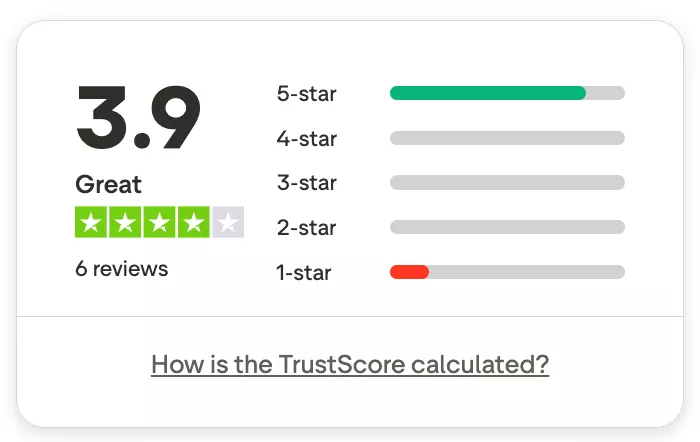
On platforms like Trustpilot, the rating appears moderately positive. Some users describe it as a working system that generates returns.
But the details matter more than the score.
There are very few reviews in total. And many of the positive ones are short, vague, and lacking specific experiences.
At the same time, a different set of users reports something else entirely.
Some say the platform stopped functioning. Others mention that access disappeared or that they could not continue using the service.
When feedback swings this sharply in both directions, it becomes difficult to form a clear picture.
If you have seen other online trading platforms before, parts of this will feel recognizable.
The structure follows a pattern that has appeared many times:
| Stage | What Happens |
| Entry | Platform is introduced as AI-driven and highly advanced |
| Hook | Users are told it can generate passive income |
| Action | Deposits are encouraged quickly |
| Detail | Technical explanation remains vague or absent |
This pattern does not prove anything by itself. But it is common enough that experienced users tend to approach it with caution.
Among all the issues, one stands out more than the rest.
Withdrawals.
Several user reports mention that depositing funds is straightforward, but withdrawing them is not. Some describe delays. Others claim they were unable to retrieve their funds entirely.
In legitimate financial systems, withdrawals are usually predictable. Delays can happen, but they are explained and resolved.
Repeated complaints about blocked or delayed withdrawals tend to signal something deeper.
It is one of the few areas where user feedback becomes more than just opinion.
Another layer of concern comes from discussions linking CrossMarket AI to earlier platforms such as QFX Trade, Botbro, and TLC Coin.
These names have been associated with financial investigations in India related to large-scale schemes.
There is no definitive public confirmation tying these platforms together. But the association continues to appear in user discussions.
Even without confirmation, that kind of connection changes how people interpret the risk.
Artificial intelligence has become a powerful marketing tool in finance.
The logic is simple.
People know that AI can analyze data faster than humans. That makes it easier to believe that it can predict markets.
But real-world finance does not work that cleanly.
Even large hedge funds with advanced models experience losses. Markets are influenced by countless unpredictable factors.
When a platform claims consistent or automated profits through AI, it creates a gap between expectation and reality.
That gap is where skepticism usually begins.
After going through the available information, a few things become clear.
CrossMarket AI presents itself as a system that simplifies trading through automation.
But when you move past the surface, there is not enough transparency to support that claim.
No technical breakdown. No identifiable team. Limited and conflicting user feedback. Repeated concerns about withdrawals.
None of these factors alone prove anything.
Together, they create uncertainty.
And in financial decisions, uncertainty without transparency is usually a signal to slow down, not speed up.
The platform may work for some users in certain situations. But based on what can actually be verified, it sits firmly in a category where caution is not optional.




PepHop AI is a web-based platform for interactive roleplay and dynamic...



Discussion