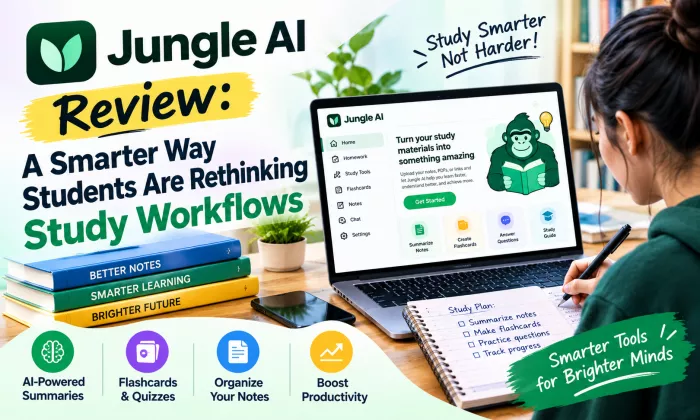
Every few years, a new study tool shows up claiming it will transform how students learn. Most of them disappear quietly. A handful manage to stick around. And then there are rare cases where a platform feels genuinely different.
Jungle AI falls into that last category. Instead of acting like another digital notebook or flashcard app, it behaves more like an adaptive study assistant that reacts to whatever material you give it. Lecture slides, PDFs, YouTube videos, textbooks, handwritten notes, it processes all of it. But more importantly, it does not just convert content into simple flashcards. It attempts to identify what you need to focus on and builds questions around that.
Today, the platform is used by over a million students, including those at universities like Harvard, Princeton, UC Berkeley, and many others. The goal is not to eliminate effort. It is to remove the repetitive, low-value parts of studying so that time spent actually leads to better understanding.
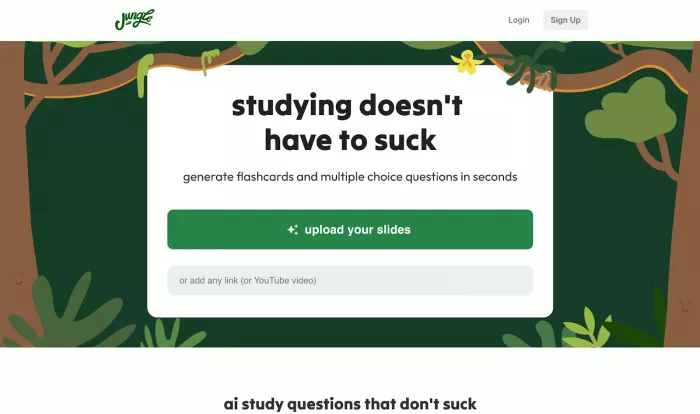
When you first encounter Jungle AI, the messaging is surprisingly straightforward. It essentially asks whether you want better study questions. That framing highlights a real issue. Many study tools rely heavily on generic flashcards, which often fail to reflect what students actually need to practice.
Jungle approaches this differently through adaptive question generation. Once you upload content, the system breaks it down into key ideas and transforms them into various formats such as multiple choice, open-ended responses, and case-based questions.
What stands out is the feedback loop. After each answer, the platform provides explanations that go beyond surface-level corrections. Students often describe this as similar to having a tutor who explains mistakes, connects ideas, and points out gaps in understanding.
This process is combined with a spaced repetition system, similar in concept to Anki but far more automated. As you continue practicing, the system adjusts difficulty and revisits concepts at the right time. Progress is not static. It evolves with your performance.
One of Jungle AI’s strongest features is how it handles different types of input. Students are not limited to one format.
You can upload:
Lecture slides
Long-form articles or webpages
YouTube lectures
Textbooks and PDFs
Once uploaded, the AI analyzes the structure and begins generating targeted questions almost immediately.
The key difference is that it does not simply extract sentences. It tries to understand relationships between ideas, definitions, and underlying logic. The experience feels closer to being quizzed by someone who has already read and understood your material.
This significantly changes how studying begins. Instead of spending hours creating notes or flashcards, students can move directly into active recall and practice, which is where most learning actually happens.
Jungle AI uses a tiered system that reflects how intensively you plan to use it.
| Plan | Content Generation | Case Questions | Feedback | Anki Export |
| Free | Limited usage per month | Very limited | Restricted feedback | Not included |
| Mega Mind | Unlimited | Unlimited | Expanded generation | Included |
| Super Learner | Unlimited | Unlimited | Full personalized feedback | Included |
The free plan works well for light usage, but it becomes restrictive during exam periods. The paid tiers are not just about removing limits. They also enhance the quality and depth of feedback, which is where much of the platform’s value lies
Jungle AI was developed by Julian Alvarez and David Glass, along with a team that combines expertise in AI, education, and learning science.
The core idea is based on a well-established principle. Students learn best through deliberate practice, which involves attempting problems, receiving feedback, correcting mistakes, and repeating the cycle.
While this concept is not new, implementing it effectively at scale has always been difficult. Jungle uses AI to automate much of the work required to maintain this cycle, allowing students to focus on understanding rather than preparation.
The platform’s philosophy is consistent throughout. Studying should not feel like busy work. It should feel like progress with direction.
A large part of Jungle’s growth comes from word of mouth. Many student reactions share a similar tone. There is a sense of relief in how quickly material can be turned into usable practice.
Students often highlight:
The study tools space is crowded, but Jungle occupies a slightly different position.
| Tool | Limitation Compared to Jungle |
| Quizlet | Lacks deep feedback and multi-format input |
| Anki | Requires manual card creation |
| StudyFetch | Less consistent in question depth |
Jungle stands out because it combines automation with structured learning principles. It is not just generating content. It is shaping how students interact with that content.
Many educational tools rely heavily on gamification, often in ways that feel distracting. Jungle takes a quieter approach.
Instead of streaks or aggressive reward systems, it uses a growing tree to represent progress. The tree develops as you continue studying, acting as a subtle visual indicator of consistency.
This avoids adding unnecessary pressure while still providing a sense of progression.
Like any AI-driven tool, Jungle has limitations.
It is important to recognize that automation does not equal understanding. The quality of learning still depends on how actively students engage with the material.
There are also privacy considerations when uploading documents, although the platform uses standard security measures.
The main risk is not technical. It is behavioral. Relying too heavily on automation without reflection can reduce the effectiveness of any study method.
Jungle AI stands out because it aligns closely with how effective learning actually works. It reduces friction, speeds up preparation, and emphasizes practice over passive review.
It does not eliminate effort, but it redirects it. Instead of spending hours organizing material, students spend more time interacting with it.
For many, that shift makes a noticeable difference. Study sessions feel more structured, less repetitive, and more focused on actual understanding.
Jungle is not just another study tool. It represents a shift toward more adaptive, feedback-driven learning systems that respond to the student rather than forcing the student to adapt to the tool.

A detailed Luminarbrush.ai review based on real usage, exploring its l...

Dopple AI is not trying to be a productivity tool or a general assista...

An AI system that trades across multiple markets and generates passive...

designed specifically for hospitals, clinics, and healthcare networks...

Akool is one of the few platforms that actually bridges that gap, and...

PepHop AI is a web-based platform for interactive roleplay and dynamic...

Discussion