Meta Description:
A detailed look at Dopple AI, how it works, why users stay, and where the platform struggles with stability, moderation, and long-term trust.
The first time you use Dopple AI, it feels different from most AI chat platforms.
There is less friction. Conversations flow more freely. Characters respond in ways that feel less restricted and more open-ended. If you have used platforms like Character.AI or Replika, the difference is noticeable almost immediately.
It gives the impression that you are finally interacting with something that is not constantly pulling back or filtering itself.
But that initial feeling does not tell the full story. The longer you stay, the more complicated the experience becomes.
Dopple AI is not trying to be a productivity tool or a general assistant. It exists for entertainment, specifically character-driven interaction.
Everything revolves around fictional or semi-fictional personas. These can be based on anime, games, historical figures, or completely original ideas created by users.
What makes Dopple stand out is how far it allows these interactions to go. It does not enforce the same level of moderation seen in other platforms. That decision attracts a certain type of user, especially those interested in long-form roleplay or storytelling.
At the same time, that same freedom creates problems that become more visible over time.
Dopple AI is operated by a relatively small company. Compared to larger AI platforms, its team size is limited, and that has a direct impact on how the product evolves.
From a technical standpoint, the platform relies on models derived from Llama architectures. These are adjusted to prioritize conversational flow rather than strict accuracy.
There is also a memory system built into the experience. Conversations are summarized and stored so that characters can recall past interactions. In theory, this allows for continuity across sessions.
In practice, this memory system does not always behave consistently. Some users report that characters remember details clearly. Others experience sudden resets or contradictions.
This inconsistency is one of the recurring themes across user feedback.
One of the most noticeable aspects of Dopple AI is the sheer number of available characters.
There are thousands of them. Some are detailed and well-written. Others feel unfinished or poorly structured.
This is because most of them are created by users.
On one hand, this creates variety. You can find highly specific personalities and niche scenarios that would not exist on more controlled platforms.
On the other hand, there is no consistent quality control. Some characters behave logically and stay in character. Others drift, repeat themselves, or respond in ways that break immersion.
As more users join and create content, this gap becomes more visible rather than less.
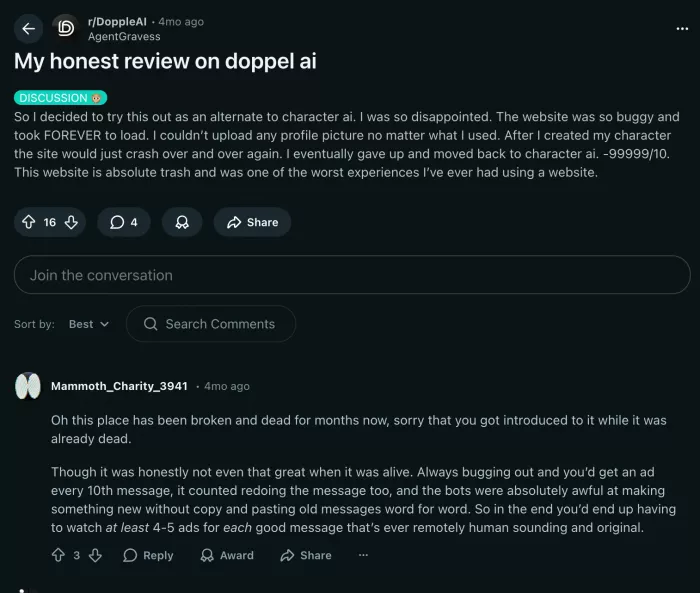
As the platform grew, changes started to appear in how it performs.
Responses became shorter at times. Conversations would loop or repeat phrases. In some cases, the AI would mirror what the user said instead of generating new responses.
These issues do not happen all the time, but they happen often enough to be noticeable.
Users who have been on the platform longer tend to describe a pattern. Periods where everything works smoothly are followed by updates that introduce new issues. Then partial fixes arrive, but not always completely.
Over time, this cycle affects trust more than any single bug.
At first glance, Dopple AI appears accessible. You can start chatting without paying, and there is no immediate barrier.
However, after some time, limitations start to appear.
Ads become more frequent. Certain features feel restricted. Response quality may seem to drop compared to earlier interactions.
There is also a subscription tier that removes ads and unlocks additional features. The price itself is not unusual, but the transition from free to paid has been a source of frustration for many users.
Some describe it as gradual restriction rather than a clear boundary. Others mention confusion around billing or difficulty resolving account issues.
These concerns show up repeatedly in user discussions.
Despite all the issues, Dopple AI still has a consistent user base.
This is not because everything works perfectly. It is because the platform offers something that is hard to replace.
The level of creative freedom is a big part of it. Users can build characters with detailed personalities and long histories. Over time, these interactions become more than casual conversations.
There is also a sense of familiarity. Once you invest time into a specific character or storyline, moving to another platform means starting over.
That emotional investment keeps people engaged even when the experience is inconsistent.
The same openness that makes Dopple appealing also introduces serious concerns.
Without strong moderation, the platform can expose users to content that may be uncomfortable or inappropriate. This includes scenarios that would be restricted elsewhere.
Enforcement exists, but it is not always consistent. Much of the moderation appears reactive rather than preventative.
There are also questions about data usage. Conversations are stored and analyzed to improve the system. For a platform built around personal and often emotional interactions, this raises concerns about how that data is handled.
Another aspect that comes up in user discussions is dependency. When conversations become immersive and ongoing, it can be difficult to step away, especially for users who rely on these interactions regularly.
It is tempting to compare Dopple AI directly with other platforms, but the comparison is not straightforward.
Character.AI offers more stability but less freedom. Replika focuses more on emotional interaction but operates within stricter boundaries. Other platforms like Janitor AI offer similar openness but with different trade-offs in usability.
Dopple sits somewhere in between.
It is not the most stable option. It is not the most controlled environment. It is something closer to an open sandbox, and that comes with both flexibility and unpredictability.
Even if Dopple AI never fully stabilizes, it represents an important shift in how AI platforms are designed.
It raises a question that most tools try to avoid. How much control should a platform enforce, and how much should it leave to users?
The answer is not simple.
Too much restriction limits creativity. Too little structure creates inconsistency and risk.
Dopple operates closer to the second side of that balance. The issues users experience are not random. They are part of the trade-off that comes with that design choice.
It is used for character-based conversations and roleplay rather than productivity or general assistance.
There is a free version, but it includes ads and some limitations that become more noticeable over time.
It attempts to, but memory consistency varies depending on different factors.
There are rules in place, but enforcement is not always consistent across all content.
Common issues include repetitive responses, shorter replies, and occasional instability after updates.
It depends on what you are looking for. It offers more freedom but less consistency compared to many alternatives.



PepHop AI is a web-based platform for interactive roleplay and dynamic...


Discussion