Gauth AI is a straightforward photo-based math solver developed by GauthTech Pte. Ltd., a Singapore-based company owned by ByteDance. The original value proposition was simple and compelling: photograph a math problem from your textbook or worksheet, and receive an instant step-by-step solution. For early adopters, this represented a significant advancement over typing equations into traditional calculators or searching through solution manuals.
In early 2024, the platform underwent a strategic rebrand to "Gauth" alongside the launch of Gauth GPT, its proprietary large language model. This expansion transformed it from a math-focused tool into a comprehensive homework assistant covering physics, chemistry, biology, economics, literature, history, and even writing assistance.
Gauth's technical architecture combines optical character recognition (OCR) with large language models and a massive pre-existing database of solved problems. When a student photographs a problem, the system first attempts to match it against its question bank of over 100 million previously solved questions. If a match is found, it returns the stored solution immediately. If no match exists, the Gauth GPT model generates a custom solution using patterns learned from its training data.
This hybrid approach explains both Gauth's speed and its inconsistency. Database matches return near-instantly with high accuracy because they're human-verified solutions. AI-generated responses take slightly longer and introduce the possibility of errors because the model is extrapolating from training patterns rather than retrieving a known-correct solution.
1. Photo Recognition
Snap a picture of printed or handwritten problems. OCR technology extracts text and mathematical notation, automatically cropping the relevant question. Accuracy varies significantly with handwriting quality and image clarity.
2. Step-by-Step Solutions
Solutions break down the solving process into sequential steps with explanations for each stage. Quality varies between database matches (consistently good) and AI-generated solutions (sometimes confusing or incorrect).
3. AI Chat Follow-Up
Conversational interface allows clarifying questions like "why did you use this formula?" or "what if the variable was different?" Responses range from genuinely helpful to generic depending on question complexity.
4. Live Human Tutors
24/7 access to a network of 50,000+ verified tutors (claimed) for problems AI cannot solve. Response time averages 10-15 minutes. Requires premium subscription or per-question payment.
5. Subject Coverage
Beyond math, covers physics, chemistry, biology, economics, literature, history, and writing. Quality degrades significantly outside STEM subjects—humanities responses are often generic and superficial.
6. Additional Tools
Reading simplification, writing assistant, focus mode, and advanced calculator. These auxiliary features are less developed than the core problem-solving capability and receive mixed user feedback.
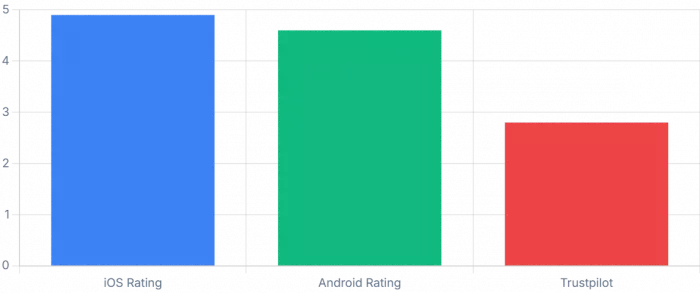
The gap between Gauth's marketing claims and user experience becomes starkest when examining actual customer feedback across multiple platforms. While the aggregate ratings appear impressive—4.9 stars on iOS from 1.67 million reviews and 4.6 stars on Android from 1.17 million reviews, closer inspection reveals patterns of both genuine praise and significant frustration that tells a more nuanced story.
Among satisfied users, several themes emerge consistently. Students genuinely struggling with concepts, particularly in algebra and geometry, report that Gauth's step-by-step breakdowns help them understand methodology rather than just copying answers. The speed of response—typically 2-3 seconds for database matches makes it practical for homework sessions where waiting 15-30 minutes for human tutor responses isn't viable.
"I have been continuously searching for an app that helps me do my homework, not only for maths, but also for History, and doesn't just do the homework all by itself and actually helps me prepare for my exam. It also lets you save questions in the 'question bank', which is amazing because you can use it just like flashcards. It doesn't even take up that much storage and has NO ads. Premium is much more helpful, and if you don't want to pay, that's okay! Gauth gives you coins which can be used to buy premium answers if you use it daily. In conclusion, I believe that Gauth AI is the best homework helping app there is."
— iOS App Store review, highlighting learning-focused use
This review captures what Gauth looks like at its best: a supplementary learning tool that provides explanations rather than just answers, doesn't interrupt with excessive ads (a genuine differentiator from competitors), and offers a viable free tier for consistent users. The flashcard functionality and question bank features demonstrate thoughtful product design that extends beyond simple answer provision.
"AMAZING app for the free experience. Almost always correct with so many options, math, biology, science, and others. Highly recommend downloading to see how it works. You'll never want to get rid of it. It has a built-in calculator and converter. When you are taking a photo to submit to AI, it has a flashlight option and so many other benefits."
— Google Play review, praising usability features
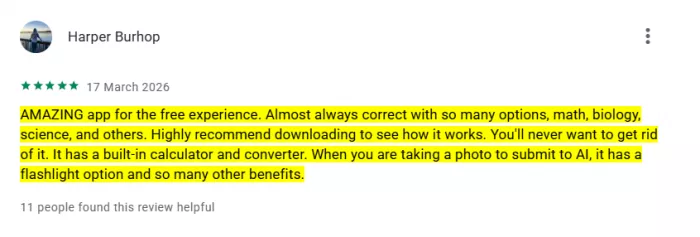
Multiple reviewers specifically mention features like the built-in flashlight for photographing problems in dim conditions, the automatic question cropping, and the clean interface details that suggest genuinely thoughtful user experience design. The "almost always correct" assessment aligns with Gauth's claimed 95% accuracy for standard STEM questions, though as we'll see, this accuracy varies dramatically by problem type and subject.
The most serious criticism involves outright incorrect answers and the AI's inability to recognize or correct its mistakes. Unlike human tutors who can acknowledge errors and adjust, Gauth's AI frequently doubles down on wrong answers even when users point out the mistake, forcing them to restart conversations or work around the system.
"Gauth AI is horrible. It almost always gives the wrong answers then REFUSES to change its answer even if you tell them what the right answer is. The only way for them to change your answer is if you restart the chat and take another picture but block out the answer choice they keep choosing. Plus, it sometimes contradicts itself and the way it teaches/explains things is way too confusing. This happens everytime I use it, and mind you, I've been using it for about a year now."
— Trustpilot review, 1-star rating
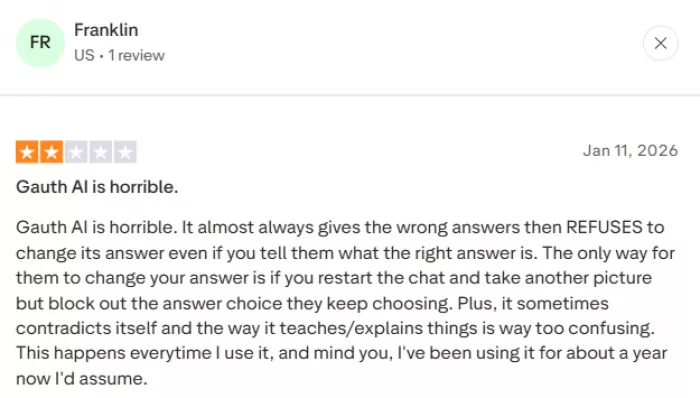
This "wrong and stubborn" behavior pattern appears repeatedly across reviews. The AI's confidence in incorrect answers creates a dangerous situation for students who trust the app without verification. When users report getting zeros on tests after relying on Gauth's solutions, it highlights the real academic consequences of accuracy failures.
"This is rubbish I got all the answers wrong and I got 0 on my test because I was doing revision on Gauth (Do not download"
— Trustpilot review, describing test failure
Independent testing from parenting education site Brave Parenting corroborates these accuracy concerns. Using actual high school geometry finals questions, they found Gauth provided wrong answers even after switching to "geometry mode"—a specialized setting that should theoretically improve subject-specific accuracy. The first attempt returned an answer that wasn't even among the multiple choice options, suggesting fundamental comprehension failures.
"This app is wrong like 80% of the time. And the AI is extremely stubborn and useless when trying to fix and clear up the mistake the AI made."
— User review quoted in multiple analyses
The "80% wrong" claim represents the negative extreme of user experiences, but even if exaggerated, it indicates a significant accuracy problem for certain problem types or users. The pattern suggests accuracy varies dramatically based on factors Gauth doesn't transparently communicate: problem standardization, subject area, question complexity, and whether the query matches existing database entries.
Beyond accuracy issues, the most heated complaints involve billing practices, particularly around free trial conversions and subscription cancellations. Multiple users report being charged immediately after starting "3-day free trials" without the ability to cancel before charges process, leading to unexpected charges and frustration when refund requests are denied.
"GAUTH AI, DO NOT USE the 3 day free trial.. YOU WILL GET RIPPED OFF. THEY WILL CHARGE YOU BEFORE THE TRIAL ENDS. There's no cancel option once you give your payment info. It wasn't 10 minutes I realized my card was pending $34.11. I contacted tried to cancel. Also, I reached out to CASH APP TO DISPUTE THE TRANSACTION AND MY DISPUTE WAS DENIED. ALSO, GOOGLE PLAY. THEY DID ABSOLUTELY NOTHING EITHER TO HELP!"
— Shawni Mayes, Trustpilot and multiple review sites
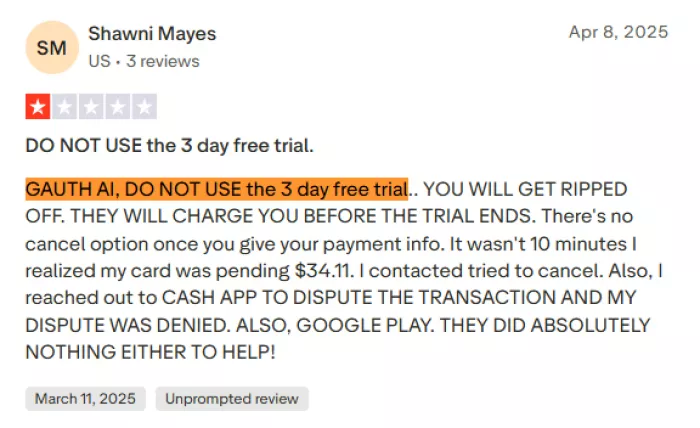
This experience pattern—immediate charges, unclear cancellation paths, and unresponsive support appears frequently enough to represent a systemic issue rather than isolated incidents. The fact that payment disputes through app stores and payment processors often fail suggests the charges technically comply with subscription terms, but the user experience clearly doesn't match expectations of what a "3-day free trial" should mean.
Multiple users report continuing charges months after believing they cancelled, pointing to subscription management interfaces that either hide cancellation options or make the process unnecessarily complex. Since subscriptions are managed through app stores rather than within Gauth itself, users often struggle to locate the correct cancellation path.
"I was charged 11.99 USD every month for more than two years even though I repeatedly tried to cancel my subscription to a total of $324. Every time I attempted to cancel on the app or website, I got..."
— Trustpilot review on subscription cancellation difficulties
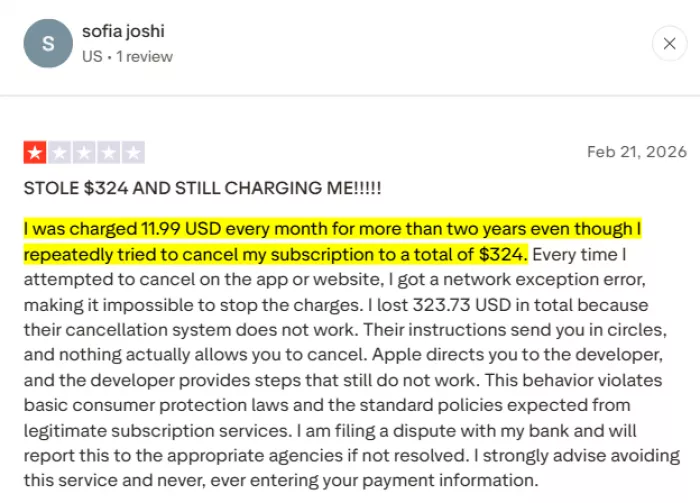
While Gauth markets itself as "100% ad-free," users on the free tier report a different experience: constant upgrade prompts and premium feature advertisements that interrupt the workflow and create pressure to subscribe.
"it's good, but it's very ad-filled. it's a game changer with studying and questions, but it's also really annoying to get a gauth+ ad whenever your done with a question, with it happening every two questions I screenshot. it's really annoying as I cannot skip it, and it is only for a free trial that I've already used. I really am glad I found this, because it's helping me pass."
— Google Play review on upgrade prompts
The distinction between "ads" and "upgrade prompts" is semantic. While Gauth doesn't show third-party advertisements (differentiating it from competitors), the persistent premium subscription prompts function similarly, interrupting workflow and creating friction. The inability to skip these prompts after already declining a free trial represents particularly poor user experience design.
App Store Ratings Comparison (iOS vs Android)
Gauth employs a freemium model that has evolved over time, with pricing that varies by region and platform. Understanding what you actually get at each tier requires parsing both official pricing and user experiences that reveal hidden limitations.
Gauth’s free tier gives users roughly 11 questions per day, though this limit is not always made clear upfront. Users can also earn extra credits through daily app activity and referrals, which encourages regular engagement. The free version includes basic AI-powered solutions along with step-by-step explanations, one of Gauth’s main strengths.
It is also ad-free in the traditional sense, since there are no third-party ads interrupting the experience. However, many users find the repeated prompts to upgrade to Gauth Plus intrusive, especially when they appear every few questions. The daily question cap resets at midnight, and any unused questions are lost rather than carried over.
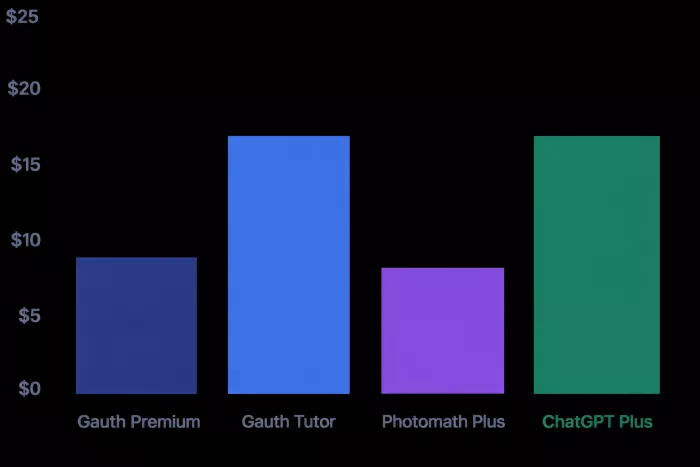
The Premium tier, marketed as Gauth Plus, removes question limits and provides unlimited AI solutions, access to the full 100 million+ question database, priority support, and faster response times. Pricing typically runs $9.99 monthly or approximately $99.99 annually (offering roughly two months free on annual billing).
Users report that Premium meaningfully improves the experience through higher-quality AI responses, access to advanced features like the "deep thinking" mode for complex problems, and the removal of upgrade prompts. However, Premium still includes watermarked solutions in some cases and doesn't provide access to live human tutors—that requires the higher Tutor tier.
| Feature | Free | Premium ($9.99/mo) | Tutor ($19.99/mo) |
| Daily Question Limit | ~11 questions | Unlimited | Unlimited |
| Step-by-Step Solutions | ✓ Basic | ✓ Enhanced | ✓ Enhanced |
| AI Chat Follow-Up | Limited | Unlimited | Unlimited |
| Question Database Access | Partial | 100M+ questions | 100M+ questions |
| Tutorial Videos | Limited | 20M+ videos | 20M+ videos |
| Live Human Tutors | ✗ | ✗ | ✓ 24/7 access |
| Upgrade Prompts | Frequent | None | None |
| Priority Support | ✗ | ✓ | ✓ Priority |
The highest tier includes everything in Premium, plus 24/7 access to live human tutors for problems the AI cannot solve or gets wrong. At $19.99 per month, or about $199 per year, it combines AI support with human help. Its value depends on how often a student needs that extra support. Those dealing with more complex or unusual problems may find it worthwhile, while students focused on routine homework may end up paying for a feature they rarely use.
Subscription Management Warning: Gauth subscriptions auto-renew by default and are managed through Apple App Store or Google Play Store, not within the app itself. Users report difficulty locating cancellation options and continuing charges after believing they cancelled. Before subscribing, familiarize yourself with your platform's subscription management interface. Set calendar reminders before renewal dates if you plan to cancel. According to multiple user reports, refunds for accidental charges or early cancellations are rarely granted unless required by local law (such as UK or EEA consumer protection regulations).
Monthly Cost Comparison: Gauth vs Competitors
Gauth claims a 95% solve rate for standard K-12 and college STEM questions, positioning itself as more accurate than human tutors for routine problems. But that claim requires substantial unpacking because "standard questions" carries a lot of definitional weight, and accuracy varies dramatically across problem types.
For straightforward problems that follow familiar patterns, such as basic algebra, standard geometry proofs, and common calculus derivatives or integrals, Gauth performs very well. Its large database of over 100 million human-verified questions helps it deliver fast and reliable solutions, especially when a problem closely matches an existing entry.
Independent testers report around 90–95% accuracy on common tasks like quadratic equations, simplifying expressions, finding triangle areas, and basic physics motion problems. This makes Gauth useful as a study tool, especially when students use the step-by-step explanations to understand the method instead of only copying the answer.
Accuracy drops more noticeably on problems that require contextual understanding, unusual multi-step reasoning, or translating word problems into the right mathematical model. Ambiguous wording and real-world constraints can especially cause trouble.
Users also report cases where Gauth does the math correctly but misunderstands what the question is actually asking. This can lead to errors such as optimizing the wrong variable or using the right physics formula with the wrong sign convention because it misread the scenario.
Accuracy by Problem Type (Based on User Testing)
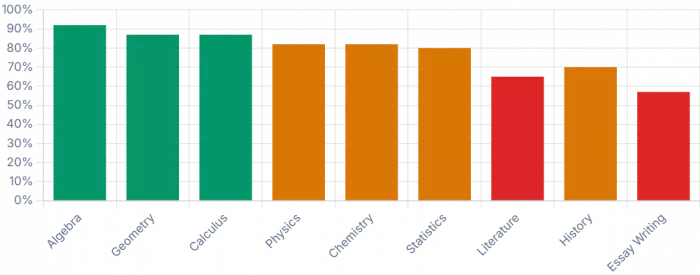
The gap between Gauth’s STEM and humanities support is wide enough that they feel almost like different products. In math, physics, and chemistry, its answers are often strong, but in literature, history, and essay writing, the responses tend to be much more generic.
Tests on literature questions show these limits clearly. For topics like Macbeth or 1984, Gauth can produce smooth, believable answers, but they usually stay at a surface level. The analysis often lacks depth, originality, and strong use of textual evidence, making it easy for teachers to spot as shallow AI-generated work.
The same weakness appears in essay writing help. Gauth can create grammatically correct and well-structured responses, but the content often feels formulaic and lacks voice, specific examples, and thoughtful argument. Students who submit this kind of output directly are likely to earn average marks at best and may also risk AI detection.
| Subject Area | Estimated Accuracy | Quality Assessment |
| Algebra & Pre-Calculus | 90-95% | Excellent for standard problems, strong step-by-step explanations |
| Geometry | 85-90% | Good for proof-based problems, occasionally struggles with spatial reasoning |
| Calculus | 85-90% | Strong on derivatives/integrals, weaker on conceptual understanding questions |
| Physics | 80-85% | Good on formulaic problems, struggles with complex scenarios and unit analysis |
| Chemistry | 80-85% | Solid on stoichiometry and equations, variable on conceptual questions |
| Statistics | 75-85% | Good on calculations, interpretation quality varies |
| Literature/English | 60-70% | Generic analysis, lacks depth and original insight |
| History | 65-75% | Surface-level summaries, limited critical analysis |
| Essay Writing | 50-65% | Grammatically correct but formulaic, easily detected as AI-generated |
Gauth's marketing emphasizes learning and understanding through step-by-step explanations and the "Gauth Honor Code" that encourages using the tool for comprehension rather than cheating. The reality, as evidenced by user behavior and educator concerns, reveals a more complex dynamic.
App store reviews reveal an honest truth that marketing materials don't address: many students use Gauth specifically to complete homework quickly rather than to learn. Reviews mentioning using it "secretly" when parents aren't looking, or celebrating that it helps them "pass" without referencing understanding, indicate the tool frequently serves as assignment completion rather than educational support.
"However, my parents dont want me cheating on homework so I secretly use this app when my parents are not looking."
— iOS App Store review, revealing actual usage pattern
This usage pattern isn't inherently Gauth's fault—any solution provider can be misused. But the design choices matter. An app optimized for learning would require students to attempt problems before showing solutions, include comprehension checks, or adaptively adjust difficulty. Gauth's one-tap photo-to-solution workflow optimizes for speed, which makes it excellent for completing assignments but removes friction that typically indicates learning engagement.
Brave Parenting, a group focused on technology’s effects on child development, reviewed Gauth in depth and came away with a clear conclusion: they do not recommend Gauth or similar AI homework tools for K–12 students. Their main concern is that these tools can short-circuit the learning process rather than support it.
Their analysis argues that learning is supposed to be difficult and time-consuming. Struggling with problems, making mistakes, and working through solutions are all part of how students build real understanding. Although Gauth offers step-by-step explanations, Brave Parenting believes many students will simply copy the answer instead of engaging with the method.
They also point to accuracy problems as an added risk. If students rely on Gauth without checking its work, they may not only avoid learning the material but also absorb incorrect methods. Mistakes they noted, including wrong answers in geometry, could create bigger difficulties later on.
The Terms of Service Age Restriction
Gauth's own terms of service state users must be 18 years or older, yet the app is marketed to students and rated 4+ on iOS and E for Everyone on Google Play. This creates a legal and ethical disconnect: the primary user base (middle and high school students) technically violates the age restriction every time they use the app.
Parents concerned about this contradiction may use the age restriction as justification for blocking the app from children's devices, regardless of its educational merits.
Despite these concerns, Gauth can still support real learning when students use it carefully. It seems most helpful when they first try problems on their own, then use Gauth to check their work, study the steps, and clear up confusion instead of simply copying the answer.
Some of its features also encourage better study habits. The question bank and flashcards can help students revisit problems they found difficult, which supports review and retention. Its chat feature can also be useful for asking follow-up questions, as long as students use it to understand the material rather than just get quick solutions.
Premium’s “deep thinking” mode is one of Gauth’s more learning-focused features because it offers fuller conceptual explanations instead of only showing procedures. Students who actually read and engage with these longer explanations are more likely to build understanding than those who only look at the final answer.
| What Actually Works | Significant Problems |
| Fast photo recognition and question cropping saves manual input time for legitimate study sessions | Accuracy for complex or non-standard problems is unreliable; AI sometimes “doubles down” on wrong answers |
| Step-by-step solutions for standard STEM problems are generally accurate and well-explained | Subscription billing practices including immediate trial charges and difficult cancellation create user frustration |
| 100% ad-free experience (no third-party advertisements) differentiates from competitor apps | Free tier’s 11 daily question limit is restrictive for serious study sessions |
| Question bank and flashcard features support spaced repetition learning strategies | Humanities and essay writing support is superficial and produces easily-detected generic AI content |
| 24/7 availability means students can get help during evening study sessions when human tutors aren’t available | Design optimizes for assignment completion speed rather than learning engagement |
| Multi-subject coverage makes it a one-stop solution rather than requiring multiple apps | Persistent upgrade prompts on free tier interrupt workflow despite “ad-free” marketing |
| Conversational follow-up questions allow clarification beyond initial explanation | Customer support is largely unresponsive based on multiple user reports |
| Live human tutor backup (in Tutor tier) provides safety net when AI fails | ByteDance ownership creates regulatory uncertainty (temporary US suspension in January 2024) |
| Privacy policy collects substantial user data including identifiers, usage patterns, and submitted content |
As a ByteDance-owned app, Gauth raises privacy questions that go beyond homework help. To understand those concerns, it helps to look at both the company’s official data disclosures and the broader regulatory issues tied to ByteDance.
According to app store privacy disclosures, Gauth collects tracking data such as device identifiers, along with data linked to users, including contact details, user content, usage data, and diagnostics. In practice, this means the app can track the problems students submit, the solutions they open, how long they spend reviewing explanations, the subjects they struggle with, and their general study habits. The privacy policy says this information is used for personalization, analytics, and service improvement, but it is less clear how long the data is kept, how well it is anonymized, or what happens to it if ownership or regulations change.
Gauth’s ByteDance ownership also creates a broader layer of concern. In January 2024, the app briefly went offline for US users alongside other ByteDance products, showing how regulatory action could suddenly disrupt access. For students who rely on the service, that creates a real stability risk. There are also ongoing questions about where student data is stored, who may be able to access it through ByteDance’s corporate structure, and whether that fits with school or district privacy rules. Because of those concerns, some schools have restricted ByteDance apps on their networks and devices.
Gauth doesn't operate in isolation. Understanding its strengths and weaknesses becomes clearer when compared against major competitors that offer similar homework assistance with different trade-offs.
Photomath is a dedicated math solver that covers topics from basic arithmetic to calculus. With more than 100 million downloads and a strong 4.8-star rating, it is one of the most established apps in this category. Its explanations are often more detailed than Gauth’s for similar math problems, and its interface is generally more polished.
The main drawback is its narrow focus. Photomath does not support physics, chemistry, or other non-math subjects. For students who only need help with math, its $9.99 per month Plus plan can offer value comparable to Gauth Premium, with stronger math-specific features. But for students who want help across multiple subjects, it is not enough on its own.
Question AI, developed by Singapore-based D3 Dimension, positions itself as the truly free Gauth alternative. With over 10 million users, it offers unlimited photo solving and broad subject coverage without the 11-question daily limit. The catch is lower accuracy than Gauth—users report more frequent wrong answers and less detailed explanations.
For budget-conscious students willing to trade some accuracy for unlimited free usage, Question AI provides viable Gauth alternative. The experience feels less polished, particularly the OCR quality for handwritten problems, but the core functionality works for straightforward questions.
While not specifically designed for homework, ChatGPT (particularly GPT-4 in paid tiers) can solve many of the same problems Gauth handles. The advantage is broader capabilities beyond homework—essay writing, code generation, general questions. ChatGPT also allows more nuanced conversation and can better handle clarifying questions and conceptual discussions.
Disadvantages include lack of specialized educational features (no question banks, no flashcards), no photo recognition without upgrading to GPT-4 Plus ($20/month), and no subject-specific optimization. ChatGPT works best for students who want one AI tool for multiple purposes and don't need specialized educational scaffolding.
After examining the technology, user experiences, pricing, accuracy, and educational implications, clear patterns emerge about when Gauth provides genuine value and when it creates more problems than it solves.
Students who genuinely try problems first and then use Gauth to check their work or see another explanation may benefit from its step-by-step help. It is especially useful for routine STEM subjects like algebra, geometry, and basic calculus, where accuracy is usually stronger. For students who only need occasional support, the free tier is often enough.
College STEM students preparing for exams may find the Premium tier more worthwhile, especially if they use it to understand solutions rather than copy them. Its 24/7 availability also makes it useful for late-night study sessions when a human tutor is not available.
K–12 students who are still building independent problem-solving skills are most at risk with Gauth. When it is used mainly to finish homework instead of support learning, it can weaken skill development and create dependence. Its fast photo-to-solution process also makes it easy to avoid the struggle that helps students actually learn.
Students should also avoid relying on Gauth for humanities work such as essays and literature analysis. The responses are often too generic and lack the quality needed for strong assignments. Teachers can also spot this kind of AI-generated writing easily, which creates academic integrity risks.
Gauth is also risky for anyone who cannot check its accuracy on their own. Because it can sound confident even when it is wrong, students may end up learning incorrect methods. That can hurt test performance, especially if they memorize answers without understanding the concepts behind them.
Gauth AI is highly effective for routine STEM problems but much less reliable for complex reasoning and humanities work. It can be a useful tool for checking answers and understanding methods, especially in subjects like algebra and geometry, but its educational value depends entirely on how students use it.
It works best as a support tool, not a substitute for real problem-solving. Students who try problems themselves and use Gauth to verify and learn can benefit from it. Those who rely on it for instant answers risk weakening their understanding, while concerns about billing and regulatory uncertainty add extra practical drawbacks.

PixNova AI is an AI-powered creative platform designed to help users c...


PolyBuzz is an AI character chat and roleplay platform.

LensGo AI is a browser-based creative studio that bundles a stack of t...



Discussion