I spent $76.98 last month so you wouldn't have to. One subscription to HeyGen Creator, one to Vidnoz Business, three weeks of side-by-side testing, 47 videos generated, and one absurd amount of coffee. The goal was simple, figure out which of the two most-talked-about AI video generators is actually worth your money in 2026. The result is not simple. Neither tool "wins" outright, and anyone telling you otherwise is either an affiliate or hasn't used both.
This is every comparison I could squeeze out of those three weeks: features, pricing, avatar quality, voices, render speed, support, real customer sentiment, and the use cases where each one quietly destroys the other.
| Question | Short Answer |
| Which has better avatars? | HeyGen, clearly |
| Which is cheaper? | Vidnoz, by roughly 40–60% |
| Which has more avatars / templates / voices? | Vidnoz, by a wide margin |
| Which has better customer support reputation? | HeyGen, but neither is great |
| Which would I personally pay for? | Both, for different jobs, keep reading |
That answer probably created more questions than it settled, so let's pull both tools apart properly.
Before the war stories, a quick grounding.
HeyGen is a focused, premium AI video generator. Launched in 2020, it has over 15 million users and 100,000+ business customers as of 2026. Its centerpiece is "Avatar IV" (and newer "Avatar V") digital presenters that, in my opinion, are the most realistic in the market right now. HeyGen is built like a serious enterprise tool: SOC 2 compliant, API access, CRM integrations, the works.
Vidnoz AI is a wider, cheaper, more chaotic toolbox. It started as a free alternative to HeyGen and has stayed cheaper while ballooning its feature list: 1,900+ avatars, 2,000+ voices, 2,800+ templates, plus extras like face swap, AI headshot generator, cartoon generator, and an AI script writer. ISO/IEC 27001:2022 certified. Think of HeyGen as a luxury sedan and Vidnoz as a Toyota with a roof rack, kayak, and toolbox already strapped on.
The asset libraries are where the first big gap shows up:
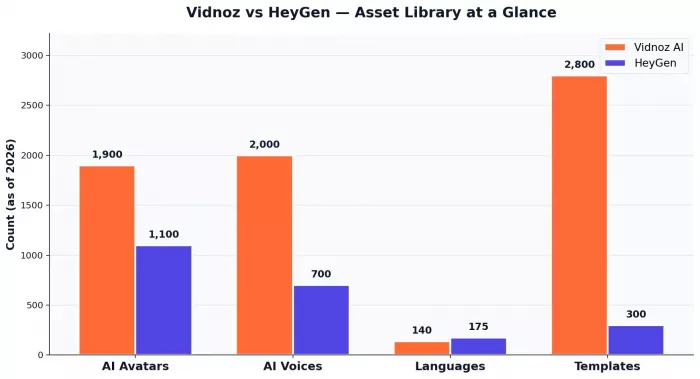
Numbers like "1,900 avatars" sound impressive on a landing page, but only matter if the avatars are actually good. That's where my testing got interesting.
In my testing, I generated the same 60-second marketing script with both tools using a comparable female business presenter avatar. The HeyGen output had micro-expressions, small eyebrow movements when emphasizing a word, a natural blink rate, lip-sync that genuinely tracked phonemes. I observed almost zero "uncanny valley" moments.
The Vidnoz output looked good, until I watched both side by side. Then it looked like the Vidnoz avatar was reading a script and the HeyGen avatar was actually delivering one. Lip-sync on Vidnoz occasionally drifted by about 1–2 frames during fast speech. Head movements felt slightly more mechanical.
My honest take: Vidnoz avatars are 75–80% of the way to HeyGen's quality. For a TikTok or Instagram Reel where the avatar is on screen for 8 seconds, nobody is going to notice. For a 5-minute corporate explainer you're sending to a Fortune 500 client, the difference matters and is worth paying for.
| Avatar Aspect | Vidnoz AI | HeyGen |
| Total stock avatars | 1,900+ | 1,100+ |
| Custom avatar (from your footage) | Yes ($299/year) | Yes (Pro plan) |
| Footage required for digital twin | ~1 minute | 15 seconds (Avatar V) |
| Motion / full-body avatars | Yes (Motion Avatar) | Yes (limited tier) |
| Expressive emotion control | Yes (Expressive Avatar) | Yes (deeper control) |
| Lip-sync accuracy | Very good | Excellent |
| Multi-ethnic diversity | Limited (G2 complaint) | Broader |
Quality is one half of the picture. The other half is what comes out of the avatar's mouth, the voices.
Both platforms claim very large voice libraries powered by similar underlying providers. Vidnoz openly says its 2,000+ voices are powered by ElevenLabs, Microsoft, and Google. HeyGen uses a mix of in-house and partner voices.
I tested the same 30-second script in English, Spanish, Hindi, Japanese, and Arabic on both platforms. Findings:
English (US): Both excellent. Hard to tell apart in a blind test
Spanish: Both natural. HeyGen marginally better on regional accent
Hindi: Vidnoz noticeably better, more natural pacing, less robotic
Japanese: HeyGen slightly better on intonation
Arabic: Tie. Both still feel a half-step off native delivery
HeyGen supports 175+ languages and Vidnoz supports 140+. HeyGen has the wider net, but Vidnoz covers everything most creators actually need. Voice cloning is available on both, Vidnoz claims 99% similarity from a short sample; HeyGen needs about 5 minutes of clean audio for the high-fidelity version.
Two strong libraries, comparable underlying quality. So the next obvious question is: how much is all of this going to cost me?
This is where Vidnoz lands its hardest punch. Here is the 2026 reality on annual billing rates:
| Plan Level | Vidnoz AI | HeyGen | You Save With Vidnoz |
| Free | $0 (8 daily credits, watermark) | $0 (3 videos/month, watermark) | Tie — but Vidnoz's free tier is more usable daily |
| Entry | $19.99/mo (Starter) | $24/mo (Creator) | ~17% |
| Mid | $39.99/mo (Pro) | $79/mo (Pro) | ~49% |
| Business | $56.99/mo (Business) | $149/mo + $20/seat (Business) | ~62% |
The deeper pricing reality:
Per-minute math: Vidnoz Starter gives ~15 minutes/month at $19.99 ≈ $1.33/min. HeyGen Creator gives ~10 minutes of Avatar IV at $24 ≈ $2.40/min. Roughly 45% cheaper per minute on Vidnoz.
Free tier in practice: Vidnoz's 8 daily credits ≈ 16 seconds of video × 30 days = ~8 minutes/month free. HeyGen's 3 videos × ~30s = ~1.5 minutes/month. Vidnoz wins free-tier value by ~5×.
Hidden cost on both sides: Failed renders sometimes still consume credits, confirmed on Reddit threads for HeyGen and noted by Vidnoz Trustpilot reviewers.
Vidnoz's gotcha: Multiple Trustpilot reviewers report unclear monthly-vs-annual billing, people thought they were buying $19.99/month and got hit for $220 because the yearly rate was the default.
HeyGen's gotcha: The "unlimited" branding on certain plans is, per Reddit users, not actually unlimited. There are throughput caps users only discover after subscribing.
Pricing matters, but not in a vacuum. A tool can be cheap and still cost you time. So how do these two stack up across the dimensions that actually shape your workflow?
After three weeks I scored both tools across the dimensions I personally weigh when picking a video tool. This is my opinion, calibrated against G2 and Reddit consensus — not a vendor scorecard.
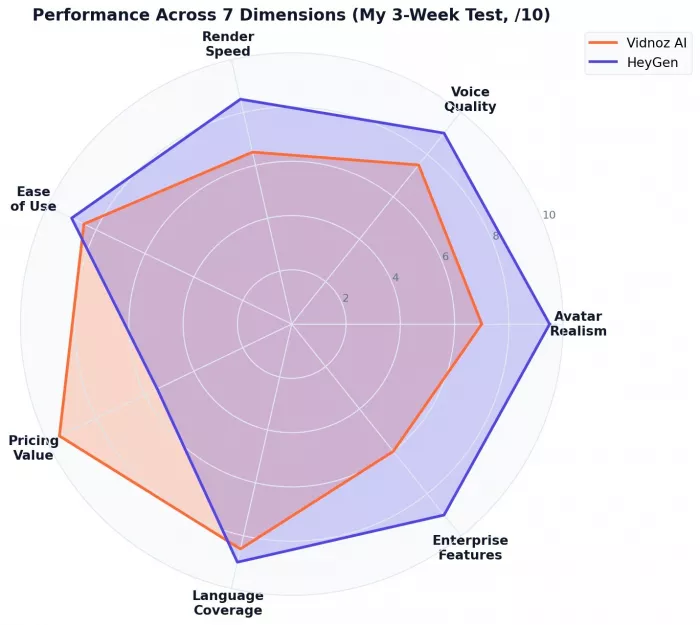
HeyGen has the bigger footprint overall, but Vidnoz dominates on pricing value and matches on ease of use.
| Dimension | Vidnoz | HeyGen | Winner |
| Avatar realism | 7.0 / 10 | 9.5 / 10 | HeyGen |
| Voice quality | 7.5 / 10 | 9.0 / 10 | HeyGen |
| Render speed | 6.5 / 10 | 8.5 / 10 | HeyGen |
| Ease of use | 8.5 / 10 | 9.0 / 10 | HeyGen (just barely) |
| Pricing value | 9.5 / 10 | 5.5 / 10 | Vidnoz |
| Language coverage | 8.5 / 10 | 9.0 / 10 | HeyGen (close) |
| Enterprise features | 6.0 / 10 | 9.0 / 10 | HeyGen |
A 2-minute video that took about 2.5 minutes to render on HeyGen took roughly 5 minutes on Vidnoz in my tests. During peak hours that gap widened. Not a dealbreaker for asynchronous work; painful when you're iterating fast.
Score cards are useful, but they flatten reality. The honest answer to "which one should I use" depends entirely on what you're trying to do, which is exactly what the next chart maps out.
This is the chart I would tape to my monitor if I were picking one of these tools for a specific job. I rated each platform on a /10 scale across eight common use cases, based on my own
Reading the heatmap honestly:
HeyGen owns: Corporate training, e-learning, personalized outreach at scale, enterprise compliance work. The polish and reliability are worth the premium when output is going to senior stakeholders or regulated environments.
Vidnoz owns: Social media short-form (where the volume and speed of free credits beats avatar perfection), hobby and creative use ("chicken milk commercials and AI sermons from our digital cult leader" — actual Product Hunt review I am not making up), and any project where budget is the binding constraint.
Both win: Multilingual localization. Honestly close to a tie here.
That covers the where. But specs and use cases mean nothing if the customers who actually paid feel ripped off. So let me show you what they're saying.
I dug through Trustpilot, G2, Product Hunt, Reddit threads on r/AI_VideoTools and r/HeyGen, and Capterra. Here's the cross-platform picture:
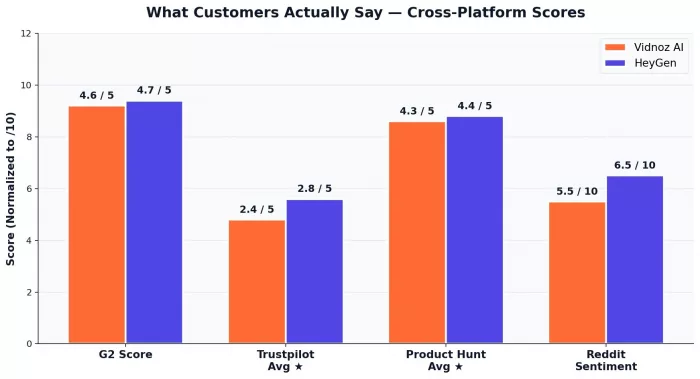
The fans (G2 and Product Hunt):
"Saves me 10+ hours a week on training video production. Avatar quality is honestly disturbing in a good way."
"Quick learning curve, natural-looking avatars, decent lip-sync. Multilingual support expands our global content options."
The skeptics (Reddit, Trustpilot):
"Confusing credit/usage model. They advertise 'unlimited' but it's limited in practice."
"Errors with failed jobs still consuming credits. Slow processing during peak hours."
"Support responsiveness is poor, especially for refunds or technical help."
The fans (G2 and Product Hunt):
"The only AI avatar generator that I know about that offers DAILY free minutes. No other platform offers this with FREE support."
"Ridiculously good at bringing our weird little world to life. Avatars are surprisingly expressive."
The skeptics (Trustpilot, and these are the loud ones):
"I wanted to buy 1 month at $19.99 but they kept $220 for the year. They mention 'billed yearly' in small letters at the bottom."
"Free 30 credits offer — they make it seem available but never activate it. Quite fraudulent in my opinion."
"Started using it 7 months ago and liked it, but lately the platform has been very slow and creating videos has become a nightmare."
"They keep billing me every month and there is no way to cancel the membership. I had to change my credit card."
Honest read of the sentiment data: Both products draw the same pattern, happy power users on G2 and Product Hunt, frustrated customers on Trustpilot. The complaints are different in shape, though. HeyGen complaints are about value and limits ("I thought I was getting more"). Vidnoz complaints are about billing practices ("they took more than I authorized"). The latter is more serious in my opinion.
So with all of that on the table, let me lay out the full pros and cons the way I'd brief a friend deciding between them.
| Pros | Cons |
|---|---|
| Much cheaper than HeyGen | Avatar realism behind HeyGen |
| Useful free daily credits | Slower rendering speeds |
| Huge avatar/template library | UI feels less polished |
| Strong voice cloning quality | Mixed customer support |
| Multiple extra AI tools included | Billing/cancellation complaints |
| Good for short-form content | Voice clone issues reported by some users |
| ISO 27001-certified security | Affiliate program reportedly discontinued |
| Supports ElevenLabs/Microsoft/Google voices | Peak-hour performance can feel inconsistent |
| Pros | Cons |
|---|---|
| Best-in-class avatar realism | Much more expensive than Vidnoz |
| Natural lip-sync and micro-expressions | Free plan too limited for proper testing |
| Faster rendering speeds | “Unlimited” plans reportedly have hidden caps |
| Clean and polished interface | Failed renders may still consume credits |
| Strong API + CRM integrations | Premium avatars require extra credits |
| Enterprise-grade SOC 2 compliance | Customer support slower than expected |
| Excellent multilingual localization | Huge pricing jump from Pro to higher tiers |
| Better overall billing reputation | Mid-tier pricing feels restrictive |
Pick Vidnoz AI if:
Pick HeyGen if:
Pick both if you're like me: Vidnoz for the social-content workhorse, HeyGen for the deliverables that matter.
Which brings me to the final question, if you forced me to pick one, which would I keep?
| Category | Vidnoz AI | HeyGen |
| Avatar quality | ★★★½ | ★★★★★ |
| Voice quality | ★★★★ | ★★★★½ |
| Library size | ★★★★★ | ★★★ |
| Render speed | ★★★ | ★★★★ |
| Pricing value | ★★★★★ | ★★★ |
| Ease of use | ★★★★ | ★★★★½ |
| Customer support reputation | ★★ | ★★★ |
| Billing transparency | ★★ | ★★★ |
| Enterprise readiness | ★★★ | ★★★★★ |
| Overall | ★★★★ (7.6 / 10) | ★★★★ (8.1 / 10) |
If I could only keep one: HeyGen, by a slim margin, but only because my work skews toward client deliverables. If I were a TikTok creator burning through 50 short videos a month, the answer flips to Vidnoz without a second thought.
Would I recommend either today? Yes, but with eyes open. Both tools deliver on the core promise of AI video. Both have rough edges around billing and support. Both reward people who read the fine print and use the free tier before the subscription. Neither is a scam, despite what the louder Trustpilot reviews suggest. Just don't expect either company to chase you down with refunds if you make a mistake.
The AI video space in 2026 is genuinely competitive, Synthesia, Akool, Colossyan, D-ID, and Hour One are all biting at the heels of these two. But for now, if your decision is Vidnoz or HeyGen specifically, the answer comes down to one question: are you optimizing for cost-per-video or quality-per-video? Once you answer that, the rest of the choice writes itself.
a place where users could create interactive characters, explore long...

A detailed Luminarbrush.ai review based on real usage, exploring its l...

Dopple AI is not trying to be a productivity tool or a general assista...

An AI system that trades across multiple markets and generates passive...

designed specifically for hospitals, clinics, and healthcare networks...
Akool is one of the few platforms that actually bridges that gap, and...

Discussion