Type "techmapz com" into any search bar and a tidy little homepage loads up. Clean menu. Tech categories — Tech News, AI & Innovation, Cybersecurity, Gaming. A friendly tagline.

An About Us page promising "no clickbait, just real, useful information." It all looks like the kind of small tech blog that pops up by the thousand every year, hoping to claim a corner of the internet.
But click around for ten minutes and the picture changes. The cybersecurity section has five posts. The AI & Innovation section has two. Tech News has three. And then there's the Gaming section, which has twenty-eight. That alone would be unusual. What's stranger is what those twenty-eight articles actually are, and that's where any honest analysis of this site has to start.
This isn't a hit piece. It's an attempt to lay out, on the record and with receipts, what techmapz.com presents itself as, what it actually publishes, and how the gap between those two things should shape the way anyone reads it.
A quick orientation, in plain terms.
| Detail | Observed Value |
| Primary domain | techmapz.com |
| First published post | April 23, 2025 (about 1 year old) |
| Stated focus | Tech news, gadget reviews, AI, cybersecurity, gaming |
| Platform | WordPress, running the generic "Voice" theme |
| Stated team | Not named anywhere on the site |
| Author bylines observed | First names only (e.g., "Sammy") |
| Physical address | Not listed |
| Contact information | A contact page exists; no phone/email/address publicly listed |
| Affiliate disclosure | None observed in spot checks |
| Visible legal pages | Privacy Policy, Terms & Conditions, Disclaimer, About, Contact |
| HTTPS / SSL | Yes |
| Category breakdown (May 2026) | Gaming: 28, Cybersecurity: 5, Tech News: 3, AI & Innovation: 2 |
The basic structure is what you'd expect from a small content site. The standard legal pages are there. The site loads, encrypts traffic, and looks acceptable on mobile. None of that, on its own, is suspicious. Plenty of perfectly legitimate niche tech blogs run on WordPress with generic themes and skeleton legal pages.
The first thing that's worth a second look, though, is how the published content stacks up against the marketing.
So before getting into who runs the site or whether the claims hold water, it's worth seeing exactly where the writing lives — because the math here is genuinely striking.
Sometimes a single chart explains more than a thousand words. This is one of those times.
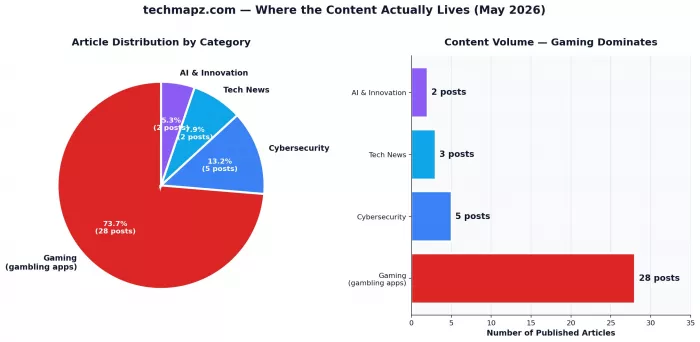
That 73.7% figure isn't an extrapolation. It comes straight from the category counters the site displays on its own sidebar. Anyone visiting techmapz.com can verify the numbers in under a minute.
The pie chart matters because the marketing positioning on the homepage and About Us page never specifies what kind of "gaming" content the site focuses on. The categories advertised in the top menu, Tech News, AI & Innovation, Cybersecurity, Gaming — invite a reader to assume "Gaming" means video games, esports, console reviews, that sort of thing. The reality is something completely different.
Which raises the obvious follow-up question: what are those 28 articles in the Gaming category actually about?
The Gaming category on techmapz.com is not populated with reviews of Elden Ring, Baldur's Gate 3, or the latest PlayStation release. It's populated with a very specific kind of content, sign-in and access pages for India-focused real-money mobile apps. A non-exhaustive list pulled directly from the visible homepage tiles:
These apps belong to a category of real-money mobile product that has spread across South Asia over the last few years. Several have been flagged by Indian state authorities and consumer protection bodies, and a number are restricted, regulated, or under investigation in specific Indian states. The pattern of "Login" landing pages on third-party sites is typically a search-engine play — sites position themselves to capture traffic from people looking for these apps, then funnel that traffic onward.
It's important to be clear about what's being said and not said here. The claim is not that techmapz.com itself operates these apps. It very obviously doesn't. The claim is more specific: a site that markets itself as a tech-information hub is, by raw content volume, mostly serving as a search-traffic doorway to apps with a contested reputation in their primary market. That's a meaningful disclosure for any reader trying to evaluate the source.
Which makes it worth slowing down and comparing what the site says about itself with what's actually verifiable. Because there's a gap there too.
The About Us page and homepage of techmapz.com make a series of confident claims. "Reliable, up-to-date content." "No clickbait — just real, useful information." "A growing tech-loving community." "Expert insights." "Carefully researched."
These aren't unusual claims for a small blog to make. They're also exactly the kind of claims that deserve a quick reality check, because they're impossible to verify in either direction without doing the actual work of looking. Below is what that work surfaces.
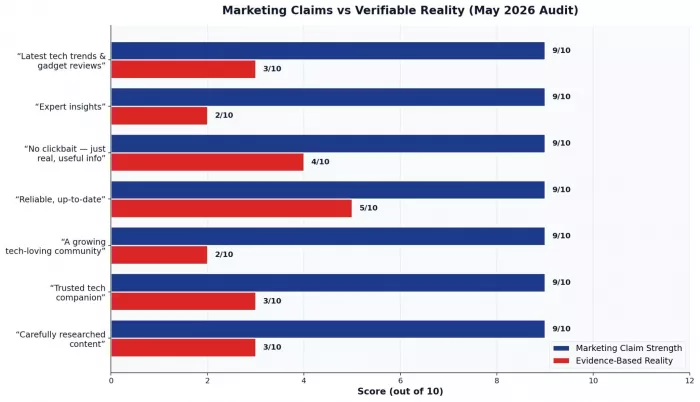
A breakdown of the same picture, in table form:
| Marketing Claim | What Verification Actually Shows |
| "Latest tech trends & gadget reviews" | Only 2 AI posts, 5 cybersecurity posts, 3 tech news posts in roughly 12 months. No identifiable gadget reviews observed in the published tiles. |
| "Expert insights" | No expert credentials listed for any writer. Bylines use first names only (e.g., "Sammy"). No "Editor," "Editorial Team," or "Contributors" page exists. |
| "No clickbait — just real, useful information" | Articles are very short ("Less than a minute" to read, per the site's own time-to-read meta tag). The majority of content is search-funnel landing pages. |
| "Reliable, up-to-date content" | Most tech-category posts are dated April–May 2025. Some categories have not been updated in roughly a year. |
| "A growing tech-loving community" | No comments visible on most posts. No forum, newsletter signup with visible subscriber count, or community channel found. |
| "Trusted tech companion" | No press mentions, awards, or coverage in tech industry trade publications. No identifiable industry partnerships disclosed. |
| "Carefully researched content" | Cybersecurity posts are generic, with no original reporting or testing methodology disclosed. No citations or source links observed in spot checks. |
None of these gaps individually make a site illegitimate. Lots of small blogs use pseudonymous bylines or skip the citations. But the pattern, every claim landing somewhere between thin and unsupported, is the part that matters when a reader is deciding how much to trust what they read.
Which leads naturally to the next question. The About page is where any responsible publisher tells the reader who's actually running things. So what's actually on it?
The About Us page on techmapz.com is short. About 140 words of body text. It opens with "Welcome to TechMapz – Your Guide to the Digital World" and lists what the site covers: tech news, gadget reviews, how-to guides, tech tips, emerging tech. The mission statement is "to make technology accessible, understandable, and useful for everyone." The "Why TechMapz?" section lists four bullet points: reliable content, easy-to-follow guides, a growing community, no clickbait.
That's the entire page.
What it doesn't contain is more revealing than what it does. There's no founder name. No editor name. No team page. No "Meet our writers" link. No country of operation. No company registration number. No physical address. No phone number. No press contact. No advertising contact. No mention of how content is reviewed or fact-checked. No mention of how affiliate relationships, if any, are disclosed.
Compare that to how an established tech publisher handles the same page. CNET's About page names the editor-in-chief, lists the leadership team, links to a careers page, and discloses the parent company. The Verge does the same. Tom's Hardware lists its editorial team by name, with bios.
On techmapz.com, none of that is available. The site speaks about itself as "we" without ever indicating who the "we" is. The single byline observed across multiple posts is “Sammy”, a first name with no surname, no bio, no photo, no credentials, no link.
That isn't a violation of any law. It is, however, a substantial departure from baseline transparency standards in tech publishing, and it materially affects how confident a reader should be in anything the site asserts as fact.
All of this builds toward a more structured trust assessment. The next chart pulls eight separate trust dimensions onto a single grid
Most discussions of "is this site trustworthy?" devolve into a single yes-or-no answer. That's almost always the wrong question. A site can be perfectly secure technically and still be untrustworthy editorially. It can have great editorial standards and a sketchy ownership trail. The honest way to evaluate any source is to look at the dimensions separately.
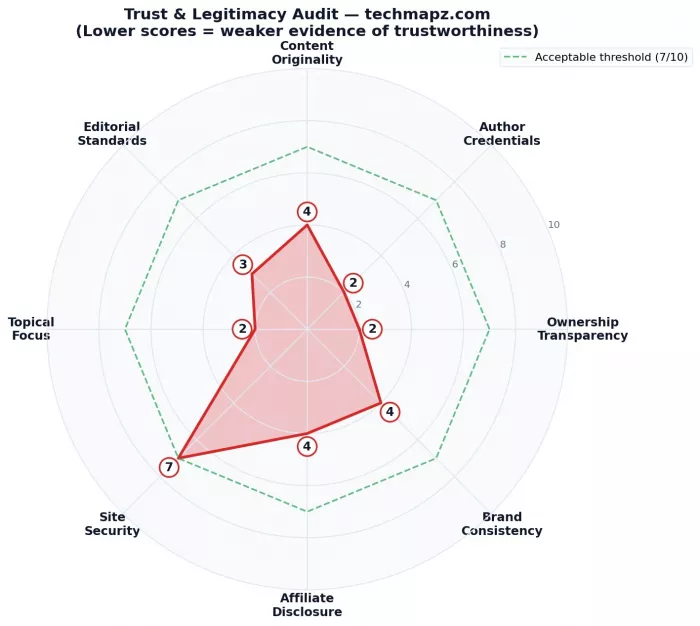
The same scorecard in table form, with the reasoning behind each score:
| Dimension | Score | Reasoning |
| Ownership transparency | 2/10 | No company name, owner, or legal entity disclosed on the site |
| Author credentials | 2/10 | First-name-only bylines with no bios, photos, or backgrounds |
| Content originality | 4/10 | Articles read as generic, undifferentiated content; no original reporting evident |
| Editorial standards | 3/10 | No published editorial policy, fact-checking process, or correction policy |
| Topical focus | 2/10 | The branded focus (tech) and the actual content focus don't align |
| Site security | 7/10 | HTTPS in place; no overt malicious behaviour observed during spot checks |
| Affiliate disclosure | 4/10 | Legal pages exist, but no clear FTC-style "this post contains affiliate links" disclosures observed |
| Brand consistency | 4/10 | Same brand name reused across multiple lookalike domains (more on this below) |
A site that scores 7/10 or higher across most of these is generally fine to read with normal caution. A site that scores under 5 on most of them is one a reader should treat as a curious entity rather than a trusted source — interesting to know about, but not something to cite, rely on, or make purchasing decisions from.
Speaking of multiple domains, that's worth its own section, because it's one of the more unusual things about this particular site's online footprint.
A search for "techmapz" returns not one site but several that share the brand name:
techmapz.com — the primary site analyzed here
techmapz.net — separately registered, similar tech-blog framing
techmapzcom.com — a "domain-com" lookalike running its own promotional content about techmapz.com
techmapzcom.net — yet another variant doing the same
It is unusual, in normal small-blog operation, to find three or four domain variants all referencing the same brand name. There are a few plausible explanations:
Defensive registration. A legitimate brand owner sometimes registers lookalikes to prevent impersonation. This is common and innocent, but normally the owner redirects the lookalikes to the main domain. None of the techmapz lookalikes appear to redirect; they each host their own promotional content.
Content network. Sometimes a single operator runs multiple domains as a private blog network (PBN) to cross-link and inflate SEO. This is a grey-area tactic, frowned on by search engines.
Pulling all of this together, the next chart puts techmapz.com side-by-side with both its closest lookalike and three established tech publishers. The contrast is striking.
There's no need to be elitist about small tech blogs. Plenty of fantastic technology writing happens on tiny independent sites. The point of comparing against established publishers isn't to say "techmapz.com isn't CNET, therefore it's bad." It's to use those established publishers as a baseline for what transparency looks like when a publisher is operating in good faith.
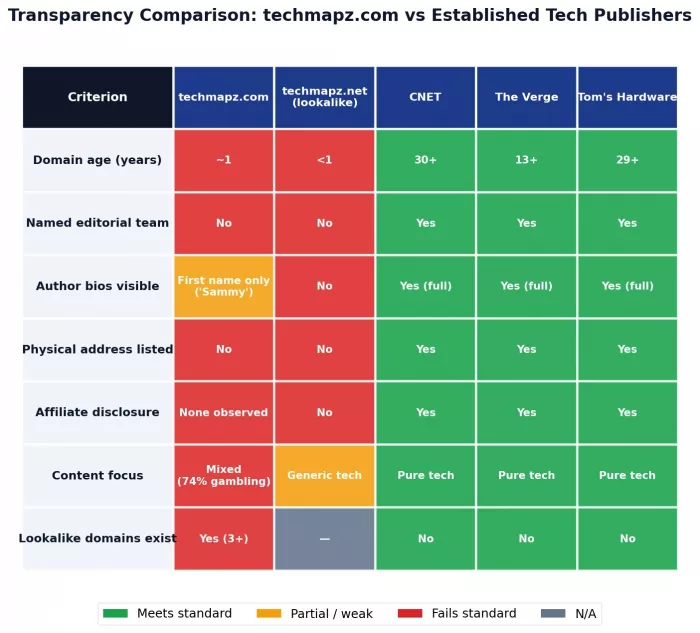
The pattern is clear at a glance. Established publishers, even on basic disclosure questions like "is there a named editorial team?" or “is a physical address listed?”, meet the standard across the board. techmapz.com and its lookalikes fall short on the same set of questions.
A small independent blogger doesn't need to match CNET on staffing or budget to clear these bars. They just need to put their name and a contact email on the site. Most do. The interesting question is why a site that markets itself as a "trusted tech companion" wouldn't.
All of that paints a picture, but it helps to summarize the picture into a single concentrated view of where the actual risk and trust signals land.
Most analyses end up generating either a clean bill of health or a screaming alarm. The reality with techmapz.com is more textured than either. Some things about the site are completely fine. Some things are notable. Some things are serious red flags. Putting them all on the same chart makes that easier to see.
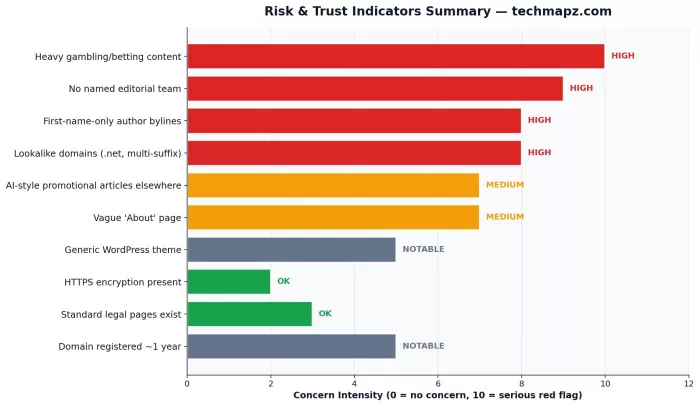
In plain English:
High-concern signals — heavy traffic-funnel content dominating the publication, no named editorial team, first-name-only bylines, multiple lookalike domains existing in parallel.
Medium-concern signals — promotional articles on third-party sites that look AI-generated, a vague About page that says nothing concrete about who's behind the site.
Notable but not alarming — generic WordPress theme, domain only about a year old. Plenty of legitimate sites share these traits.
Things that are actually fine — HTTPS encryption is present, standard legal pages (Privacy, Terms, Disclaimer, About, Contact) all exist. There's no evidence of malware, phishing, or active attack-style behavior.
A useful mental model: techmapz.com is unlikely to harm a casual visitor's device or steal a credit card from someone who lands on the homepage. The risk it poses is editorial, not technical — it presents itself as a trusted tech information source while functioning largely as a search-traffic entry point to apps with serious reputational issues.
Which doesn't mean there's nothing positive to say. A fair review owes the site credit for what it does well, even if the larger picture is concerning.
Listing the strengths matters, because no source is purely good or purely bad, and a reader benefits from understanding where the actual usable parts are.
These are real positives. They don't outweigh the structural issues, the content imbalance and the transparency vacuum are still the dominant facts about the site, but they're worth noting in any fair assessment.
So with strengths and weaknesses both on the table, who is this site actually useful for, and who should steer clear?
| If a reader is looking for | Recommendation |
| Casual entry-level explanations of basic tech concepts | techmapz.com can serve as one source among several, but not the only source. Cross-check important claims against established publishers. |
| Honest gadget reviews to inform a purchase | Look elsewhere. There are no identifiable gadget reviews on the site at the time of writing, despite the marketing claim. |
| Cybersecurity advice for serious decisions | Look elsewhere. Use established sources like CISA, NIST, Krebs on Security, or the security blogs of major vendors. |
| Tech news that's timely and accurate | Look elsewhere. Established publishers (CNET, The Verge, Tom's Hardware, TechCrunch) update daily and cite sources. |
| Originality, journalism, or expert commentary | Look elsewhere. There is no evidence the site does any of these things. |
The honest summary is that techmapz.com is best treated as a curiosity rather than a destination. The "tech blog" framing is a thin wrapper around a search-traffic operation pointing at apps with reputational issues. That's not a moral judgment about the people running the site, there's no way to know who they are, but it is the picture the evidence draws.
Three sentences are enough to summarize where this lands.
First, techmapz.com is a real, functioning website that is not technically dangerous to visit.
Second, it is not a trustworthy or reliable source of tech information, and it doesn't meet baseline publisher-transparency standards that even small independent blogs typically clear.
Third, the bulk of its actual content has nothing to do with the "tech information hub" identity it advertises — it's a search-traffic funnel toward apps that should be evaluated on their own legal and reputational merits, not on the implied endorsement of being mentioned on a "tech" site.

Why is everyone talking about Seedance 2.0? It topped the AI video lea...

Microsoft plans to cut thousands of jobs next week across sales, consu...

Wix-owned Base44 launches Base1, its own AI model for vibe coding, bet...
Thinking about Brasssmile? Read our honest review covering content qua...

Ford rehired veteran 'greybeard' engineers after AI-powered quality in...

OpenAI launched GPT-5.6 on Friday, but a White House approval list - n...

Discussion