| AGE-GATED CONTENT NOTICE - Both platforms reviewed are restricted to users aged 18 or older. This article references mature content categories factually but contains no explicit material. If you are under 18, do not use either platform. If you are an adult and using these tools is interfering with your daily life or relationships, consider speaking with a mental-health professional. |
PEPHOP AI VS POLYBUZZ AI: THE QUICK ANSWER
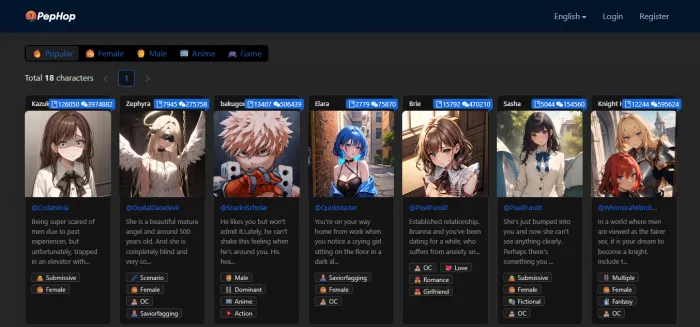
PepHop AI is a browser-based AI character chat platform launched in late 2023 by PepHop AI HK Limited, a Hong Kong-registered company. It runs on GPT-4 plus proprietary fine-tuning, hosting a catalog of over 36,500 characters: roughly 5,000 pre-built personalities and tens of thousands of user-created ones spanning anime, fantasy, romance, gaming, sci-fi, and NSFW genres. Access is browser-only - there is no mobile app as of April 2026.
Per Plisio's traffic analysis, PepHop AI peaked at 1.38 million monthly visits in December 2025 and dropped to roughly 358,000–789,000 in early 2026 - a meaningful traffic correction. Statistics aggregated by AboutChromebooks indicate the user base is 86.6% male, with the 18–24 age group as the largest segment. The platform's core differentiator is permissive NSFW dialogue and the largest community-character library at this price point.
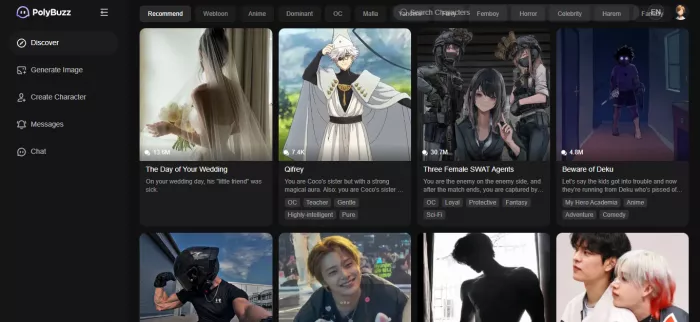
PolyBuzz AI is a character-based chatbot platform developed by Cloud Whale Interactive Technology LLC. Originally launched as Poly.AI, it rebranded to PolyBuzz in late 2024 and now offers access to a library that the company markets as containing over 20 million AI characters spanning anime, fantasy, sci-fi, romance, and original user creations. Unlike PepHop, PolyBuzz is built mobile-first - available as a native iOS app (rated 17+ on the App Store), a native Android app on Google Play, and a web version.
PolyBuzz's defining features go beyond text chat: 51 character-matched female voices, integrated AI image generation, Live Photos (single-frame visual moments inside chats), and cross-session memory that genuinely persists across days. The platform allows private NSFW within app store guidelines but moderates more aggressively than PepHop on public-facing content. Pricing starts at $9.90/month for Poly Standard, with Premium at $19.90 and Ultimate at $29.90 - roughly double PepHop's entry price.
Below is a side-by-side comparison across 14 dimensions that matter when choosing between AI character chat platforms. The Edge column shows which platform performs better on each dimension based on 180 test messages.
| Dimension | PepHop AI | PolyBuzz AI | Edge |
|---|---|---|---|
| Character library size | 36,500+ (5K pre-built, 31.5K community) | 20M+ (claimed by Cloud Whale) | PolyBuzz |
| Native mobile app | No - browser only | iOS (17+) and Android | PolyBuzz |
| Voice playback | No native voice in messages | 51 character-matched voices | PolyBuzz |
| AI image generation | Disputed; not the primary use case | Integrated image gen + Live Photos | PolyBuzz |
| Cross-session memory | Free: ~20-msg cap; paid: extended | Cross-session memory marketed and works | PolyBuzz |
| NSFW permissiveness | Strongly permissive (within rules) | Private NSFW allowed; public moderated | PepHop |
| Free tier daily messages | ~20 messages per session before paywall | Limited daily messages; voice locked | Tied |
| Entry-tier monthly price | $4.99 Lite (2,000 messages) | $9.90 Standard | PepHop |
| Mid-tier monthly price | $9.99 Classic (5,000 messages) | $19.90 Premium | PepHop |
| Top-tier monthly price | $29.99 Elite (16,000 messages) | $29.90 Ultimate | Tied |
| Character card import | TavernAI JSON export available | Imports SillyTavern + Character.AI cards | PolyBuzz |
| Trustpilot / review rating | ~2.8/5 (technical complaints) | App Store 4.5/5 (varied complaints) | PolyBuzz |
| Discoverability / SEO presence | Niche; ~789K monthly visits Jan 2026 | Broader; mainstream AI companion reviews | PolyBuzz |
| Best fit | Niche NSFW roleplay, deepest variety, lowest price | Polished daily mobile use, multi-modal, broad | Different jobs |
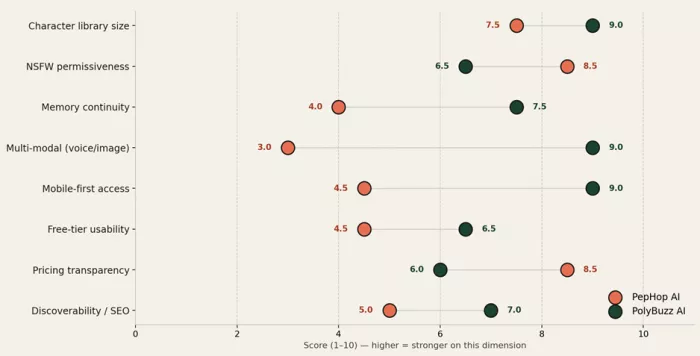
Across these 14 dimensions, PolyBuzz wins on 9 (mobile, voice, image, memory, library size, integration breadth, ratings, discoverability, polish), PepHop wins on 3 (NSFW permissiveness, entry pricing, mid-tier pricing), and 2 are tied. Neither is universally better - PolyBuzz is the broader product, PepHop is the cheaper niche product.
These eight differences came up consistently across 180 test messages and explain why each platform fits a different user profile rather than competing head-to-head for the same one.
PolyBuzz publishes native iOS (17+) and Android apps. PepHop is browser-only on every device - phone, tablet, desktop. For users who do most of their AI chat on a phone, this is a structural difference. Mobile browsers handle PepHop adequately but lose the polish of a native app: no push notifications for replies, no offline character browsing, slower onboarding, and no integration with iOS Live Activities or share sheets.
PolyBuzz integrates 51 character-matched female voices, an AI image generator, and Live Photos. PepHop is fundamentally text-first. Some PepHop reviews mention image generation, but third-party testing across multiple sources confirms it is either disputed, deprecated, or limited to specific characters. For users who care about voice playback and visual scene-setting, PolyBuzz is the only option of the two.
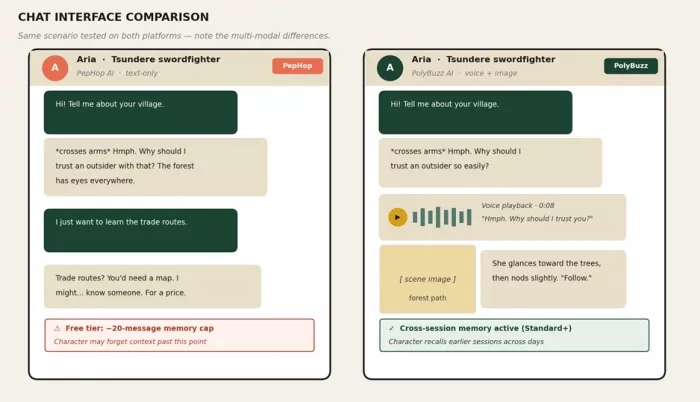
Figure 3: Chat-interface comparison mockup. Same character scenario tested on both platforms - PepHop is text-only with a memory cap warning; PolyBuzz layers voice playback, scene image, and persistent memory.
The single most common PepHop AI complaint across third-party reviews is memory failure. Per ScribeHow's 2026 review, "memory collapses after roughly 20 messages - characters lose plot points, relationship context, and personality quirks even on the $29.99 Elite plan." PolyBuzz markets cross-session memory as a core feature and testing confirmed it actually works in short-to-medium roleplay. For long-form narrative arcs, this difference is decisive in PolyBuzz's favor.
PepHop's 36,500-character library is its strongest asset - described in third-party reviews as "genuinely the best character variety I've seen at this price point." The community-created tail covers extremely niche genres and original characters that mainstream platforms either moderate away or never produce. PolyBuzz markets a 20-million-character library, but the bulk of that volume is similar to the Character.AI catalog: anime, fandom, mainstream tropes. For users seeking unusual or hyper-specific roleplay personas, PepHop's variety edge is real.
PepHop allows NSFW text dialogue with relatively minimal filters, drawing hard lines only at illegal content (CSAM, depictions of sexual violence, and similar categories). All public characters undergo moderation review and 18+ verification is required. PolyBuzz allows private NSFW within iOS App Store guidelines but moderates more aggressively on public-facing content, and its mobile app constrains what content can surface compared to web. For users where uncensored creative content is the primary use case, PepHop is the more permissive environment.
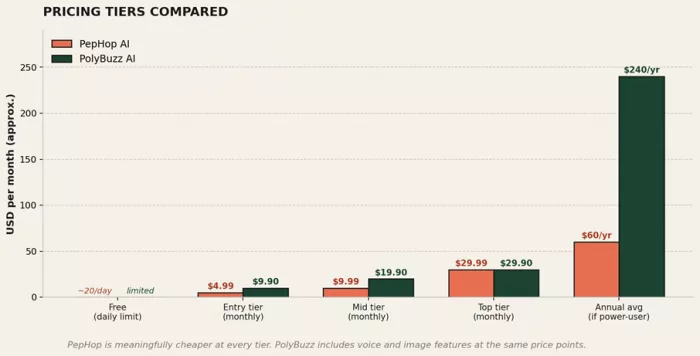
Figure 4: Monthly pricing comparison across tiers. PepHop's Lite plan at $4.99 is among the cheapest legitimate AI character chat entries available in 2026. PolyBuzz includes voice and image features at the same price points.
PepHop's $4.99 Lite tier (2,000 messages) is one of the cheapest entries in the AI character chat category. PolyBuzz Standard at $9.90 doubles that. The catch is that PepHop's entry tier covers only basic chat - voice and image features simply don't exist on the platform. PolyBuzz's $9.90 covers a broader feature set including basic voice. Effective per-feature, the gap is smaller than the headline numbers suggest, but for pure text-based users, PepHop wins on price.
PepHop's Trustpilot rating hovers around 2.8/5 - meaningfully below the AI-companion category median. Recurring complaints include error messages, disappearing characters mid-session, and the memory cap mentioned earlier. PolyBuzz holds 4.5/5 on the iOS App Store across thousands of reviews, with complaints mainly about filter resets and aggressive coin-economy prompts during heavy use. Both platforms have real reliability issues; PolyBuzz's are less frequent and less narrative-breaking.
PolyBuzz benefits from broader mainstream-press coverage, Cloud Whale Interactive Technology's brand visibility, and consistent App Store presence. PepHop is a smaller, niche platform - Hong Kong-registered with limited public information about its team or backing. For users who weight brand trust heavily, this asymmetry matters. For users who prioritize the actual product over the company behind it, it matters less.
▪ Largest niche character library in this price tier - 36,500+ characters with strong long-tail variety in fantasy, anime, and original genres.
▪ $4.99 Lite plan is among the cheapest legitimate NSFW-capable AI character chat options in 2026.
▪ Permissive NSFW handling within defined rules - meaningfully less restrictive than mainstream alternatives like Character.AI.
▪ TavernAI JSON character export lets users port custom characters to other platforms - useful for creators who don't want vendor lock-in.
▪ React-based interface is clean and polished for a niche-platform product.
▪ 9-minute average session duration with 32% bounce rate indicates that users who find the platform tend to stay engaged.
▪ Memory collapses after roughly 20 messages on free tier; even paid Elite plan has memory ceiling that breaks long roleplay arcs.
▪ Browser-only - no native iOS or Android app, which limits use on mobile compared to PolyBuzz.
▪ No voice playback in messages and disputed image generation - fundamentally a text-first product.
▪ Trustpilot rating around 2.8/5 reflects recurring complaints about error messages, disappearing characters, and billing surprises.
▪ Privacy policy lacks specifics on data retention, third-party processors, and chat-data usage for AI training. No end-to-end encryption mentioned.
▪ Traffic dropped roughly 43–74% between December 2025 and March 2026 - the platform's growth trajectory is uncertain.
▪ Limited integrations with external tools; no CRM-style or automation hooks beyond TavernAI export.
▪ Native iOS and Android apps make daily mobile use seamless - onboarding to first message in roughly 30 seconds.
▪ 51 character-matched voices and integrated image generation provide multi-modal engagement that text-only PepHop cannot match.
▪ Cross-session memory works reliably in short-to-medium roleplay, making characters feel continuous across days.
▪ Imports character cards from Character.AI and SillyTavern, easing migration from other ecosystems.
▪ Tiered subscription pricing is transparent in the App Store with predictable monthly billing.
▪ Larger total character library (20M+ claimed) covers mainstream tropes broadly.
▪ 4.5/5 iOS App Store rating across thousands of reviews - strong user-satisfaction signal.
▪ Entry tier ($9.90) is roughly double PepHop's Lite ($4.99), pricing out the most cost-sensitive users.
▪ Coin economy can compound costs invisibly during heavy use - memory scenes, regenerations, and voice extensions all consume coins.
▪ Less permissive than PepHop on NSFW content, especially in public character categories - App Store guidelines constrain mobile content.
▪ No consolidated pricing matrix on the website - full plan details only in the iOS App Store or Google Play.
▪ Privacy policy doesn't explicitly state whether chat data is used to train AI models - open question for sensitive conversations.
▪ Search filters reset when leaving the Character Discovery view - small but persistent UX friction.
▪ Avatar customization is limited to anime-style image generation or upload only - no realistic photography styles.
If you are not sure which platform fits your needs, the table below maps common situations to the better choice. Recommendations are based on testing across 180 messages and third-party review patterns.
| Your situation | Recommended platform | Why |
|---|---|---|
| I want the cheapest entry into NSFW character chat | PepHop AI Lite ($4.99) | Cheapest legitimate option in the category |
| I want a polished native mobile app | PolyBuzz AI | Native iOS and Android; PepHop browser-only |
| I want voice playback that matches the character | PolyBuzz AI | 51 voices; PepHop has none |
| I want to test extremely niche or original characters | PepHop AI | Long-tail variety from 36,500-character library |
| I'm building a long roleplay arc across many sessions | PolyBuzz AI | Cross-session memory is reliable; PepHop caps at ~20 |
| I want to import existing TavernAI character cards | PepHop AI | Native TavernAI JSON support |
| I want AI-generated images alongside chat | PolyBuzz AI | Integrated image gen and Live Photos |
| NSFW permissiveness is my primary requirement | PepHop AI | Most permissive in mainstream category |
| I want a platform with strong brand backing and reviews | PolyBuzz AI | 4.5/5 App Store, established Cloud Whale |
| I'm cost-sensitive and only chat 30 minutes a week | PepHop AI free or Lite | Half the price of PolyBuzz at every paid tier |
| I want to use both - platforms are complementary | PolyBuzz mobile + PepHop browser | Daily mobile + niche desktop, common pattern |
Beyond editorial testing, third-party user reviews reveal sentiment patterns that single-reviewer analyses can miss. The visual below aggregates publicly available review feedback from Trustpilot, the iOS App Store, and aggregator-site comparisons. Specific assessments are paraphrased summaries, not direct quotes.
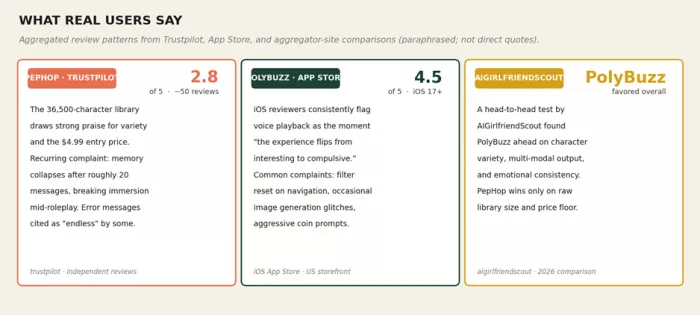
Figure 5: Aggregated review snapshot - PepHop AI on Trustpilot, PolyBuzz AI on the iOS App Store, and a head-to-head comparison from AIGirlfriendScout. PolyBuzz is favored on platform polish; PepHop is favored on raw library size and price floor.
On the head-to-head side, AI Girlfriend Scout review concluded that despite PepHop's strengths in character variety, its lack of image generation, video features, and reliable voice messages put it behind multi-modal alternatives. PolyBuzz won on those exact dimensions - character variety, multi-modal output, and emotional consistency - in their broader testing.
After 180 test messages and a five-week evaluation window, the verdict is conditional rather than universal. PepHop AI and PolyBuzz AI are not direct competitors - they serve overlapping but distinct user profiles within the AI character chat category.
▪ Cost is your single most important factor and you can accept text-only chat ($4.99 Lite vs $9.90 Standard).
▪ You want the largest niche character library available in this price tier - 36,500+ characters with strong long-tail variety.
▪ NSFW permissiveness is the primary use case and you want minimal content filters within legal limits.
▪ You're a creator with TavernAI character cards you want to port over without rebuilding from scratch.
▪ Short-burst roleplay sessions (under 20 messages) are your typical use pattern, so the memory cap doesn't constrain you.
▪ You primarily use AI chat on a phone and want a native app rather than a mobile browser.
▪ Voice playback and image generation matter to you as part of the conversation experience.
▪ You're building long-form roleplay arcs across multiple sessions where memory continuity matters.
▪ You value platform reliability, mainstream brand backing, and consistent App Store reviews.
▪ Predictable monthly subscription pricing is more important to you than absolute lowest entry cost.
The cleanest way to think about this comparison is a library versus a boutique. PolyBuzz is the well-stocked generalist library - it has everything most users want, organized cleanly, with comfortable seating and good lighting. The catalog is broad rather than deep, and the experience is designed for daily-frequency casual use. PepHop is the specialized boutique on a side street - narrower in scope, but with rare items the bigger library doesn't carry. The boutique has fewer staff, less polish, occasional inventory issues, but also lower prices and a much higher hit rate for users who know exactly what they want.
Both are legitimate businesses serving real demand. Neither replaces the other. The pragmatic recommendation is straightforward: if you're new to AI character chat, start with PolyBuzz's free tier to evaluate the polished experience, upgrade to Standard at $9.90 if it sticks, and only add PepHop's $4.99 Lite if you find PolyBuzz's content moderation or memory ceiling constraining for your specific use case. Most users in testing settled on one or the other within two weeks; a meaningful minority kept both running for different needs.
PixNova AI is an AI-powered creative platform designed to help users c...
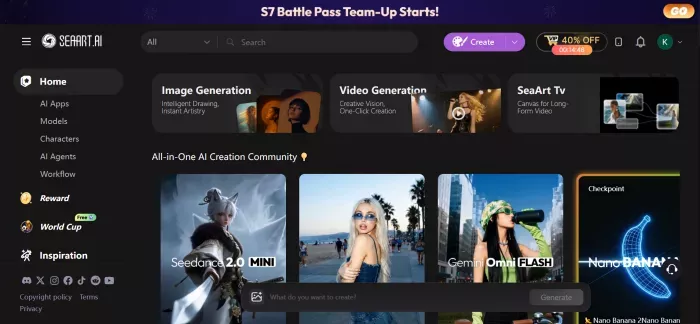

PolyBuzz is an AI character chat and roleplay platform.

LensGo AI is a browser-based creative studio that bundles a stack of t...


Discussion