Brasssmile looks like a simple publishing blog at first, but its structure says more once you look closer. It has active posts, broad categories, and search-friendly articles, but it does not clearly show who runs the site, how content is reviewed, or why so many different topics sit under one domain.
This review looks at Brasssmile through its content quality, category focus, author signals, footer, transparency, and overall trust.
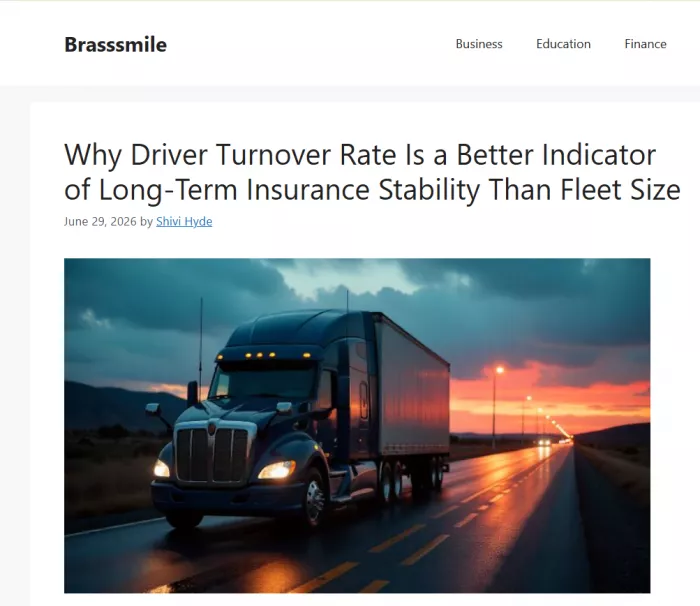
Brasssmile.com makes a plain first impression. The homepage is built around posts, categories, dates, author names, snippets, and older-post navigation. There is no heavy branding, no strong editorial introduction, and no clear statement explaining who the site is for. The browser title also describes it as “Brasssmile.com - Publish news blog,” which makes the site feel more like a general publishing blog than a specialist brand.
That does not make the website useless. The site is active, and the homepage shows recent posts from 2026. It also has an archive going up to Page 23, which suggests regular publishing activity rather than an abandoned blog.
Still, the first impression is more functional than trustworthy. A reader can quickly find articles, but they cannot quickly understand who runs the website, what editorial standards it follows, or why it covers such a wide mix of topics.
The main menu gives the clearest signal about Brasssmile’s identity. It lists seven categories: Business, Education, Finance, Health, Insurance, Technology, and Travel. These are normal categories for a general blog, but together they create a very wide editorial spread.

A focused website usually builds authority by staying close to one subject area. Brasssmile does the opposite. It moves across business, insurance, health, finance, technology, travel, education, online gaming, and law-related topics. That makes the domain flexible, but it also makes it harder to understand what the site is truly known for.
The menu works well for browsing. It is simple and direct. But from a quality point of view, it also shows that Brasssmile is built more around broad content coverage than around one strong editorial purpose.
The category structure is one of the most important parts of this review because it explains the website’s real behaviour. Brasssmile is not just a business blog, a health blog, a finance blog, or a tech blog. It is a multi-category publishing site that moves between unrelated topics.
| Category | What appears on the site | Review note |
| Business | Driver turnover, business verification, livestock trade, trading-related business topics | Active category, but the topics are broad and not tied to one business niche |
| Education | Law schools, universities, scholarships | Useful for general student guides, but some education topics appear loosely categorized |
| Finance | Trading strategy and money-related topics | Needs stronger sourcing because finance content can affect real decisions |
| Health | Clear aligners, invisible braces, dental care | Sensitive area where expert review and author credentials matter |
| Insurance | Car insurance and risk-related articles | Useful topic area, but trust signals should be stronger |
| Technology | AI examples, password management, green cloud, AR shopping, tool-site guides | More beginner-friendly than deeply technical |
| Travel | General travel and lifestyle-style content | Fits a broad blog, but does not define the site’s core identity |
The issue is not the number of categories alone. Many publications cover more than one subject. The issue is that Brasssmile does not give enough context to explain why these categories belong together. A reader may land on an insurance article, then see casino bonuses, dental content, law school guides, and trading topics nearby. That makes the site feel search-led rather than audience-led.
There are also signs of loose category organization. For example, the homepage shows “Best Universities in the US for Indian Students with Low Tuition Fees” under the Law category, even though the topic is more naturally education-focused. The Technology category also includes mixed topics such as hospital data privacy, classroom gamification, green cloud computing, password management, AI examples, AR fitting rooms, Node.js developers, and online tool guides.
This does not make the site bad, but it does show that Brasssmile is not tightly organized around a clear editorial map.
The category menu makes Brasssmile look broad, but the depth is not equal across all sections. Insurance and Travel are good examples. Insurance appears to have only around six posts, while Travel has around ten. That means both categories are present in the site structure, but they do not yet look developed enough to carry strong topical authority on their own.
This matters because a category is not only a navigation label. It also signals whether a site has built enough coverage around a subject to help readers trust it. A small number of posts does not make a category weak by default, but for topics like insurance and travel, readers usually expect more supporting articles, updated guides, and stronger publishing consistency.
Brasssmile’s content follows a familiar search-first pattern. Most posts are written as explainers, guides, comparisons, or practical introductions. The homepage includes articles on driver turnover and insurance stability, business verification, casino bonuses, livestock trade, trading strategy, car insurance calculators, clear aligners, law schools, universities, and scholarships.
The writing is usually simple and easy to scan. That helps casual readers who want a quick overview. But the content often feels built around search demand rather than original reporting or a distinct editorial point of view.
The Technology section is a good example. It covers useful topics, but the snippets feel beginner-level. The article on daily AI examples opens with familiar examples like face recognition, Netflix recommendations, smart home tools, and virtual assistants. The TechyHitTools article uses a promotional, casual style around online tools rather than hands-on testing or detailed comparison.
That pattern appears across the site. Brasssmile explains topics, but it rarely shows the kind of depth that would make a reader say, “This could only have come from this publication.” There is limited visible evidence of expert interviews, original data, field testing, screenshots, methodology, or specialist review.
Google’s helpful content guidance encourages content that provides original information, substantial value, clear expertise, and a satisfying reader experience. It also warns against publishing lots of content on many topics mainly to attract search visits. Brasssmile is not automatically failing that test, but its wide topic spread and thin site transparency make the question fair.
The biggest issue with Brasssmile is not the layout. It is trust.
A reader can see articles, dates, categories, and author names. But the checked pages do not show a clear About Us page, Contact page, editorial policy, privacy policy, terms page, correction policy, or publisher background in the visible menu or footer. The footer only shows “© 2026 Brasssmile • Built with GeneratePress.”
That matters because Brasssmile covers topics where trust is not optional. Health, finance, insurance, law, education, and gambling-related content can affect real choices. If a site publishes in those areas, readers need to know who is behind the site, how content is reviewed, and whether the writer has relevant knowledge.
| Trust signal | What Brasssmile shows | Why it matters |
|---|---|---|
| About Us page | Not visible in the checked menu or footer | Readers cannot easily understand who runs the site |
| Contact page | Not visible in the checked menu or footer | Readers do not have a clear public route to reach the publisher |
| Author bios | Author archive pages show post lists, not detailed credentials | No Proper details and Bio |
| Editorial policy | Not visible in the checked site structure | Readers cannot see how content is reviewed or corrected |
| Privacy and terms | Not visible in the checked footer | Weak basic transparency for a publishing site |
| Expert review | Not clearly shown | Important for health, finance, insurance, legal, and gambling topics |
Google’s guidance places strong importance on “Who, How, and Why.” It says readers should be able to understand who created the content, how it was produced, and why it exists. It also says trust is the most important part of E-E-A-T, especially for topics that can affect health, financial stability, safety, or well-being.
Brasssmile’s visible structure does not strongly answer those questions.
The footer is a small part of the page, but on Brasssmile it becomes a major quality signal. On the checked pages, the footer says “© 2026 Brasssmile • Built with GeneratePress,” with GeneratePress linked externally. GeneratePress itself is not a problem. It is a common WordPress theme. The problem is that the footer has not been used to build trust.
A stronger publishing site would usually use the footer to show important links: About, Contact, Privacy Policy, Terms, Editorial Policy, Advertise, Write for Us, Corrections, or social profiles. Brasssmile does not appear to show these in the visible footer.
That makes the site feel unfinished from a publisher-transparency point of view. The article archive is active, but the identity layer is thin. For a small personal blog, that might be less serious. For a multi-category site covering health, insurance, finance, law, and gambling-related topics, it is a real weakness.
Brasssmile does have author pages, but they work more like archives than credibility pages.
The Shivi Hyde author page shows posts across driver turnover and insurance stability, business verification, online casino bonuses, livestock trade, vape pods, invisible braces, and dental care. The page shows the name and list of articles, but it does not show a visible professional bio, qualifications, role, experience, or subject background in the checked page text.
The brasssmile_ljhgui author page is even broader. It includes posts on car insurance, clear aligners, windsurfing, blogging websites, and other unrelated subjects. The name also appears as a username-style account rather than a clear professional author profile.
This is not an attack on the writers. A writer can cover different subjects. The issue is that readers are not given enough context to judge expertise. If someone is reading about dental treatment, insurance costs, trading, or gambling bonuses, they should be able to see whether the writer has relevant knowledge or whether the article was reviewed by someone who does.
Author pages are a chance to build confidence. Brasssmile currently uses them mainly to group posts.
Brasssmile does have practical strengths.
The site is active, and the homepage shows recent 2026 articles. It also has enough archive depth to show that content has been published over time, not just once or twice. The layout is also easy to understand. Readers can browse categories, open posts, and move through older pages without confusion.
The writing is simple enough for general readers. A casual visitor looking for an introduction to car insurance calculators, university scholarships, business verification, clear aligners, or daily AI examples may find a basic starting point. The content is not locked behind a complicated design, and the site does not feel difficult to navigate.
For publishers, Brasssmile’s wide category spread can also be useful. It can fit business, education, technology, insurance, travel, health, and lifestyle-style articles. That flexibility is one reason the site feels guest-post-friendly.
Where Brasssmile works best is in light informational content. It can introduce a subject, explain a basic idea, and give readers a simple overview.
Confidence drops when the topic needs stronger proof.
The first issue is transparency. There is no clearly visible About Us or Contact page in the checked menu or footer. That means readers cannot easily verify who owns the site, who manages it, or how to reach the publisher.
The second issue is topical focus. Brasssmile covers many unrelated subjects. That helps with publishing volume, but it weakens authority. A reader may wonder whether the site is built around expertise or around capturing many search queries.
The third issue is author credibility. The author pages list articles, but they do not clearly explain the author’s background or areas of knowledge. This matters more because the same author archives cover very different topics, from insurance and dental care to casino bonuses and livestock trade.
The fourth issue is editing. Some snippets are clean, but others feel rough. The clear aligners snippet, for example, includes awkward wording such as “comfortable wire-less treatment” and “no social consciousness.” That kind of phrasing weakens confidence, especially in a health-related article.
The fifth issue is depth. Brasssmile content is readable, but many posts do not show original reporting, expert review, strong citations, testing evidence, or detailed methodology. For general browsing, that may be fine. For medical, legal, insurance, finance, or gambling topics, it is not enough.
Brasssmile is best used as a general starting point, not as a final authority.
It is suitable for:
It is less suitable for:
| Review factor | Rating | My take |
|---|---|---|
| Website activity | 3.5/5 | Active site with recent posts (latest post - June 29, 2026) |
| Category focus | 3/5 | Useful range, but too broad to feel strongly focused. |
| Content quality | 3/5 | Readable, but not always polished or deeply researched. |
| Author transparency | 1/5 | Author pages have no clear bios, credentials, or expertise. |
| Publisher trust | 1.5/5 | No visible About Us or Contact information is a major weakness. |
| E-E-A-T | 1.5/5 | Weak for sensitive topics like health, finance, law, and insurance. |
| Overall rating | 2.5/5 | Useful as a general blog, but not a strong authority site. |
Brasssmile.com is best described as an active, search-first, multi-category publishing blog. It has regular content, simple navigation, and broad topic coverage, so it is not an empty or inactive site.
Still, it does not feel like a strong expert publication. The missing About Us and Contact information, thin footer, limited author context, and wide category mix weaken trust.
My overall rating is 2.5 out of 5. Brasssmile can work for light informational reading or broad guest-post-style content, but readers should verify health, finance, insurance, legal, or gambling-related information through more specialized sources.
Why is everyone talking about Seedance 2.0? It topped the AI video lea...

Microsoft plans to cut thousands of jobs next week across sales, consu...

Wix-owned Base44 launches Base1, its own AI model for vibe coding, bet...

Ford rehired veteran 'greybeard' engineers after AI-powered quality in...

OpenAI launched GPT-5.6 on Friday, but a White House approval list - n...

Patronus AI raised $50M to expand its simulated "world models" that st...

Discussion