I clicked into TechExample.org expecting another beginner-friendly tech blog. I'd seen it pop up in search results, read a couple of glowing third-party reviews calling it a "trusted name in the digital world," and figured I'd take twenty minutes to confirm what they said.
I ended up spending closer to two hours, and the picture I came away with is more complicated than any of those reviews suggested.
This isn't a hit piece. The site is real, it's been around since 2025, and there's nothing dangerous about visiting it. But if you're searching for a tech resource you can actually trust for buying decisions, for learning, for staying current there are some facts about TechExample.org you should know before you do. I'm going to walk you through what I actually saw on the site, what works, what doesn't, and where I'd land if I had to give it an honest rating.
TechExample.org is a low-to-mid quality WordPress content blog that started as a tech news site but, based on its current homepage, has pivoted heavily toward paid sponsored content, most of it casino, betting, and gambling-related. Genuine tech articles still exist, mostly older ones, but they're now buried under a wave of recent promotional posts about online slot platforms, baccarat sites, and casino registration guides.
Use it for: Casual, surface-level tech reading. Light entertainment. Don't use it for: Buying decisions, technical research, professional reference, or as an authoritative source for anything important.
I'll explain how I got there.
I want to be clear about my methodology because most "reviews" of this site online appear to be either AI-generated puff pieces or paid placements. Here's what I did:
What follows is what I found, with receipts.

The homepage tagline reads: "Stay updated with Tech Example! Discover the latest tech news, trends, reviews, and innovations."
The site is built on WordPress with the Elementor 4.0.1 page builder, which is a fine, common setup. The published_time metadata shows the site was created in March 2025, with the homepage last modified in January 2026. So it's a roughly one-year-old site.
The structure is standard:
| Section | What's There |
| Home | Mixed feed of recent posts |
| Future Tech | AI, quantum computing, nanotech articles |
| Gadgets and Reviews | Smartphone, laptop, earbud roundups |
| Latest Tech News | Industry updates (and other content — see below) |
| Tech Trend | A catch-all section dominated by recent posts |
The site has all the standard transparency pages — Privacy Policy, About Us, Contact Us, Disclaimer, Terms and Conditions, Write for Us. So that's better than some critics have claimed.
But here's where things get interesting.
This is the part of the review I think matters most, because it's the part you can't see from a quick glance at the homepage.
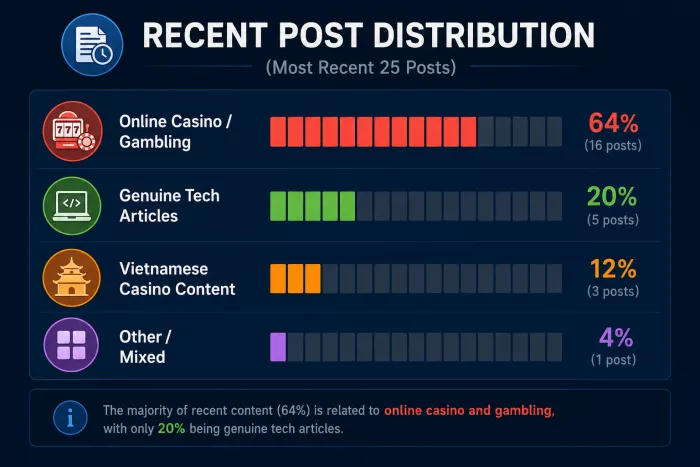
I counted the 25 most recent posts on the site at the time of my visit (May 2026) and categorized them by subject matter. Here's the breakdown:
RECENT POST DISTRIBUTION (Most Recent 25 Posts)
Let me name some of those casino posts directly, because I want this to be verifiable:
Multiple Vietnamese-language posts (DA88, 58win, đá gà trực tuyến)
These aren't tucked away in a hidden corner. They're the first thing visitors see on the homepage.
The legitimate tech content does exist, articles on quantum computing, AI workforce trends, gaming laptops, and DevOps skills. Most of these are dated 2024, which suggests the site started with genuine tech content and shifted its publishing pattern significantly over the last 12 months.
That shift is the single biggest fact about this website, and no other review I found mentions it.
If you scroll to the bottom of any page on TechExample.org, you'll find a section labeled "Useful Links". I read through it. Here's what's there:
The links go out to sites like 11bet, 9betgame, multiple "บาคาร่า" (baccarat) and "ซื้อหวยออนไลน์" (buy lottery online) destinations, and Vietnamese football streaming domains. This is, in SEO terms, a paid backlink footer, a fairly common monetization tactic where websites sell footer links to other sites looking for SEO juice.
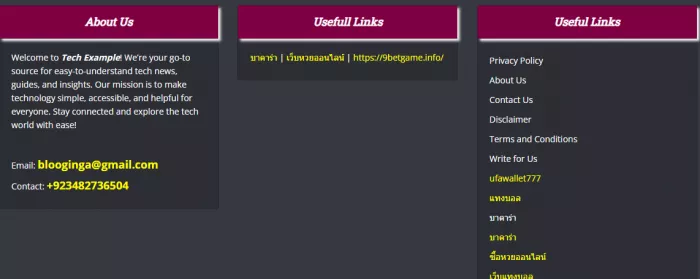
This isn't illegal. It's not even unusual on smaller WordPress blogs. But it tells you something important: the site's revenue model isn't primarily about serving readers — it's about serving advertisers and SEO clients.
Combined with the "RENT YOUR BANNER, YOUR BANNER WILL BE PLACED HERE" advertising widget that appears prominently on the homepage (advertised by an entity called Blooginga, with a UK phone number and a Pakistan-based WhatsApp contact), the picture becomes pretty clear.
This is where I'd want to point readers carefully.
The byline on every post I checked was simply "admin." There's no individual author name, no credentials, no bio, no LinkedIn link, no editorial team page. Just "admin."
The "About Us" page is short. It says: "At TechExample, we believe technology should simplify life, not complicate it." It does not name a founder, an editor, a writer, an owner, or a parent company.

The contact email listed is [email protected] — note that this is the same brand (Blooginga) that runs the banner-rental advertising on the site. So the site appears to be run by, or in partnership with, an advertising operation rather than an independent editorial team.
For a "tech news and reviews" website, that's a meaningful trust gap. Reputable tech publications tell you who's writing and editing. TechExample.org doesn't.
I want to be fair here, because the site isn't all bad. From a pure usability standpoint:
The good:
The not-as-good:
Some categories are heavily skewed by recent posting patterns
In short: it works. It's just not particularly substantive.
I read six articles in full to evaluate the actual writing. Here's my honest assessment of what I found:
| Article Topic | Length | Quality | Notes |
| Future Tech Trends 2024 | ~600 words | Generic | Reads like a SEO listicle, no original insight |
| Top AI-Powered Gadgets 2024 | ~800 words | Vague | Lists products without depth or testing |
| Best Gaming Laptops Under $1000 | ~700 words | Generic | No hands-on info; dated picks |
| Quantum Computing Future | ~650 words | Acceptable | Surface-level explainer, factually OK |
| Casino Platform Comparison | ~500 words | Promotional | Reads as a paid post for OK8386 |
| English Grammar Corrector Guide | ~700 words | Generic | Reads as AI-generated content |
The genuine tech articles aren't wrong. They're just shallow — the kind of writing that summarizes what's already common knowledge without adding anything new. The casino posts read as straightforwardly promotional.
If you're researching a real purchase decision or trying to understand a technology, you'd be better served by Wirecutter, The Verge, How-To Geek, or even basic Wikipedia.
| Criterion | Score |
| Site usability | 7/10 |
| Speed & performance | 8/10 |
| Mobile experience | 7.5/10 |
| Content depth | 3.5/10 |
| Editorial trustworthiness | 2/10 |
| Authorship transparency | 1.5/10 |
| Niche focus | 3/10 |
| Ad balance | 3/10 |
| Browser safety | 8/10 |
| Real value for tech learners | 4/10 |
| Overall Score | 4.7/10 |
For the same broad use cases, beginner-friendly tech news, gadget reviews, software guides, these sites are genuinely better:
For beginner-friendly tech explainers:
How-To Geek — Clear, well-edited, named authors, decades of history
Lifewire — Beginner-focused, structured tutorials, real editorial team
MakeUseOf (MUO) — Practical guides with bylines and accountability
For gadget and product reviews:
Wirecutter (NYTimes) — Hands-on testing, transparent methodology
The Verge — Industry-leading reviews and tech journalism
Tom's Hardware — Deep technical reviews, especially for PCs and components
For tech news:
TechCrunch — Industry news with named reporters
Ars Technica — In-depth, science-backed tech coverage
Engadget — Consumer tech news with editorial standards
For developer-focused content:
Dev.to — Community-written, named authors, active discussion
freeCodeCamp — Free, well-structured learning resource
MDN Web Docs — Authoritative reference for web developers
Any of these will serve you significantly better than TechExample.org for any purpose where accuracy, expertise, or trustworthiness matters.
TechExample.org isn't dangerous. It isn't a scam. The site loads quickly, doesn't push malware, and has the standard policy pages a legitimate website should have. On those baseline measures, it's fine.
But if you came here because you're trying to decide whether this is a tech resource you should bookmark, follow, or trust for buying decisions, the honest answer is no, not really. The site started as a beginner-friendly tech blog in early 2025 and has, over the last year, drifted into being primarily a paid-content vehicle. The most recent dozen-plus posts on its homepage at the time of my visit were almost entirely promotional content for online casino and betting platforms. The footer hosts a paid-link operation for gambling sites in Thai, Vietnamese, and English. The byline on every article is "admin." The contact email matches the site's banner-advertising operation.

Why is everyone talking about Seedance 2.0? It topped the AI video lea...

Microsoft plans to cut thousands of jobs next week across sales, consu...

Wix-owned Base44 launches Base1, its own AI model for vibe coding, bet...
Thinking about Brasssmile? Read our honest review covering content qua...

Ford rehired veteran 'greybeard' engineers after AI-powered quality in...

OpenAI launched GPT-5.6 on Friday, but a White House approval list - n...

Discussion