Apple appears to be preparing a new generative AI web presence just weeks before WWDC 2026, raising expectations that the company will use its developer conference to reset the narrative around Apple Intelligence and Siri. The genai.apple.com subdomain has reportedly been added to Apple’s domain name servers, though it does not currently load as a live public page.
The timing is difficult to ignore. Apple has confirmed that WWDC26 will run from June 8 to June 12, with the keynote on June 8, and says the event will include AI advancements across its platforms. That makes the inactive Gen AI subdomain less a product launch in itself and more a signal that Apple may be preparing a more formal destination for its generative AI work.
Apple introduced Apple Intelligence at WWDC 2024 as a personal intelligence system for iPhone, iPad, and Mac, combining generative models with personal context and privacy-focused on-device processing. The system was pitched around writing tools, image generation, smarter Siri features, and Private Cloud Compute for more complex requests.
But Apple’s AI rollout has not carried the same market force as OpenAI’s ChatGPT, Google’s Gemini, Microsoft Copilot, or Samsung’s Galaxy AI. The company has faced criticism over delayed Siri improvements and a perception that its AI features have been more incremental than transformative. Reuters noted that Apple’s WWDC 2025 AI announcements were relatively restrained, even as rivals moved aggressively into conversational assistants, search, agents, and AI-native productivity tools.
The biggest question heading into WWDC is whether Apple can finally deliver the more capable Siri experience it has been promising. Reports have suggested Apple is testing a more powerful Siri that can work across iOS and macOS, understand personal context, answer more complex questions, and complete tasks inside apps. The Verge reported earlier this year that Apple has also tested a standalone Siri app with chat-style interaction, history browsing, and support for analyzing documents and photos.
That matters because Siri is Apple’s most obvious AI interface. If Siri remains limited, Apple Intelligence feels like a collection of features. If Siri becomes a reliable systemwide assistant, Apple can turn its massive installed base into a meaningful AI distribution advantage.
Apple is unlikely to compete only by building the biggest chatbot. Its advantage is the operating system layer: iPhone, iPad, Mac, Apple Watch, Vision Pro, and the default apps where users already store messages, photos, files, calendar entries, notes, and calls. Apple’s public AI positioning has consistently emphasized personal context and privacy, including on-device processing and Private Cloud Compute on Apple silicon.
That gives Apple a different route from Google, OpenAI, and Microsoft. Google is pushing Gemini across search, Android, Workspace, and cloud. Microsoft is embedding Copilot into Windows and Office. OpenAI is becoming a cross-platform AI assistant. Apple’s bet is that AI becomes most useful when deeply integrated into the device and protected by a privacy architecture users can trust.
The new Gen AI page does not prove what Apple will announce. It could support developer documentation, consumer education, Apple Intelligence marketing, Siri updates, or a broader generative AI platform. But the signal comes at a moment when Apple needs to show that it has moved from cautious AI integration to a more confident product strategy.
The stakes are high because AI is becoming central to phone upgrades, developer tools, productivity software, search, and operating-system differentiation. If Apple delivers a more capable Siri and clearer developer access to its AI stack, WWDC26 could mark the beginning of a stronger Apple Intelligence phase. If the announcements feel modest again, the Gen AI page may only reinforce the view that Apple is still trying to catch up in a market it once expected to redefine.
PixNova AI is an AI-powered creative platform designed to help users c...
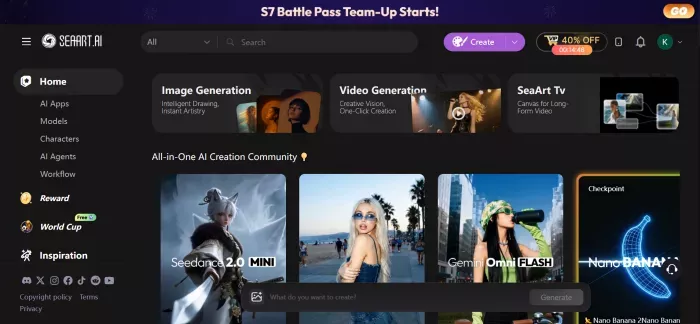

PolyBuzz is an AI character chat and roleplay platform.

LensGo AI is a browser-based creative studio that bundles a stack of t...



Discussion