If you've searched for "snapjotz com" recently, you've probably noticed something strange.
One article tells you it's an AI-powered note-taking platform with voice-to-text transcription. Another swears it's a meeting summary tool used by sales teams. A third describes it as an e-commerce store running scammy Facebook ads. A fourth calls it a "revolutionary productivity workspace" with real-time collaboration.
And then you actually visit the site, and none of those descriptions match.
So what is Snapjotz.com really? Is it safe? Should you trust it? I went through the site, the WHOIS-style trust signals, the third-party reviews, and the actual published content to find out. Here's the unfiltered answer.
Snapjotz.com is not a productivity app, an AI tool, or an e-commerce store. It's a multi-niche WordPress blog, almost certainly operating as a guest post / SEO content farm.
It's not technically a scam. It's not stealing your money. But it's also not the "innovative platform" that dozens of fake-looking review sites claim it is. The features those reviews describe don't exist on the actual website.
Safety: Probably fine to browse. Trustworthiness as a content source: Low. Utility for users searching for a productivity tool: Zero.
If you came here looking for the next Notion or Otter.ai, keep walking. This isn't that.
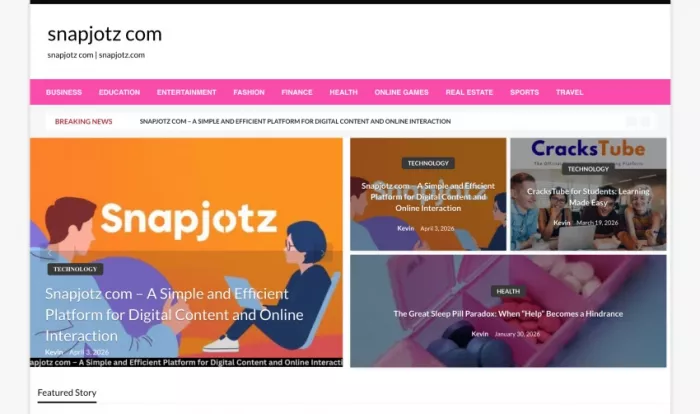
Let's start with what's verifiable: the live site itself, as of early 2026.
When you load snapjotz.com, you don't land on a product page, a sign-up flow, or a software dashboard. You land on a generic blog homepage running on WordPress with the "Silk Themes" framework. There are no app features. No login button for a "platform." No download link. No pricing page.
Just blog posts.
Here are the categories listed on the site's navigation:
A real productivity tool doesn't have a "Pets" category. A real AI note-taking app doesn't publish articles about "Online Master of Science in Applied Nutrition" or "North Texas Plastic Surgery." This is the structure of a multi-niche general blog, the same template used by hundreds of low-trust SEO sites that exist to publish guest posts and capture random search traffic.
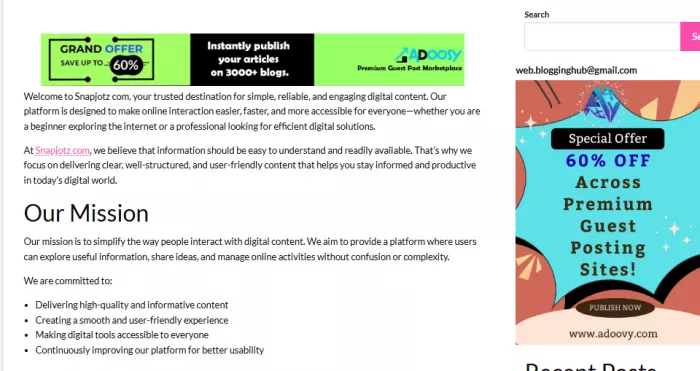
There's a sidebar advertisement on the homepage that reads: "Guest Post Marketplace 2026." That single graphic tells you the entire business model. The site isn't selling a product to users. It's selling backlinks to other website owners who want to place sponsored articles.
The site's archive pages reveal something interesting: posts from October 2020, then a long gap, then resumed activity starting in February 2023, with consistent publishing through 2024, 2025, and into 2026.
That gap is significant. It often indicates a domain that was either dormant, expired and re-registered, or sold to a new owner who repurposed it. Either way, the snapjotz.com you're looking at today is probably not the same site that originally registered the domain years ago.
Here's where it gets interesting.
If you Google "snapjotz com," you'll find dozens of articles that describe the site in glowing terms. They claim Snapjotz is a "cloud-based note-taking platform," an "AI meeting tool," a "digital workspace," a tool with "voice-to-text transcription," "real-time collaboration," "multimedia notes," "smart search," and "team plans starting at $X per month."
None of those features exist on the actual website.
I'm not exaggerating. There is no app. There is no login. There is no pricing page. There are no features. There's just a WordPress blog publishing articles about plastic surgery, daycare in Tumwater Washington, and online MS programs.
So why do these reviews exist?
What's happening here is a well-known SEO pattern. When a domain name sounds vaguely tech-related (like "Snapjotz", which sounds like a note-taking app), low-quality content sites generate AI-written "reviews" describing fictional features to capture search traffic from people googling the name. These articles read suspiciously similar to each other because they're often generated from the same prompt patterns.
A few tells that give them away:
| Tell | What to look for |
| Identical features across reviews | Multiple unrelated sites listing the exact same fictional features (voice-to-text, multimedia notes, real-time collaboration) |
| No screenshots of the actual product | Real reviews show the interface. These don't, because there isn't one. |
| Vague "users say" language | "Users praise the platform for…" without naming a single user, source, or review platform |
| Made-up testimonials | One article claimed "a Sales Director saved 7 hours per week", with no name, company, or verifiable source |
| Cross-promotion of similar low-trust domains | These review sites also write about other suspiciously similar domains (Quikconsole, Keepho5ll, MyGreenBucks, Puzutask, etc.), all with the same template |
If you've ever wondered why "is X.com legit?" articles all read the same, this is why. They're a content category, not genuine journalism.
To be fair, not every review is positive. One site (blogsbuz.co.uk) describes snapjotz.com as an e-commerce scam selling cheap products through Facebook ads. That doesn't match what I see on the live site today either, there's no shopping functionality, no product listings, no checkout. That review may have been describing a different site at a different time, or it may simply be inaccurate.
The bigger lesson: online reviews about lesser-known domains are unreliable in both directions. Don't trust the rave reviews. Don't trust the "scam alert" panic posts either. Look at the actual site.
This is the question that probably brought you here. Let's break it down honestly.
No way to verify article accuracy. No editorial team, no fact-checking statement, no citations to reliable sources within most articles.
Browsing the site? Probably fine. Same risk profile as any random WordPress blog, low if you don't click suspicious ads, don't download anything, and don't take its content as expert advice.
Trusting it as a source for health, finance, or product purchase decisions? No. This is not a place to make decisions that affect your money or your body.
Here's how snapjotz.com stacks up across the signals that matter when evaluating any unknown website:
| Trust Signal | Status | Notes |
| HTTPS / SSL | Present | Standard requirement, met |
| Domain age | Mixed | Active since 2020, with a notable gap suggesting possible repurposing, now copyright at 2026 |
| Owner transparency | Hidden | No real names, no company info |
| Editorial credentials | None | Single anonymous "author" handle |
| Contact information | Email only | Cloudflare-protected email, no phone or address |
| Privacy policy | Present | Standard template, not specifically reviewed |
| Original content | Generic | Articles read AI-generated, cover unrelated topics |
| Niche focus | None | Multi-niche structure typical of guest post sites |
| Third-party reviews | Unreliable | Most existing "reviews" appear AI-generated and inaccurate |
| Verifiable user base | None | No comments, no community, no social proof |
| Monetization clarity | Unclear | Affiliate links and sponsored content not always disclosed |
| Search blocklist status | Not flagged | Not on major malware/phishing lists |
Overall trust score: 3 out of 10. Safe to look at. Not safe to rely on.
If you landed on this site hoping for genuine value, here's what you'll actually run into:
Most people searching "snapjotz com" expect to find an app or service. You won't. The misleading reviews send people on a wild goose chase looking for features that were invented by AI content writers.
Articles cover wildly unrelated topics (plastic surgery, peptides, formal events, online games, daycare reviews) with no apparent expertise behind them. Most read like AI output that was lightly edited and published. There's no consistent editorial voice because there's no consistent editor.
A legitimate platform, even a small blog, usually has comments, social media engagement, named contributors, or backlinks from credible sources. Snapjotz.com has none of these. The "Recent Comments" widget on the sidebar literally reads "No comments to show."
Some articles, particularly in finance, appear written to drive clicks toward broker platforms or product pages. Affiliate disclosures aren't consistently present. You may be reading what looks like advice but is actually paid promotion.
Like most ad-supported sites, snapjotz.com is loaded with third-party ad scripts. Even if you don't click anything, your browsing data is fed into ad networks. That's not unique to this site , it's the default state of the internet, but it's worth noting if you came here expecting a clean, "tool-like" experience.
If you actually need a note-taking or productivity tool, the kind of thing the fake reviews described, here are real, established alternatives:
Notion — Multimedia notes, real workspaces, free for individuals.
Obsidian — Local-first markdown notes with extensive plugin support, free for personal use.
Apple Notes / Google Keep — Free, fast, well-integrated with their respective ecosystems.
Otter.ai — If you specifically wanted AI meeting transcription.
Evernote — The original cross-device note app, still functional.
Any of these will give you what the fake snapjotz.com reviews promised, with the small advantage of actually existing.
Snapjotz.com is a small case study in something larger that's happening across the internet right now: domains being recycled, AI-written reviews fabricating features for products that don't exist, and search results filling up with content that confidently describes fiction.
The site itself isn't a scam. It's not stealing from you. It's just not what the search results say it is.
If you remember three things from this review:
Check the site before you trust the reviews. A 30-second visit would have answered most of your questions before you read any of the inflated review articles.
Anonymous, multi-niche blogs covering health and finance topics are not credible sources. Whatever advice they offer, verify it elsewhere.
"Is X.com legit?" articles are themselves a low-trust content category. Including this one, verify what I've said by visiting the site yourself.
That last point matters. Don't take my word for it either. Open snapjotz.com in a new tab. Look at the categories. Read one article. You'll see exactly what I'm describing.
And then close the tab and go find a tool that's real.
Why is everyone talking about Seedance 2.0? It topped the AI video lea...

Microsoft plans to cut thousands of jobs next week across sales, consu...

Wix-owned Base44 launches Base1, its own AI model for vibe coding, bet...
Thinking about Brasssmile? Read our honest review covering content qua...

Ford rehired veteran 'greybeard' engineers after AI-powered quality in...

OpenAI launched GPT-5.6 on Friday, but a White House approval list - n...

Discussion