Nvidia’s $20 billion license of Groq’s AI inference technology is a non‑exclusive “license‑plus‑acquihire” that gives Nvidia Groq’s ultra‑low‑latency LPU designs and core engineering talent, without buying Groq as a company. The move is explicitly about dominating the next phase of AI: real‑time, large‑scale inference rather than just model training.
At the core, this is a non‑exclusive licensing agreement for Groq’s inference technology, especially its Language Processing Unit (LPU) architecture used to run generative AI models at very high tokens‑per‑second with deterministic latency. Nvidia is reported to be paying roughly $20 billion to license Groq’s IP and buy most of its AI chip assets, making this the largest transaction in Nvidia’s history by deal value.
● Groq has confirmed that its inference technology is being licensed, while Nvidia and market sources frame the total package (IP license plus asset purchase) at about $20 billion.
● Founder Jonathan Ross, president Sunny Madra, and key engineers are joining Nvidia to help integrate and scale the LPU‑based designs inside Nvidia’s AI “factory” architecture.
● Groq remains an independent company under new CEO Simon Edwards (its former CFO), and GroqCloud continues to serve customers on Groq hardware.
Groq’s LPU is built from the ground up for inference, not training, with an architecture that stores model weights in on‑chip SRAM instead of off‑chip HBM, pushing memory bandwidth into the ~80 TB/s range versus roughly an order of magnitude lower on typical GPUs. That, combined with deterministic execution (no random stalls), enables extremely consistent token timing and throughput for large language models and streaming workloads.
● In Groq’s own benchmarks, LPU‑based systems can deliver up to 10× or more throughput for some NLP inference workloads versus conventional GPU setups, especially at low batch sizes where latency dominates.
● These characteristics are tailor‑made for use cases like real‑time conversational AI, high‑frequency recommendation ranking, trading systems, robotics, and autonomous vehicles, where every millisecond counts and jitter is unacceptable.
By taking Groq’s inference IP in‑house, Nvidia can evolve future accelerators that blend its GPU strengths in training with Groq‑style, low‑latency inference techniques, rather than letting a new class of inference‑only competitors grow outside its ecosystem.
Strategically, this is Nvidia admitting that the center of gravity in AI economics is shifting from one‑off model training to continuous, always‑on inference at global scale. Analysts expect inference to grow faster than training, with AI inference markets projected to more than double from roughly $100+ billion in the mid‑2020s to over $250 billion by 2030.
● Nvidia already dominates AI training with its GPU stack; this deal is a pre‑emptive strike to lock in leadership as hyperscalers and enterprises optimize for inference cost per token and cost per request.
● Instead of launching a direct acquisition and inviting harsh antitrust scrutiny after the failed Arm deal, Nvidia is using a high‑value license‑plus‑talent structure to achieve almost the same strategic outcome with lower regulatory risk.
● Financially, $20 billion is large but digestible for Nvidia, which is sitting on tens of billions in cash and generating over $20 billion in free cash flow per quarter, making this effectively a one‑quarter free‑cash‑flow bet on inference leadership.
In other words, the business logic is to neutralize a fast‑moving rival, internalize a differentiated architecture, and stretch Nvidia’s AI factory narrative from training clusters to full‑stack, training‑plus‑inference infrastructure.
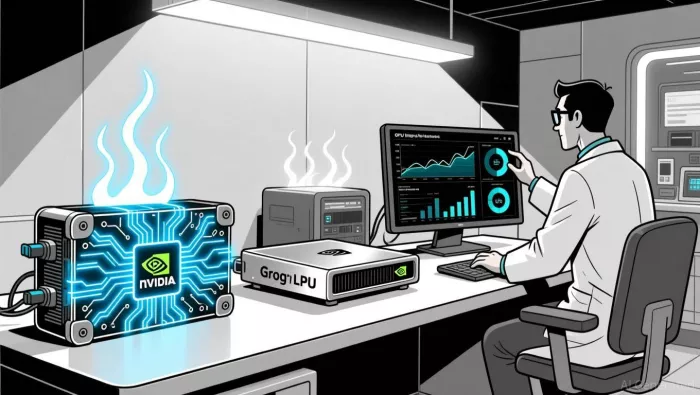
This deal is intentionally structured as something between a classic IP license, an asset purchase, and an acquihire.
● Structure: Nvidia licenses Groq’s IP on a non‑exclusive basis, acquires “most” of Groq’s AI chip assets, and hires core leadership and engineering teams, but does not formally acquire Groq the corporate entity.
● Governance: Groq continues operating independently with new leadership and the theoretical ability to license its technology to others—although Nvidia’s capital, ecosystem pull, and newly hired Groq engineers make Nvidia the de facto primary outlet for this IP.
For competitors, the impact is stark:
● AMD, Intel, Cerebras, and a long tail of inference startups now face an Nvidia that can offer both GPU‑centric and LPU‑style products, potentially bundling them into AI factories with tight software integration.
● Cloud providers that had flirted with Groq as a hedge against Nvidia now see Groq’s core technology flowing into Nvidia’s roadmap, reducing diversity in the high‑end inference stack even if Groq remains nominally independent.
● The non‑exclusive label helps Nvidia argue that competition still exists, even as analysts describe this as “maintaining the fiction of competition while securing critical assets.”
The timing fits a broader narrative: training clusters have already been built out aggressively, and the next wave of capex is shifting toward “AI factories” optimized for serving, ranking, and agentic workflows 24/7. Bank and market analysts describe 2026 as the year when AI inference, not training, becomes the primary driver of incremental silicon demand and data‑center design.
● In this context, Nvidia’s move is being read as a template for future mega‑deals: high‑value licensing plus talent, rather than headline acquisitions that cross antitrust tripwires.
● The deal also lands as regulators in the US and EU scrutinize concentration in AI chips, meaning Nvidia needed a structure that could be framed as “access‑expanding” (through non‑exclusive tech) while still consolidating real power.
For Groq’s investors and employees, the $20 billion valuation is a substantial win versus its last private round in the high‑single‑digit billions, turning a once‑scrappy Nvidia critic into one of Nvidia’s largest strategic payouts.
The next 12–24 months will likely be defined less by press releases and more by how quickly Nvidia can harden Groq‑style inference into shipping products and cloud offerings. Several concrete shifts are likely:
● Nvidia roadmaps: Expect future “AI factory” announcements and DGX‑class systems that explicitly advertise LPU‑inspired low‑latency inference paths alongside GPU‑based training, potentially as part of integrated racks or pods tuned for agents and real‑time copilots.
● Market behavior: Hyperscalers and large enterprises will pressure Nvidia to convert the deal into lower cost‑per‑token and more predictable latency SLAs, while rivals scramble to differentiate on openness, price, or specialized vertical accelerators.
● Regulatory and ecosystem response: Expect renewed debate over Nvidia’s dominance in AI hardware and whether “non‑exclusive” mega‑licenses like this should be treated closer to de‑facto acquisitions in antitrust policy.
If Nvidia executes, this deal will be remembered less as a one‑off $20 billion check and more as the moment the company re‑architected its empire around the economics of inference, embedding Groq’s low‑latency DNA deep inside the world’s most powerful AI hardware stack.

AI-powered image editing has moved far beyond simple filters. Today’s...

AI chat platforms built around fictional characters and roleplay conve...

AI chat platforms have evolved far beyond simple question-and-answer b...
Platform OverviewCutout.pro is an AI-powered image editing platform de...

AI chat platforms designed for roleplay and interactive conversations...
Goth AI is a character-based AI chat platform designed for dark, gothi...

Discussion