European banks are preparing to eliminate roughly 200,000 jobs by 2030 as they double down on artificial intelligence and close thousands of physical branches, with the deepest cuts expected in back‑ and middle‑office roles rather than customer‑facing staff. This shift amounts to around 10% of the workforce at 35 major European lenders and marks one of the largest technology‑driven restructurings the region’s banking sector has ever seen.

Analysts at Morgan Stanley, cited by multiple outlets, forecast that more than 200,000 roles across European banks will disappear by 2030 as AI and digitalization make many routine tasks redundant. The estimate covers 35 large banks that together employ about 2.12 million people, implying a reduction of roughly 10% of total staff.
Several forces are converging at once:
● Rapid deployment of AI tools across risk, compliance, operations and customer service.
● Aggressive cost‑cutting targets and efficiency programs after years of pressure on margins and return on equity.
● Continued branch closures as customers shift to mobile and online banking, shrinking the need for traditional support functions that sat behind physical networks.
The heaviest impact is expected in “central services” and middle‑office functions, rather than front‑line relationship managers or specialised deal‑makers. Banks expect algorithms to handle much of the routine data processing, transaction checks and regulatory reporting that once required large operational teams.
Functions most at risk include:
● Back office: payments processing, reconciliations, settlements, KYC file updates and documentation workflows.
● Middle office: risk management, compliance monitoring and financial reporting, where AI can scan vast datasets faster and more consistently than human analysts.
● Some call‑centre and basic customer support roles, as chatbots and AI agents absorb simple queries.
Specific institutions have already pinned numbers to their plans. Dutch lender ABN Amro has said it aims to cut roughly 20% of its workforce by 2028 as automation ramps up, while Société Générale’s leadership has warned that no unit is “off‑limits” in its ongoing restructuring. Swiss giant UBS, meanwhile, is experimenting with AI “avatars” that can deliver personalised video analysis to clients, signalling further scope to streamline advisory support staff over time.

AI is moving from experimental pilots to the operational core of European banks, touching everything from onboarding to credit underwriting. In many cases, the same work can be performed with fewer people once models are fully embedded in workflows and supported by modern data platforms.
Key use cases that directly intersect with jobs include:
● Automated document and identity checks for onboarding and KYC, replacing manual review teams.
● Real‑time transaction monitoring, sanctions screening and anomaly detection in compliance, cutting the need for large investigative units on low‑risk alerts.
● Credit scoring and loan processing, where AI models can pre‑assess applications and flag borderline cases for human review instead of requiring full manual underwriting.
● Intelligent workflow orchestration, which routes tasks to either bots or humans and progressively reduces human touch points in standard processes.
Across these domains, Morgan Stanley estimates that banks could achieve efficiency gains of up to 30%, meaning the same volume of activity could be supported with substantially fewer staff.
The projected 200,000 job losses are expected to play out over the rest of this decade, with many banks already in the early stages of their restructuring programs. Analysts suggest that much of the reduction will occur over the next five years as legacy systems are replaced and AI platforms move from pilots into scaled deployment.
Although the analysis focuses on Europe, similar dynamics are emerging in the United States and other banking markets. Goldman Sachs, for example, has warned staff of layoffs and a hiring freeze through the end of 2025 as part of an AI‑driven overhaul branded “OneGS 3.0,” targeting processes from client onboarding to regulatory reporting. This underscores that the European cuts are part of a broader global realignment of financial sector employment around automation and digital tools.

For employees, the headline risk is displacement, but the picture is more nuanced than simple elimination of roles. Banks and policymakers expect a reshaping of skill demand, with fewer pure processing jobs and more emphasis on data literacy, model oversight and complex client work that AI cannot yet handle well.
Several implications are already visible:
● Reskilling and redeployment programs are becoming a core plank of banks’ HR strategies, particularly in the EU where labour protections are strong and regulatory scrutiny is high.
● Supervisors and central banks are beginning to question not only prudential risks from AI models but also the social and employment impact of rapid automation.
● Industry leaders warn that over‑automating early‑career tasks could stunt the development of junior bankers, who historically learned by doing the manual work that AI is now absorbing.
In practice, the next few years will test whether European banks can translate promised 30% efficiency gains into sustainable profitability without triggering a political and social backlash over large‑scale white‑collar job losses.
European banks are not just trimming headcount; they are fundamentally rewiring how financial work gets done, with AI embedded at the center of operations rather than at the edges. The 200,000 roles projected to vanish by 2030 signal a long‑term structural shift in which routine process jobs steadily disappear, while higher‑skilled roles in data, model governance and complex client advisory become more valuable. For workers, regulators and bank executives alike, the real challenge over the next decade will be managing this transition in a way that captures efficiency and innovation gains without letting a purely cost‑cutting narrative erode trust, talent pipelines and social stability around one of Europe’s most systemically important industries.

AI-powered image editing has moved far beyond simple filters. Today’s...

AI chat platforms built around fictional characters and roleplay conve...
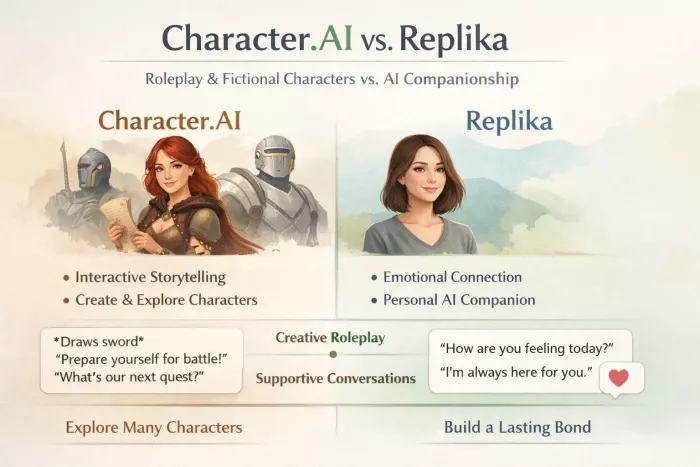
AI chat platforms have evolved far beyond simple question-and-answer b...

Platform OverviewCutout.pro is an AI-powered image editing platform de...

AI chat platforms designed for roleplay and interactive conversations...
Goth AI is a character-based AI chat platform designed for dark, gothi...

Discussion