For the past few months, a name kept appearing in my inbox and social feeds.
CrossMarket AI.
Someone would ask if it was a new AI trading platform. Someone else would claim it generated passive income. A few people simply wanted to know if it was real.
That pattern alone made me curious.
Whenever a platform promises automated profits through artificial intelligence, it deserves a closer look. Financial markets are complicated systems filled with uncertainty. Any service claiming it can remove that uncertainty automatically deserves scrutiny.
So instead of ignoring the platform, I spent time digging through the website, user discussions, traffic data, and review platforms to see what could actually be verified.
What I found was not a clear answer. Instead, it was a collection of signals that point in very different directions.
Some users describe CrossMarket AI as a passive income opportunity. Others call it a scam.
The reality sits somewhere between those extremes, but several warning signs make it difficult to treat the platform as trustworthy.
The first thing CrossMarket AI promotes is simplicity.
According to its promotional language, the platform uses artificial intelligence to analyze multiple financial markets at once. The idea is that an automated system watches stocks, cryptocurrencies, currencies, and commodities simultaneously.
The system supposedly identifies correlations between these markets and uses them to generate profitable trading signals.
On paper, this concept sounds impressive.
Cross-market analysis is a legitimate area of financial research. Hedge funds often examine how different assets influence one another. For example, oil prices can affect currency movements in energy exporting countries. Interest rate decisions can impact stock markets worldwide.
But legitimate systems that perform this type of analysis usually provide technical details. They publish whitepapers, explain their models, or at least describe how the technology works.
CrossMarket AI does not.
Instead, the platform relies almost entirely on marketing language about artificial intelligence without providing evidence of the technology behind it.

According to its own descriptions, CrossMarket AI offers several capabilities.
It claims to monitor financial markets in real time, analyze relationships between assets, and detect trading opportunities automatically.
Some descriptions of the system mention the following features.
Multi-market data analysis that tracks stocks, forex, crypto, and commodities simultaneously.
Pattern recognition that supposedly detects relationships between different assets.
Predictive analytics that forecasts market trends based on historical data.
Real-time alerts or automated trades based on detected signals.
Automation that removes the need for manual trading decisions.
These claims sound familiar to anyone who has seen AI based trading advertisements before.
The problem is that none of these features are independently documented.
There is no public documentation explaining the algorithms used by the system. There is no data showing past performance. There is no technical breakdown of how the AI models were trained.
For a platform asking users to trust it with money, that absence of detail is difficult to ignore.
Another thing that caught my attention during the investigation was the lack of transparency about who operates the platform.
When financial companies launch legitimate trading tools, they usually publish clear information about their team. Investors want to know who built the system and who is responsible for it.
CrossMarket AI provides very little information in this area.
Domain registration details are hidden behind privacy services. The website does not provide detailed company leadership information.
In the financial technology industry, anonymity is rarely considered a positive sign.
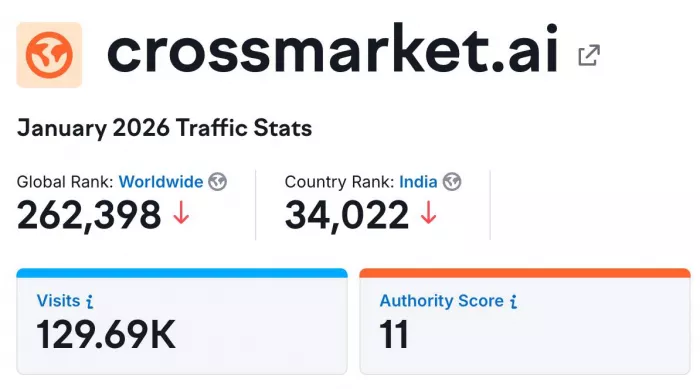
Despite these concerns, the platform clearly attracts attention.
Traffic estimates suggest that the website receives over one hundred thousand visits per month. Most of that traffic appears to come from mobile devices, with users primarily located in India and Bangladesh.
This indicates that CrossMarket AI is actively being promoted and discussed online.
Interestingly, a large portion of visitors arrive directly rather than through search engines. This usually means users are reaching the site through shared links, advertisements, or messaging platforms rather than organic discovery.
That pattern often appears in platforms promoted through referral networks or social media campaigns.
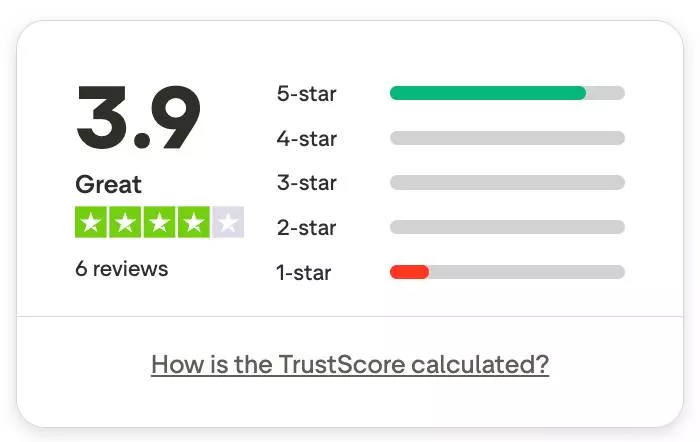
When I checked review platforms, the feedback was confusing.
On Trustpilot, CrossMarket AI holds a moderately positive rating. Several users describe it as a profitable opportunity or a source of passive income.
But there are two problems with these reviews.

First, the number of reviews is extremely small. Only a handful exist, which makes it difficult to determine whether the feedback reflects real user experiences.
Second, many positive reviews contain very little detail. They read more like short endorsements than detailed evaluations of a trading platform.
At the same time, other users report completely different experiences.
Some claim the platform stopped working for them. Others say the website became inaccessible.
This kind of contradiction is common in platforms that operate in legally uncertain spaces.
One reason CrossMarket AI raises suspicion is that it follows a pattern seen in many online investment schemes.
The formula usually looks like this.
Step one is marketing the platform as a powerful automated trading system powered by artificial intelligence.
Step two is promising consistent daily profits that require little effort.
Step three is encouraging users to deposit money quickly before the opportunity disappears.
The technology itself often remains vague.
Without transparency, it becomes impossible for users to verify whether real trading is actually happening behind the scenes.
One of the most serious concerns mentioned by users involves withdrawals.
Several reports claim that deposits are processed immediately, but withdrawal requests are delayed or blocked.
This type of complaint appears frequently in questionable trading platforms.
In legitimate financial services, withdrawing funds should be straightforward. Delays can happen occasionally due to compliance checks, but they are rarely the norm.
When users repeatedly report withdrawal problems, it becomes difficult to ignore.
Another detail that surfaces in discussions about CrossMarket AI involves earlier trading platforms such as QFX Trade, Botbro, and TLC Coin.
These services were linked to fraud investigations in India involving large scale investment schemes.
Some reports claim that the same individuals may be connected to CrossMarket AI.
These claims are difficult to confirm completely, but the association alone adds another layer of concern for potential users.
Artificial intelligence has become a popular marketing term in online investment schemes.
The reason is simple.
Most people understand that AI can analyze large datasets and detect patterns. That reputation makes it easy for platforms to claim their system can predict markets.
In reality, financial markets remain extremely unpredictable.
Even the most advanced hedge funds experience losses despite using sophisticated machine learning models.
When a platform promises guaranteed profits through AI, skepticism is usually justified.
After examining the available information, I reached a simple conclusion.
CrossMarket AI does not provide enough transparency to be considered a trustworthy trading platform.
The lack of technical documentation, unclear ownership, mixed user feedback, and repeated withdrawal complaints create too many unanswered questions.
This does not automatically prove the platform is fraudulent. But it does place it firmly in the category of high risk online financial services.
And when money is involved, high risk platforms deserve extreme caution.
CrossMarket AI presents itself as a powerful artificial intelligence trading system capable of generating profits automatically.
But when you look beyond the marketing language, the platform offers very little evidence to support those claims.
There are no verifiable technical details, no publicly known development team, and very limited user feedback that can be independently confirmed.
That combination makes the platform difficult to trust.
Anyone considering using services like CrossMarket AI should remember a simple rule.
If a platform promises easy profits in financial markets without transparency, the safest decision is usually to walk away.

What "Safe" and "Legit" Actually Mean HereMost reviews answer neither...

Intel has joined Elon Musk’s ambitious “Terafab” semiconductor initiat...

Where automation actually saves time in real workflowsInstead of think...

April 7, 2026Samsung Electronics said Tuesday it expects first-quarter...

DeepSeek AI usually stops meeting expectations at a very specific poin...

Anthropic is tightening how its AI coding platform is billed, confirmi...

Discussion