Recent advances in neural networks and large language models have significantly improved transcription accuracy. Many modern platforms now achieve accuracy rates above ninety percent when audio quality is clear. This progress has made speech recognition tools practical for everyday use across industries such as journalism, research, podcasting, education, and enterprise documentation.
Speech-to-text tools are commonly used in several real-world scenarios:
1. Meeting transcription and team documentation
2. Podcast and video transcription
3. Accessibility for hearing-impaired users
4. Subtitle and caption generation
5. Academic interviews and research transcription
As demand grows, several specialized platforms have emerged that focus specifically on transcription and speech recognition rather than general AI features. The following sections explore the most reliable tools designed for this purpose.
| Tool | Best For | Language Support | Key Strength |
| Otter.ai | Meetings and collaboration | 20+ languages | Real time meeting transcription |
| Descript | Content creators and podcasts | 20+ languages | Editing audio through text |
| Rev AI | Developers and APIs | Multiple languages | High accuracy speech recognition |
| Sonix | Media transcription | 40+ languages | Fast automated transcription |
| Dragon Professional | Professional dictation | Primarily English | Voice typing accuracy |
| Google Cloud Speech to Text | Enterprise AI applications | 125+ languages | Scalable cloud APIs |
| Microsoft Azure Speech to Text | Enterprise AI systems | 100+ languages | Enterprise integration |
The table highlights how speech recognition tools typically specialize in different types of users. Some focus on collaboration and meeting documentation, while others target enterprise development environments where transcription is embedded inside applications.
Platforms such as Otter and Descript are designed for everyday users who want easy transcription workflows. Enterprise solutions like Google Cloud Speech to Text and Microsoft Azure Speech focus on developers building voice driven products.
Otter.ai has become one of the most widely used speech to text tools for meetings and collaboration. The platform focuses on real time transcription and automated meeting documentation. When a meeting begins, Otter can capture spoken dialogue and generate a live transcript that participants can follow during the conversation.(Otter.ai)
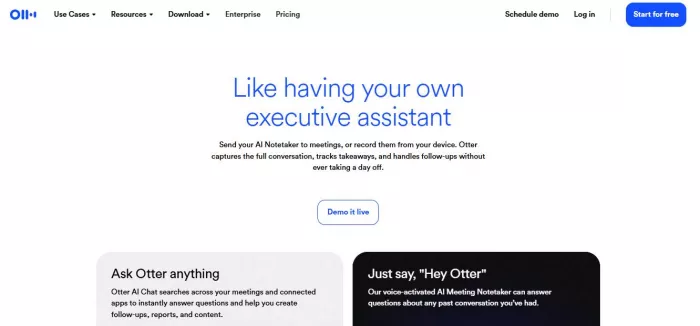
One of Otter's strengths is its integration with conferencing platforms such as Zoom, Google Meet, and Microsoft Teams. The system can automatically join scheduled meetings and produce transcripts without manual recording. It also identifies different speakers and organizes conversations into structured notes.
Another useful feature is collaborative editing. Teams can highlight sections, add comments, and search through transcripts after meetings end. Otter also generates summaries and key points, making it easier for teams to review discussions without replaying entire recordings.
Descript combines speech recognition with audio and video editing, which makes it particularly popular among content creators and podcast producers. Instead of editing audio through complex timelines, users can edit spoken recordings directly by editing the transcript text.(Descript)
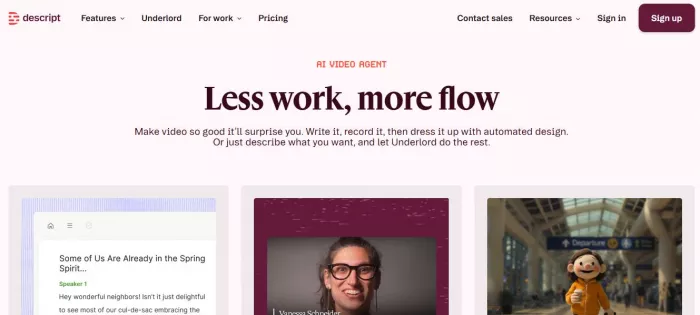
The platform supports transcription accuracy around ninety five percent across more than twenty languages when audio quality is clear. Once transcription is complete, users can delete words, move sections of dialogue, or correct mistakes directly in the text document.
Descript also includes features such as automatic filler word removal, speaker detection, and subtitle generation. These capabilities simplify workflows for podcasters, video editors, and journalists who frequently work with recorded speech.
Rev AI is primarily designed for developers and enterprise users who need programmatic access to speech recognition technology. The platform provides APIs that allow applications to convert audio streams into text automatically.(Rev AI)
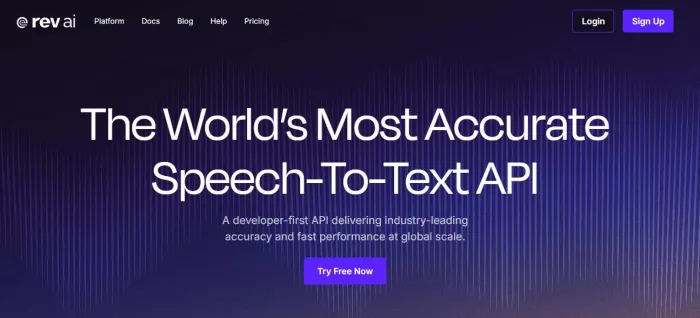
Rev AI is known for high transcription accuracy and strong support for speaker detection. Developers commonly integrate the service into customer support systems, call analysis platforms, and media transcription pipelines.
Another advantage is scalability. Rev AI can process large volumes of audio simultaneously, which makes it suitable for companies handling thousands of recorded conversations or media files. Pricing is typically based on the number of minutes of audio processed.
Sonix is a transcription platform widely used by journalists, filmmakers, and researchers who need fast and accurate transcripts. The system supports more than forty languages and offers automated transcription for audio and video files.(Sonix)
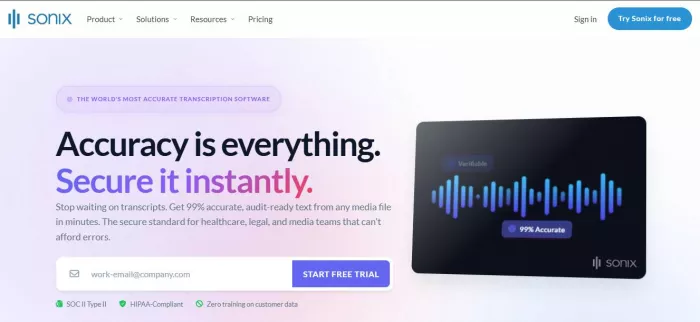
After uploading audio, Sonix quickly produces a searchable transcript. Users can review timestamps, correct words, and export captions or subtitles. This makes it particularly useful for video production workflows where subtitles are required.
Sonix also includes translation features, allowing transcripts to be converted into different languages. For international teams and media companies, this capability helps streamline localization and global content distribution.
Dragon Professional has been a leader in speech recognition software for many years. Unlike cloud transcription services, Dragon focuses on voice dictation for professionals who want to convert spoken thoughts directly into written documents.
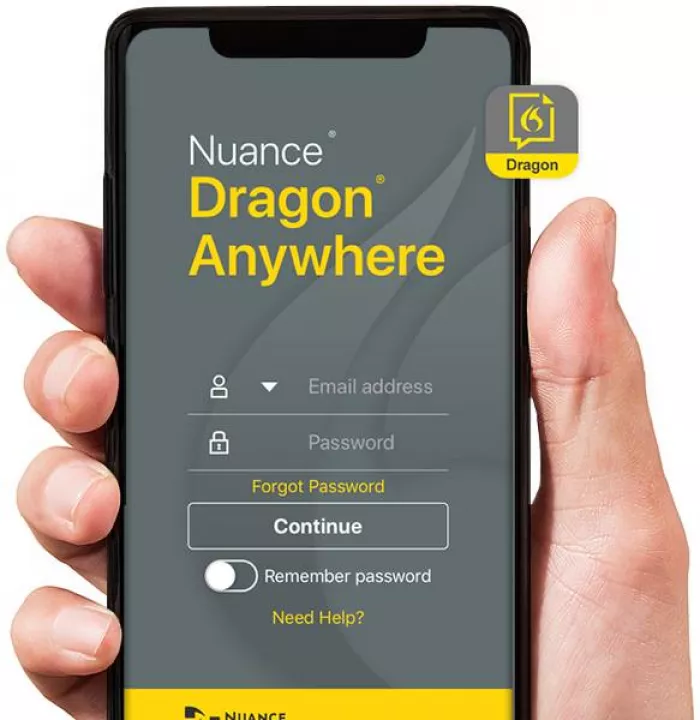
The system works by training on the user's voice. Over time it learns pronunciation patterns and vocabulary preferences, which allows it to achieve extremely high accuracy levels. Many doctors, lawyers, and researchers rely on Dragon for writing reports and documentation through voice.
Dragon Professional also allows users to create custom voice commands that control computer functions. For example, a user could dictate emails, open applications, or navigate documents entirely through voice commands.
Google Cloud Speech to Text is one of the most advanced enterprise speech recognition systems available. The service uses deep learning models trained on large datasets collected from multiple languages and environments. (Google Cloud)
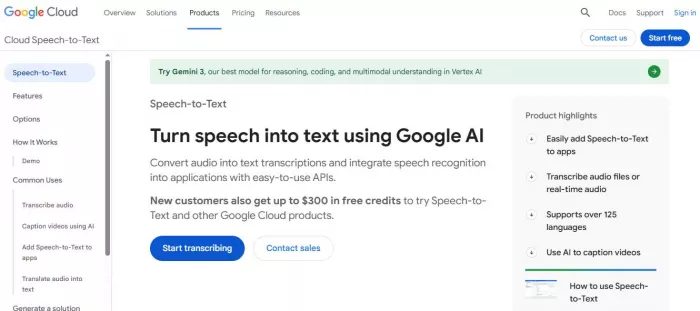
The platform supports more than one hundred twenty languages and dialects. Developers can integrate the service into applications that require voice commands, automated transcription, or audio search functionality.
Google Cloud also provides features such as speaker diarization, punctuation prediction, and streaming transcription for real time applications. Because the platform operates through cloud APIs, it can process massive amounts of audio data efficiently.
Microsoft Azure Speech to Text is another enterprise level speech recognition platform used by companies building voice enabled applications. The system is part of Microsoft's broader AI services ecosystem. (Microsoft Azure)
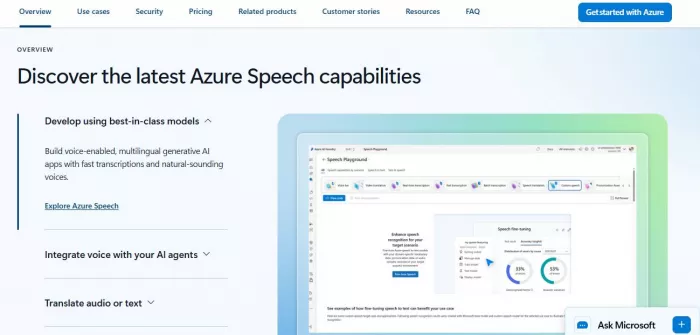
Azure Speech supports multilingual transcription, custom speech models, and real time audio streaming. Organizations can train custom models using domain specific vocabulary, which improves accuracy in industries such as healthcare, finance, and customer support.
The platform also integrates with other Microsoft tools such as Teams, Power BI, and enterprise analytics services. This integration allows companies to analyze spoken conversations for insights, compliance monitoring, and customer sentiment.
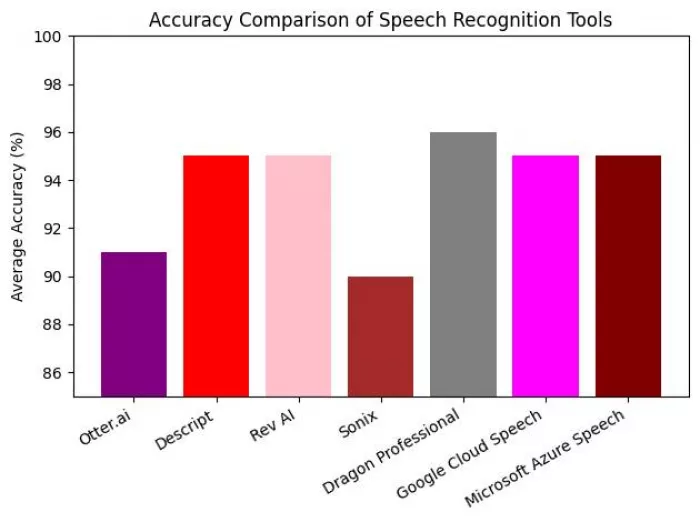
This chart shows that the overall accuracy range among modern tools is relatively close. Differences typically emerge when dealing with noisy audio, specialized vocabulary, or multiple speakers.
Dictation focused tools such as Dragon Professional often perform best when a single user trains the system to recognize their voice. Meanwhile enterprise platforms excel at multilingual recognition and large scale processing.
1. Speech recognition technology has expanded far beyond simple dictation. In many industries, automated transcription has become a core productivity tool.
2. Journalists frequently use transcription software to convert interviews into searchable text. Instead of manually typing hours of recordings, reporters can generate transcripts quickly and focus on analysis and storytelling.
3. Podcast producers also depend on transcription tools for generating captions and searchable content archives. Transcripts help improve accessibility and allow audiences to follow conversations in written form.
4. Businesses increasingly use speech recognition during meetings to capture discussions and decisions. Automatic transcripts ensure that team members who missed meetings can review key information without relying on memory or handwritten notes.
5. Accessibility is another major area where speech recognition has made a significant impact. People with hearing impairments can use live transcription tools to follow conversations, lectures, and presentations in real time.
Speech recognition technology continues to evolve as AI models become more advanced. Large language models are now being combined with acoustic recognition systems, allowing transcription engines to better understand context and grammar.
Future systems will likely support even more languages and dialects with higher accuracy. Improvements in noise filtering and speaker separation will also make transcription more reliable in crowded environments.
Another trend involves deeper integration with productivity platforms. Instead of functioning as standalone tools, speech recognition systems will become embedded within collaboration software, research tools, and media production environments.
As AI models continue to improve, speech-to-text technology is gradually shifting from a convenience feature to a core infrastructure layer that helps people capture knowledge from spoken conversations. This evolution suggests that speech recognition will play an increasingly important role in how information is recorded, analyzed, and shared across digital systems.
The First Few Minutes on the Site Tell You a LotWhen I first landed on...

Fraud has evolved alongside technology. What was once limited to paper...
SoftBank Group has secured a $40 billion loan from a consortium o...

There is a quiet shift happening inside AI chat platforms, and it has...

Meta Platforms has significantly increased its investment in a West Te...
One tool gaining attention among programmers is Blackbox AI. Rather th...

Discussion