Anthropic CEO Dario Amodei has turned a routine Davos panel into a flashpoint in the global AI power struggle, openly attacking Washington’s latest AI chip export policy and drawing a stunning comparison between key partner Nvidia and an arms dealer in a nuclear crisis.
In a major policy shift, the U.S. administration recently reversed an earlier ban and approved the sale of Nvidia’s H200 GPUs and an AMD chip line to “approved” customers in China.
These chips are not the absolute cutting edge of each company’s roadmap, but they remain high-performance processors designed for large-scale AI, making any export decision geopolitically sensitive.
Officials have framed licensing and vetting as safeguards, yet the move is widely viewed as relaxing one of the most powerful levers Washington has to slow China’s access to advanced AI compute.
That tension set the backdrop for Amodei’s unusually blunt intervention on the Davos stage.
Responding to a question on the new rules, Amodei dismissed the idea that chip export restrictions are simply throttling business, paraphrasing industry complaints as “It’s the embargo on chips that’s holding us back” and treating them with open incredulity.
He argued the decision “is going to come back to bite the U.S.,” insisting that America is still “many years ahead of China” in chip manufacturing capability and that shipping these GPUs is a “big mistake.”
To underline the stakes, he described frontier AI as having “incredible national security implications” because advanced models are “essentially cognition” — in effect, engineered intelligence.
He urged the audience to imagine a “country of geniuses in a data center,” equating future systems to 100 million entities “smarter than any Nobel Prize winner,” all concentrated under the command of whichever state controls the compute.
For Amodei, that mental picture explains why hardware exports matter more than quarterly sales.
In his framing, deciding who gets access to top-tier AI chips is akin to deciding which countries get to build and operate those “countries of geniuses.”
The most shocking line came when Amodei said the administration’s policy was “crazy,” likening it to “selling nuclear weapons to North Korea and [bragging that] Boeing made the casings.”
The analogy landed with particular force because it implicitly casts chipmakers as arms suppliers in a proliferation scenario, and Nvidia is not some distant, abstract firm for Anthropic — it is at the center of its technical and financial ecosystem.
Anthropic’s models run on infrastructure from Microsoft, Amazon, and Google, but under the hood those clouds all rely on Nvidia’s GPUs to train and serve Anthropic’s systems at scale.
On top of that dependence, Nvidia recently committed to invest up to $10 billion in Anthropic, coupled with a “deep technology partnership” announced just two months ago, full of upbeat language about co-optimizing each other’s stacks.
In Davos, that partnership was recast in a harsher light as Amodei’s analogy effectively compared his largest GPU backer to a company boasting about its role in a nuclear weapons supply chain.
For Nvidia executives, the implication that their export agenda aligns with something as reckless as arming North Korea would be hard to ignore.

Amodei’s willingness to publicly challenge both Washington and Nvidia reflects Anthropic’s unusually strong position in the current AI landscape. The company has raised billions of dollars, carries a valuation in the hundreds of billions, and has built Claude — including its coding assistant — into one of the most respected AI tools among developers tackling complex, real-world software work.
That combination of capital, valuation, and product reputation gives Anthropic a degree of insulation from immediate commercial retaliation. Amodei could sit on a global stage, deliver a line that would once have been considered career-ending for a CEO reliant on a single chip vendor, and then simply walk to his next meeting without visibly flinching about investor or partner backlash.
It is also plausible that Anthropic’s stance is motivated less by theatrics and more by genuine concern about the trajectory of Chinese AI labs and their access to compute.
In that light, invoking nuclear proliferation is not a stray rhetorical flourish but a deliberate escalation designed to jolt policymakers into treating chip exports as a matter of national security rather than trade alone.

The Davos episode underscores how existential the AI race has become in the minds of its leaders. Traditional constraints — polite diplomacy with strategic partners, careful investor messaging, and deference to government policy increasingly give way when executives believe core security questions are on the line.
Amodei’s remarks suggest that top AI founders now see themselves as central actors in global power politics, not just in technology markets. His apparent lack of concern about what he “can and can’t say” reflects a broader shift: when the perceived risks of AI scale are framed as civilization-level, the usual corporate playbook starts to look small.
If anything, the most telling detail is not the nuclear metaphor itself but the fearlessness with which it was delivered. In a world where GPUs have become the bottleneck resource for AI capability, the clash between national security, corporate strategy, and global competition is only going to get sharper — and Davos just got an early preview of that new reality.

AI-powered image editing has moved far beyond simple filters. Today’s...

AI chat platforms built around fictional characters and roleplay conve...
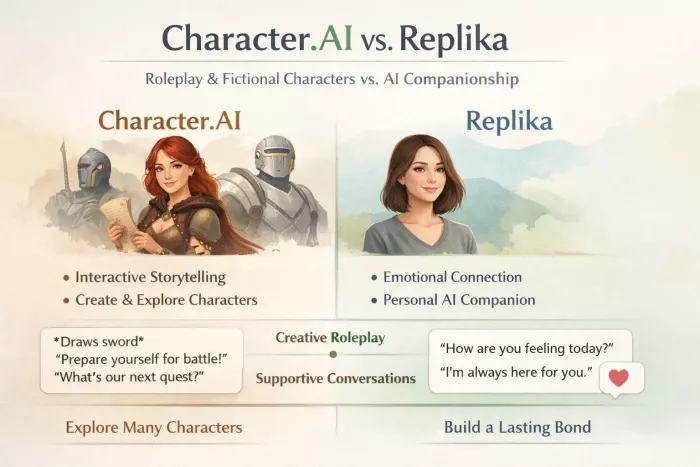
AI chat platforms have evolved far beyond simple question-and-answer b...

Platform OverviewCutout.pro is an AI-powered image editing platform de...

AI chat platforms designed for roleplay and interactive conversations...
Goth AI is a character-based AI chat platform designed for dark, gothi...

Discussion