Most reviews answer neither question. They describe ease of use and move on. Before any data is presented, these two terms need precise definitions in the context of AI tools.
| Term | What it actually asks | Key evidence to look for |
| Legit | Does the product exist, function, and deliver what it advertises? | Real company, working features, honest pricing |
| Data safety | What is collected, stored, and shared? | Privacy policy, GDPR/SOC 2 claims, breach history |
| Billing safety | Can you predict and control what you're charged? | Subscription terms, refund policy, documented disputes |
| Output reliability | Is the product consistent enough to trust for real work? | User-reported editing needs, accuracy complaints |
A tool can be completely legit and still be unsafe from a billing standpoint. These are separate verdicts, and this analysis treats them separately.
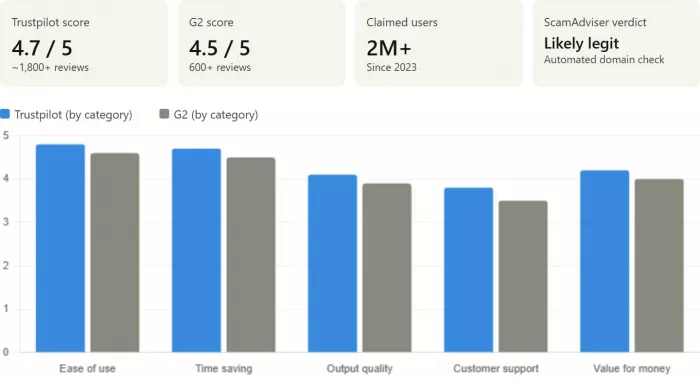
The chart tells a specific story. Ease of use, time saving, and interface quality consistently earn the highest scores on both platforms. But customer support scores are noticeably the weakest category across both Trustpilot and G2, sitting nearly a full point below the headline average. That is not a minor inconsistency. It is the most practically important number in the entire dataset, because it tells you what happens when something goes wrong.
What positive reviews consistently say:
● The dashboard is clean and easy to navigate, even for beginners with no technical background
● Users can draft SEO-ready blog posts in about 15 minutes instead of hours
● The all-in-one approach combining writing, image generation, and text humanizing reduces the need for multiple separate subscriptions
● The AI Humanizer feature gets repeated praise for producing content that passes AI detection tools
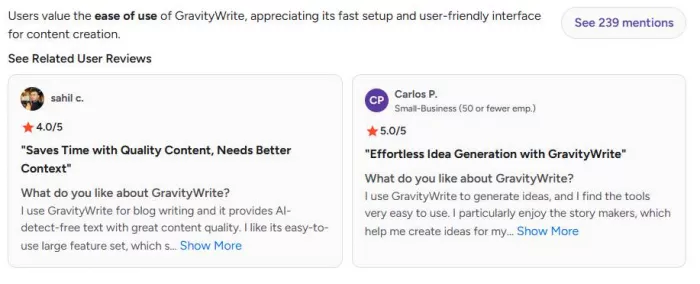
What negative reviews consistently say:
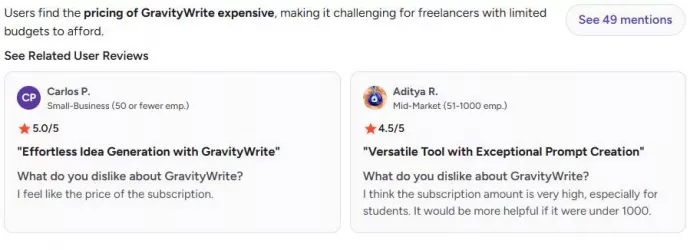
● "Expensive" is the single most tagged criticism on G2, appearing in 49 separate reviews
● Word limits disrupt workflows, and the credit system pushes users toward spending more than anticipated
● Longer-form content regularly needs tone and flow edits, particularly when a specific brand voice is needed
● Billing disputes and slow refund resolution appear across multiple Trustpilot threads
Star averages tell you sentiment. Specific complaints tell you the risk. These three complaint categories matter most when judging legitimacy.
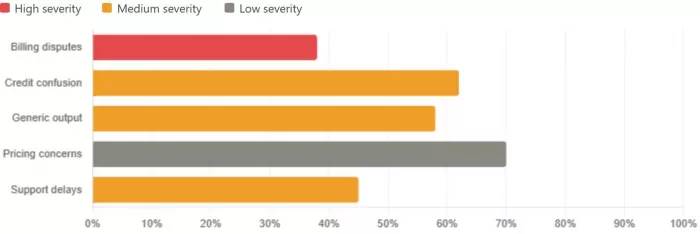
Billing disputes (high severity): One documented Trustpilot case describes a user being charged $97 after a failed cancellation attempt, being blocked on the platform when seeking a refund, and receiving a response only after persistent follow-up. GravityWrite replied publicly that the refund was issued once formal communication was received. The outcome was resolved, but the process broke down severely before that.
Credit confusion (medium severity): Users report the credit system pushes them to chain multiple tools together to complete a single task, which burns through credits faster than expected. This is a design choice, not a bug. It benefits the platform commercially and works against budget-conscious users.
Generic output (medium severity): Several G2 reviewers note the output quality is good enough for high-volume, low-stakes content but falls short for work requiring a very specific brand voice or nuanced long-form writing. AI-generated content that needs significant editing undermines the core time-saving value proposition.
Why these matter for a legitimacy assessment: pricing complaints are a usability issue. Billing disputes and credit confusion are a trust issue. The first kind tells you a product is imperfect. The second kind tells you the relationship between the platform and the user is adversarial by design.
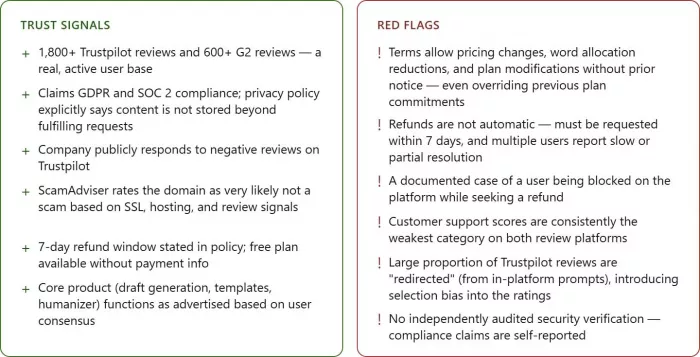
The single most concerning item in the red flag column is the terms clause. GravityWrite's own terms state that the platform reserves the right to modify the number of words charged or impose usage restrictions per hour based on model capacity, and that this may override previous commitments made during the subscription period. A paid plan that can be silently downgraded at the company's discretion is a material billing risk, not a theoretical one.
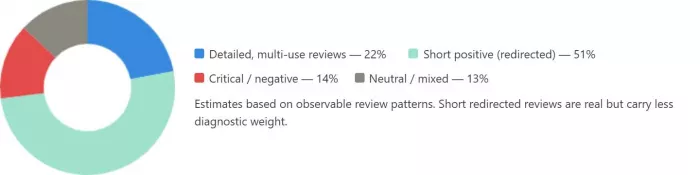
The chart above is an estimated breakdown based on observable patterns in the Trustpilot review pool. It is not an official platform audit, but it reflects a real pattern worth naming.
A large proportion of GravityWrite's Trustpilot reviews are labeled "redirected," meaning the reviewer arrived via a link from GravityWrite's own platform or email. This is permitted by Trustpilot's rules, but it creates selection bias. Users who are satisfied enough to still be on the platform are the ones most likely to follow that link and leave a review.
More importantly, many of the short positive reviews show patterns that reduce their evidential weight:
● One-line reviews with no specific use case described ("the best app," "very helpful tool")
● First-time reviewers with no other review history
● Grammar and sentence structure suggesting non-native English written very quickly
● No mention of how long the user has been on the platform or which plan they use
"A lot of the reviews look templated or overly positive- you can scroll through and see the same three sentences rephrased."
This observation from a forum discussion reflects a real problem with aggregate ratings. A 4.7 built partly on a large volume of these entries carries less evidential weight than a 4.2 built entirely on detailed, multi-paragraph accounts. The practical instruction: read the 2-star and 3-star reviews. They come from users who tried the product seriously but were not angry enough to write a 1-star review. They are usually the most accurate.
| Safety dimension | Evidence available | Assessment |
| Data collection | Privacy policy states content is not stored beyond request fulfillment; payment data is shared with third-party processors | Standard SaaS practice — no red flags |
| GDPR / SOC 2 compliance | Self-reported by the company | Claimed but not independently verified |
| Known breaches | No public record of a confirmed data breach | Neutral — absence of evidence is not evidence of safety |
| Billing predictability | Terms allow mid-subscription changes; multiple documented disputes | Active concern |
| Refund process | 7-day window, manual request required, partial refunds documented | Unreliable in practice |
| Fraud/scam status | ScamAdviser rates the domain as likely legitimate; no coordinated fraud pattern found | Not a scam operation |
| Output accuracy | AI-generated content requires editing; no fact-checking built in | Standard AI tool risk |
GravityWrite claims to use standard data encryption and states compliance with GDPR and SOC 2 standards. These are the right things to claim. The problem is that neither has been verified by an independent third party in any publicly available audit. Self-reported compliance is a starting point, not a guarantee.
Scamadviser's automated analysis rates gravitywrite.com as very likely not a scam, based on SSL certification, domain age, and cross-platform review presence. That is reassuring but limited in scope. Automated trust checkers do not evaluate billing practices, refund behavior, or whether a platform's terms put users at a disadvantage.
Two things that need to be stated clearly:
● Lack of a confirmed scam record does not mean the billing system is trustworthy. It means no coordinated fraud has been documented. Those are different statements.
● The standard risks of any AI tool still apply here: outputs can be factually wrong, content can be flagged by AI detectors despite the humanizer feature, and users who publish without editing own the consequences.
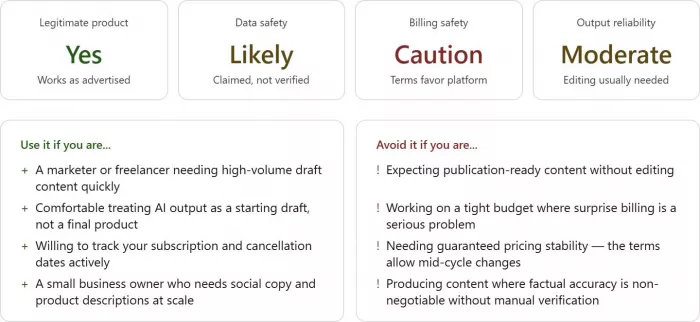
Is GravityWrite legit? Yes. It is a real, operational product that does what it claims at the feature level. The core writing tools, templates, and humanizer function as advertised. The company has a traceable presence, responds to reviews, and has been operational since 2023 without collapsing.
Is it safe for regular use? Conditionally. Data handling is within normal SaaS standards and no breach has been documented. But the billing layer carries documented risk. The platform's own terms reserve the right to change pricing, reduce word allocations, or override previous plan commitments, potentially mid-subscription and without prior notice. That is not fine print to skim. If you subscribe, document your cancellation steps, set a calendar reminder before renewal, and do not count on support resolving disputes quickly.
The final position, stated plainly: GravityWrite is not a scam. It is a functioning product with a real value proposition for high-volume, low-stakes content creation. But the combination of aggressively user-unfavorable billing terms, documented refund difficulties, and a review pool inflated by redirected one-liners means the 4.7-star rating should not be trusted at face value. Use the product skeptically, manage your subscription actively, and treat every output as a draft.

Intel has joined Elon Musk’s ambitious “Terafab” semiconductor initiat...

Where automation actually saves time in real workflowsInstead of think...

April 7, 2026Samsung Electronics said Tuesday it expects first-quarter...
DeepSeek AI usually stops meeting expectations at a very specific poin...

For the past few months, a name kept appearing in my inbox and social...
Anthropic is tightening how its AI coding platform is billed, confirmi...

Discussion