12 Best AI Sales Automation Tools: The Pipeline Test

By Sayee Jadhav
Content Writer, TechLinos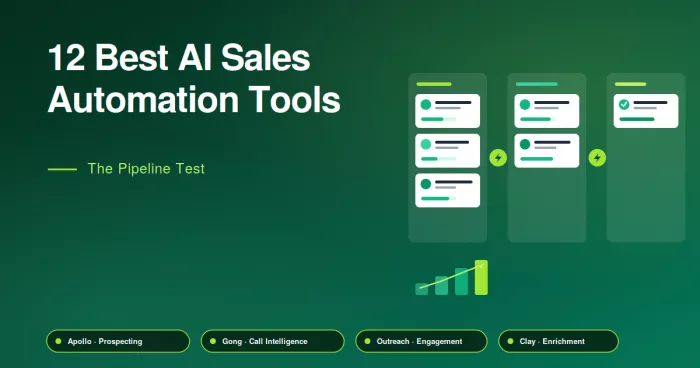
Why The Sales Stack Fragmented
The promise of AI sales automation is straightforward: automate the administrative work that keeps reps away from selling. The reality is messier. No single tool owns the full workflow well. Prospecting data lives in one platform, email sequencing in another, conversation intelligence in a third, and the CRM ties them together imperfectly. The result is that tool selection has become a stack-design problem rather than a single-product decision.
This roundup tests 12 tools across that full stack, from data and prospecting through engagement, intelligence, and the CRM layer. Some are all-in-one platforms that cover several layers acceptably. Others are specialists that dominate a single layer. The right answer depends on team size, sales motion, and where the measurable bottleneck sits, which is why the reviews below are organized around fit rather than a single universal ranking.
The Four Layers of the Modern Sales Stack
1. Data and prospecting. Finding and researching the right accounts and contacts. Apollo, Clay, ZoomInfo, and 6sense operate here. Quality of contact data and depth of enrichment define this layer.
2. Engagement and sequencing. Sending the right message at the right time across email, phone, and social. Outreach, Salesloft, Instantly, and Lemlist live here. Automation depth and deliverability define it.
3. Conversation and revenue intelligence. Understanding and predicting what happens inside deals. Gong and Clari own this layer, turning call recordings and pipeline data into coaching and forecasts.
4. CRM and platform. The system of record that ties everything together. HubSpot and Salesforce anchor the stack, increasingly with native AI layered on top through Breeze and Einstein.
How The Pipeline Test Was Run
TechLinos editors evaluated all 12 platforms over a six week testing window from April to May 2026. Each tool was run through a simulated B2B outbound motion using three team scenarios, with automation depth, AI output quality, and integration behavior assessed against the same baseline tasks. Pricing was verified directly with each vendor at the time of publication, and integration depth was tested against both Salesforce and HubSpot where applicable.
Each tool received scores out of 10 across five dimensions: Workflow Automation (how much manual work it removes), AI Intelligence (quality of scoring, insights, and generated content), Data and Enrichment (accuracy and coverage of contact and account data), Integration Depth (how well it fits an existing CRM and stack), and Pricing Value (cost relative to delivered outcomes). The overall TechLinos Score combines all five into a single 1 to 5 figure, shown alongside a radar profile that makes each tool's shape visible at a glance.
Where Each Tool Sits
Before comparing scores, it helps to see which layer of the stack each tool occupies. Few tools span more than two layers well. The map below groups all 12 tools by their primary function. Tools that genuinely operate across multiple layers appear in more than one row.
Reviews of All 12 Tools
Each review includes a radar profile showing the tool's shape across the five Pipeline Test dimensions, an About section, top features, pros and cons drawn from testing, and an Editor's Take. Tool names are anchored for direct linking.
Apollo.io
The best-value all-in-one platform, combining a 275M+ contact database, AI sequencing, and a dialer in a single tool that scales from solo founders to growth teams.
The Pipeline Test Scorecard
About Apollo.io
Apollo combines three layers that usually require separate tools: a large contact database, AI-assisted outreach sequencing, and a built-in dialer. For solo founders and early-stage teams, this consolidation is the entire value proposition. The free tier alone covers a founder's first 100 outbound emails, and the paid tiers stay affordable as a team grows. During testing, Apollo's data accuracy was strong though not class-leading, and its sequencing depth trailed dedicated engagement platforms like Outreach. What it lacks in specialist depth it recovers in breadth and price: no other tool in the test set delivered this much functional coverage at this cost. Apollo also offers a native HubSpot integration that runs more smoothly than the Salesforce-first engagement platforms manage.
Top Features
- All-in-one coverage: Contact data, AI sequencing, and a dialer in a single subscription with no add-on stacking required.
- 275M+ contact database: Large B2B contact and account database with AI enrichment and intent signals built in.
- AI email and sequencing: Generates outreach copy and runs multi-step sequences with automated follow-up logic.
- Native HubSpot integration: One of the smoothest HubSpot syncs in the category, unlike Salesforce-first engagement tools.
- Genuinely useful free tier: Free plan with monthly email credits and database access, strong enough for founder-led outbound.
- Best functional coverage per dollar of any tool tested; consolidates three layers in one
- Free tier is the strongest starting point in the category for solo and founder-led outbound
- Native HubSpot integration runs smoother than the Salesforce-optimized engagement platforms
- Contact database depth competes with dedicated data vendors at a fraction of the stack cost
- Sequencing depth trails dedicated engagement platforms like Outreach and Salesloft
- Data accuracy is strong but not class-leading; Clay-style waterfall enrichment is more thorough
- Deliverability tooling is lighter than dedicated cold-email platforms like Instantly
- Reporting and forecasting are basic compared to revenue-intelligence specialists
HubSpot Sales Hub
The strongest CRM-plus-AI platform, anchoring the entire stack with unified records and Breeze AI for teams that want one system rather than a stitched-together toolset.
The Pipeline Test Scorecard
About HubSpot Sales Hub
HubSpot Sales Hub anchors the stack at the CRM layer and layers AI on top through Breeze. The advantage is unification: contact records, marketing context, service history, and sales activity live in one system, which removes the data-reconciliation tax that fragmented stacks impose. Breeze adds a prospecting agent for first-touch research, AI drafting for emails, and conversation intelligence that transcribes calls. During testing, HubSpot's integration depth scored highest in the set because it is the integration point, not a tool bolted onto one. The trade off is that its specialist layers (data enrichment, deliverability, conversation intelligence) are competent rather than best-in-class. For teams that value one platform over best-of-breed depth, that trade is usually worth it.
Top Features
- Unified customer record: Sales, marketing, and service data in one system, eliminating cross-tool reconciliation.
- Breeze AI suite: Prospecting agent, email drafting, and forecasting built natively into the CRM.
- Conversation intelligence: Call transcription and key-moment surfacing included without a separate tool.
- Full free CRM: A genuinely usable free CRM tier that scales into paid Sales Hub features.
- Reporting dashboards: Revenue, forecast-accuracy, and productivity dashboards native to the platform.
- Highest integration score in the test set because it is the stack's anchor, not an add-on
- Breeze AI covers prospecting, drafting, and forecasting without bolting on extra vendors
- Free CRM tier makes it a low-risk foundation that scales with the team
- Unified records remove the data-reconciliation overhead that fragmented stacks create
- Specialist layers (enrichment, deliverability, conversation intelligence) are competent, not class-leading
- Salesforce-optimized engagement tools integrate with friction, narrowing third-party options
- Costs escalate quickly as seats and Hub tiers are added
- Breeze AI features are newer and less battle-tested than dedicated specialist tools
Clay
The data enrichment and workflow orchestration leader, pulling from 75+ sources through waterfall enrichment and using AI to personalize outreach at a depth no single-source tool matches.
The Pipeline Test Scorecard
About Clay
Clay is the highest-leverage tool in the stack for teams that have outgrown generic sequences. Rather than relying on a single data provider, Clay runs waterfall enrichment: it queries 75+ sources in sequence (Apollo, LinkedIn, Clearbit, Crunchbase, and dozens more) to maximize coverage while controlling cost. On top of the enriched data, AI writes personalized email snippets grounded in real account context. During testing, Clay produced the highest data coverage and the most genuinely personalized outreach of any tool, but it is not a sending platform. It pairs with Instantly, Smartlead, or Outreach as the delivery layer. The learning curve is steeper than any other tool tested, which is the main barrier to adoption for non-technical teams.
Top Features
- Waterfall enrichment: Queries 75+ data sources in sequence to maximize contact coverage and control cost.
- AI personalization at scale: Generates 1:1 email snippets grounded in enriched account and contact data.
- Workflow automation: Triggers actions based on data changes, prospect behavior, or custom conditions.
- Multi-provider data strategy: Avoids single-source data gaps by combining dozens of providers per record.
- Integrations as a sending layer: Feeds enriched, personalized data into Instantly, Smartlead, Outreach, or a CRM.
- Highest data coverage in the test set through waterfall, multi-source enrichment
- Produces the most genuinely personalized outreach of any tool, not generic mail-merge
- Workflow automation handles complex conditional logic that simpler tools cannot
- Pairs cleanly with any sending layer, slotting into an existing stack rather than replacing it
- Steepest learning curve in the category; non-technical teams ramp slowly
- Not a sending platform; requires a separate delivery tool to complete the workflow
- Credit-based pricing can climb quickly with heavy enrichment volume
- Overkill for teams whose outreach does not depend on deep personalization
Gong
The conversation intelligence standard, analyzing every call to surface deal risks, coaching opportunities, and the winning patterns that separate top reps from the rest of the team.
The Pipeline Test Scorecard
About Gong
Gong records, transcribes, and analyzes sales conversations to surface what actually happens inside deals. The AI detects deal risk, flags coaching moments, and identifies the conversation patterns that correlate with closed-won outcomes. For sales managers, this replaces anecdotal coaching with data: instead of guessing why deals stall, Gong shows the talk-track patterns of top performers. During testing, Gong's AI intelligence scored highest in the set on conversation analysis quality. The economics require scale, though. Gong recommends a minimum of 10 to 15 reps to generate meaningful pattern data, and with average contract value below $10,000 the cost math gets tight. Below that threshold, the coaching insight does not yet pay for itself.
Top Features
- Full call analysis: Records and transcribes every call, surfacing key moments and discussion topics automatically.
- Deal-risk detection: AI flags at-risk deals based on conversation signals before they stall.
- Coaching insights: Identifies the talk-track patterns of top performers for replication across the team.
- Revenue intelligence: Connects conversation data to pipeline and forecast views for managers.
- Pattern analysis at scale: Finds winning and losing patterns across hundreds of calls once volume is sufficient.
- Highest conversation-intelligence quality in the test set, the category standard for a reason
- Replaces anecdotal coaching with data on what top performers actually say
- Deal-risk detection surfaces stalling deals earlier than manual pipeline review
- Pattern analysis across call volume reveals insights no individual manager could spot
- Requires 10 to 15 reps minimum to generate meaningful pattern data
- Quote-based pricing is among the highest in the category and not transparent
- Cost math gets tight when average contract value is below $10,000
- Value is concentrated in coaching and visibility, not prospecting or sequencing automation
Outreach
The enterprise sales engagement leader, offering the deepest sequence automation and tightest Salesforce integration, with Kaia conversation intelligence built into the platform.
The Pipeline Test Scorecard
About Outreach
Outreach is the enterprise standard for sales engagement, with the deepest sequence automation of any tool tested. Where lighter tools offer linear cadences, Outreach supports complex branching logic, conditional steps, and granular A/B testing across email, phone, and social touches. Its Kaia AI adds conversation intelligence for call analysis. The platform is optimized for Salesforce and syncs deeply, which is both its strength and its constraint: HubSpot users routinely report integration friction. During testing, Outreach scored highest on workflow automation, reflecting that sequence depth. It is built for teams with dedicated SDR functions and the operational maturity to use that depth. For smaller teams, much of the capability goes unused while the per-seat cost stays high.
Top Features
- Deepest sequence automation: Complex branching cadences with conditional steps across email, phone, and social.
- Kaia conversation AI: Built-in call analysis and real-time guidance during live conversations.
- Granular A/B testing: Sequence and message testing at a depth lighter tools do not support.
- Deep Salesforce sync: Two-way Salesforce integration that surpasses most engagement platforms.
- Enterprise governance: Team management, permissions, and reporting built for large SDR functions.
- Deepest sequence automation in the test set with full conditional branching logic
- Kaia conversation AI adds call intelligence without a separate tool
- Salesforce integration is the tightest among dedicated engagement platforms
- Enterprise governance and reporting suit large, structured SDR teams
- HubSpot users report integration friction; the platform is Salesforce-first
- Quote-based pricing is high and much of the depth goes unused by smaller teams
- Steeper setup and administration than all-in-one tools like Apollo
- Data and enrichment are not native strengths; pair with a dedicated data layer
Salesloft
The multi-channel sequencing platform built around Rhythm AI and manager coaching workflows, strongest where visibility into rep activity is the organizing priority.
The Pipeline Test Scorecard
About Salesloft
Salesloft competes directly with Outreach in the sales engagement layer, with a different emphasis. Where Outreach leads on raw sequence depth, Salesloft organizes around Rhythm AI and coaching workflows that give managers visibility into rep activity. The Rhythm engine prioritizes which actions reps should take next based on buyer signals, which suits teams where execution consistency across reps matters more than maximum sequence complexity. During testing, Salesloft matched Outreach closely on automation and AI, trailing slightly on integration depth. Its HubSpot integration is more workable than Outreach's, making it the smoother of the two enterprise engagement platforms for HubSpot shops. The choice between the two often comes down to which interface reps prefer in daily use.
Top Features
- Rhythm AI prioritization: Signals-based engine that tells reps which action to take next across accounts.
- Coaching workflows: Manager-facing tools for reviewing rep activity and call performance.
- Multi-channel cadences: Email, phone, and social sequencing with team-level consistency controls.
- Conversation analytics: Call recording and analysis integrated with the engagement workflow.
- Workable HubSpot integration: Smoother HubSpot sync than Outreach, suiting HubSpot-based teams better.
- Rhythm AI prioritization drives execution consistency across a full team
- Manager coaching and visibility tools are stronger than most engagement platforms
- Smoother HubSpot integration than Outreach for teams not on Salesforce
- Matches Outreach closely on automation depth with a more guided rep experience
- Sequence complexity ceiling is slightly below Outreach for the most advanced teams
- Quote-based pricing sits in the same high enterprise range as Outreach
- Data and enrichment require a separate layer, as with all engagement platforms
- Value concentrates in mid-to-large teams; underused by small operations
Salesforce Einstein
The predictive AI layer native to the world's most widely deployed CRM, turning Sales Cloud data into lead scoring, forecasting, and next-step guidance at enterprise scale.
The Pipeline Test Scorecard
About Salesforce Einstein
Salesforce Einstein is the predictive AI layer for organizations already running Sales Cloud. Because it operates on data already in Salesforce, it requires no integration work for those teams: lead scoring, opportunity insights, forecasting, and next-step guidance all draw on the existing system of record. During testing, Einstein scored well on integration (it is native) and AI quality, but its value is gated behind a Salesforce subscription and add-on pricing that pushes the effective cost high. For teams not on Salesforce, Einstein is not an option. For teams that are, it is the lowest-friction way to add predictive intelligence without bolting on a third-party tool, provided the budget absorbs the add-on cost on top of an already significant Sales Cloud spend.
Top Features
- Predictive lead scoring: Scores leads and opportunities using models trained on the organization's Salesforce data.
- Forecasting intelligence: AI-driven forecast projections built into Sales Cloud pipeline views.
- Next-step guidance: Recommends the next best action on opportunities based on historical patterns.
- Native data access: Operates directly on Salesforce records with zero integration overhead.
- Activity capture: Automatically logs emails and meetings to CRM records, reducing manual entry.
- Zero integration friction for teams already running Salesforce Sales Cloud
- Predictive scoring and forecasting draw on the complete system-of-record data
- Native activity capture reduces the CRM data-entry burden automatically
- Enterprise-grade governance and scale that standalone tools cannot match
- Requires a Salesforce Sales Cloud subscription; not an option for other CRMs
- Add-on pricing pushes effective cost high on top of significant Sales Cloud spend
- Lowest pricing-value score in the set given the total cost of ownership
- Prospecting and outbound sequencing are not its focus; it is an intelligence layer
Clari
The revenue intelligence and forecasting platform that turns pipeline and activity data into forecast accuracy, giving revenue leaders a defensible view of what will actually close.
The Pipeline Test Scorecard
About Clari
Clari operates at the revenue intelligence layer, focused on a single high-stakes question: what will actually close this quarter. It ingests pipeline data, rep activity, and engagement signals, then uses AI to project forecasts and flag pipeline risk earlier than manual review allows. For revenue leaders and RevOps functions, the value is forecast accuracy: replacing the optimistic guesswork of rep-submitted forecasts with data-grounded projections. During testing, Clari's AI scored high on forecasting and risk detection. It is squarely an enterprise tool, with quote-based pricing and value that only materializes at the scale where forecast misses carry real consequences. Smaller teams without a dedicated RevOps function will not extract enough value to justify the spend.
Top Features
- AI forecast projection: Data-grounded quarter projections that replace optimistic rep-submitted forecasts.
- Pipeline risk detection: Flags at-risk deals and pipeline gaps earlier than manual review.
- Activity capture: Automatically logs rep activity to enrich the forecast data set.
- Revenue visibility: Executive dashboards connecting activity, pipeline, and forecast in one view.
- RevOps tooling: Built for revenue operations teams managing forecast cadence at scale.
- Forecast accuracy is the strongest in the test set for revenue leaders
- Pipeline risk detection surfaces gaps earlier than manual quarter-end review
- Activity capture enriches forecast data without adding rep workload
- Executive revenue visibility ties activity, pipeline, and forecast into one view
- Enterprise quote-based pricing; not accessible for smaller teams
- Value requires a dedicated RevOps function and meaningful pipeline volume
- Focused on forecasting and visibility, not prospecting or sequencing
- Overlaps with Salesloft, which now bundles Clari revenue intelligence in some tiers
Instantly
The cold email automation specialist built for deliverability at volume, with unlimited sending accounts, warmup, and inbox rotation that protect sender reputation as outreach scales.
The Pipeline Test Scorecard
About Instantly
Instantly solves the deliverability problem that kills high-volume cold email: protecting sender reputation. It supports unlimited sending accounts, automated warmup, and inbox rotation, distributing volume across domains so the primary domain stays protected. For teams sending at scale, this is the difference between landing in the inbox and the spam folder. During testing, Instantly scored highest on pricing value in its layer, delivering specialist deliverability at a fraction of enterprise engagement costs. Its B2B database and CRM features were added recently and lack the depth of dedicated tools, which is why power users pair Instantly with Clay for enrichment and use Instantly purely as the high-volume sending layer. As a standalone, its AI and data layers are the weakest part of the package.
Top Features
- Unlimited sending accounts: Distributes email volume across many accounts to protect deliverability.
- Automated warmup: Warms new sending domains and inboxes to build sender reputation safely.
- Inbox rotation: Rotates sends across inboxes to keep volume per address within safe limits.
- AI email writing: Generates and optimizes cold email copy and sequences.
- Deliverability monitoring: Tracks bounce and spam-complaint rates to protect the primary domain.
- Best deliverability tooling in the test set for high-volume cold outreach
- Unlimited sending accounts and warmup protect sender reputation at scale
- Strongest pricing value in its layer, far below enterprise engagement costs
- Pairs cleanly with Clay as the sending layer in a personalization-first stack
- B2B database and CRM features are shallow compared to dedicated tools
- AI and enrichment are the weakest part of the package as a standalone
- Real cost climbs with add-ons; most power users pair it with Clay or Smartlead
- Built for volume; less suited to low-volume, high-touch enterprise selling
6sense
The predictive intent and account-based marketing platform that identifies in-market accounts before they raise their hand, prioritizing outbound around buying signals at scale.
The Pipeline Test Scorecard
About 6sense
6sense operates at the data and intelligence layers with a specific focus: predicting which accounts are in-market before they engage directly. It combines intent data, predictive scoring, and behavioral signals to surface accounts showing buying signals, then orchestrates account-based outreach around them. For enterprise demand-generation and ABM teams, this front-loads prioritization: instead of working accounts evenly, reps focus on the ones the model flags as in-market. During testing, 6sense scored high on AI intelligence and data, reflecting strong intent modeling. It is firmly an enterprise platform with quote-based pricing and the lowest pricing-value score in the set relative to total cost. The intent data is genuinely useful but requires the volume and structure of an enterprise ABM motion to pay off.
Top Features
- Predictive intent data: Identifies accounts showing buying signals before they engage directly.
- Account scoring: AI prioritizes accounts by predicted likelihood to enter a buying cycle.
- ABM orchestration: Coordinates account-based outreach and advertising around in-market accounts.
- Behavioral signals: Aggregates anonymous and known buyer behavior into account-level intent.
- Demand-gen integration: Connects intent data to advertising and sales prioritization workflows.
- Strong predictive intent modeling identifies in-market accounts early
- High data and AI scores reflect genuinely useful buying-signal intelligence
- ABM orchestration coordinates sales and marketing around the same priority accounts
- Front-loads rep prioritization toward accounts most likely to convert
- Enterprise quote-based pricing with the lowest value score in the set per total cost
- Requires the volume and structure of a mature ABM motion to pay off
- Intent data accuracy varies by industry and account profile
- Not a sequencing or execution tool; it prioritizes, then hands off to other layers
Lavender
The AI email coaching tool that scores and improves outreach in real time as reps write, lifting reply rates and ramping new SDRs faster than generic templates allow.
The Pipeline Test Scorecard
About Lavender
Lavender takes a narrow, high-ROI focus: improving individual emails as reps write them. It scores each email in real time on length, readability, personalization, and likelihood to get a reply, then suggests specific edits. For teams sending high volumes of prospecting email, the per-email lift compounds, and the coaching helps new SDRs ramp faster by teaching what good outreach looks like in the moment. During testing, Lavender scored well on AI quality within its narrow scope but low on data and workflow automation because that is not its job: it is a coaching layer, not a sending or enrichment platform. The highest ROI per dollar in the set for teams sending 50+ emails daily, but only meaningful alongside a real sending and data stack.
Top Features
- Real-time email scoring: Scores each email on length, readability, and reply likelihood as it is written.
- In-the-moment coaching: Suggests specific edits that teach reps what effective outreach looks like.
- Personalization assist: Surfaces prospect context to make each email more relevant.
- SDR ramp acceleration: Coaching features help new reps reach effectiveness faster.
- Email client integration: Works inside the inbox where reps already write, not as a separate app.
- Highest ROI per dollar in the set for teams sending 50+ prospecting emails daily
- Real-time coaching ramps new SDRs faster than generic templates or playbooks
- Per-email lift compounds across high outreach volume
- Works inside the existing inbox, requiring no workflow change to adopt
- Narrow scope; it coaches email and does nothing for data, sequencing, or CRM
- Lowest data score in the set because enrichment is outside its remit
- Only meaningful alongside a real sending and data stack
- Value is marginal for low-volume senders who write few emails per day
Lemlist
The budget multichannel outreach platform combining email, LinkedIn, and calling sequences with personalization features, aimed at small teams that want sequencing without enterprise pricing.
The Pipeline Test Scorecard
About Lemlist
Lemlist delivers multichannel sequencing (email, LinkedIn, and calling) at a price point well below the enterprise engagement platforms. Its signature features are personalization touches like custom images and video in outreach, which can lift reply rates for the right audience. For small teams and agencies that want real sequencing without Outreach or Salesloft pricing, Lemlist covers the essentials. During testing, it scored solidly on workflow automation for its price tier but trailed on AI and data depth. Its email database and enrichment lag dedicated tools, so heavy users typically pair it with a data layer. As an affordable on-ramp to multichannel sequencing, it fills the gap between basic tools and enterprise platforms without the cost commitment of the latter.
Top Features
- Multichannel sequencing: Email, LinkedIn, and calling steps combined into a single cadence.
- Personalized media: Custom images and video embedded in outreach to lift reply rates.
- AI copywriting: Generates and adapts outreach copy across sequence steps.
- Deliverability tools: Warmup and sending controls to protect sender reputation.
- Affordable entry pricing: Real multichannel sequencing at a fraction of enterprise engagement cost.
- Affordable multichannel sequencing well below enterprise engagement pricing
- Personalized image and video features differentiate outreach for the right audience
- Solid workflow automation for its price tier across email, LinkedIn, and calling
- Good on-ramp for small teams that have outgrown basic email tools
- AI and data depth trail dedicated tools; enrichment requires a separate layer
- Email database lags Apollo and dedicated data vendors in coverage
- Scales less smoothly than enterprise platforms for large SDR functions
- Personalized media features add value only for specific audiences and motions
Price vs Automation Depth
The chart below plots each tool by approximate monthly cost per seat against its Workflow Automation score. The quadrants describe the value position: tools in the upper left deliver strong automation at low cost, tools in the upper right justify a premium with the deepest automation, tools in the lower right charge premium prices for narrower automation, and tools in the lower left are lightweight and inexpensive. Enterprise tools use quote-based pricing, so their X positions are estimates.
The chart explains why early-stage teams cluster around Apollo, Instantly, Lemlist, and Lavender: all four sit in the value-leader and lightweight quadrants, delivering usable automation without enterprise commitment. The enterprise-power quadrant (Outreach, Salesloft, Clay) is where automation depth peaks, and the premium-niche quadrant (Einstein, Clari, 6sense, Gong) holds tools whose value comes from intelligence and forecasting rather than raw automation breadth. No quadrant is wrong; the right one depends on team scale and the specific bottleneck.
Common Mistakes to Avoid
Patterns that surfaced repeatedly during testing and across buyer experiences, regardless of which tool was chosen.
Buying the platform before naming the bottleneck
The most common and most expensive mistake is selecting a tool by reputation rather than by the specific problem it solves. A team with a data-quality problem does not need a conversation-intelligence platform, and a team with a coaching gap does not need better enrichment. Name the measurable bottleneck first (low reply rates, poor data, stalling deals, forecast misses), then choose the tool that targets it. Buying broadly before diagnosing wastes both budget and the team's adoption energy.
Stacking tools with overlapping functions
Layering Apollo, Outreach, and Clay together without a plan creates overlap, duplicate data, and confused workflows. Each tool should own a distinct layer: data, sequencing, intelligence, or CRM. When two tools claim the same layer, reps fragment their work across both and the promised time savings evaporate. Map the stack by layer before adding any tool, and remove a tool whenever a new one absorbs its function.
Blasting AI email from the primary domain
Sending high volumes of generic AI-generated email from the main company domain is the fastest way to damage sender reputation and land future mail in spam, including legitimate sales replies. Tools built for volume (Instantly, Lemlist, Smartlead) use separate sending domains, warmup, and inbox rotation precisely to prevent this. Always warm up new sending domains, throttle volume, and favor deeper personalization at lower volume over generic blasts at high volume.
Ignoring CRM integration depth
An integration that exists is not the same as an integration that works. Outreach and Salesloft are optimized for Salesforce and create friction for HubSpot users; the reverse is true for some HubSpot-native tools. A shallow integration that requires manual data reconciliation erases the time savings the tool was bought to deliver. Before committing, test the depth of the sync with the specific CRM in use, not just confirm that a connector is listed.
Buying enterprise tools below their required scale
Gong needs 10 to 15 reps to generate meaningful pattern data. Clari and 6sense need a RevOps function and real pipeline volume to justify their cost. Buying these tools too early means paying enterprise prices for value that cannot yet materialize. Match the tool to the team's current scale, and revisit enterprise platforms when the volume and structure to use them are actually in place.
Two pricing patterns stand out. First, the entry-level and specialist tools (Apollo, Instantly, Lavender, Lemlist) are transparent and affordable, which is why they dominate early-stage stacks. Second, the enterprise intelligence and engagement platforms (Gong, Outreach, Salesloft, Clari, 6sense) use quote-based pricing that scales with seats and usage, so the true cost only becomes clear during procurement. Budget for the specialist tools precisely and for the enterprise tools with a wide range until a quote is in hand.
Final Verdict
The AI sales automation category does not have a single winner, because the tools solve different problems at different layers of the stack. The clearest pattern from testing is that tool selection is a stack-design decision, not a single-product choice. Apollo.io earns the top overall score at 4.7 because it covers the most ground well at the lowest cost, making it the right first tool for almost any team under 15 reps. HubSpot Sales Hub and Clay follow at 4.6, one as the unifying CRM anchor and the other as the highest-leverage enrichment specialist.
Above that, selection sorts by layer and scale. Gong, Outreach, and Salesloft are the enterprise engagement and intelligence leaders, justified once a team has the rep count and CRM maturity to use them. Salesforce Einstein, Clari, and 6sense serve enterprise teams whose value comes from prediction and forecasting rather than outreach volume. Instantly, Lavender, and Lemlist are the affordable specialists that compound value when layered onto an active outbound motion.
The practical path is to start with a single platform sized to the team, name the one bottleneck that most limits pipeline, and add the specialist tool that targets it. Adding tools before naming the bottleneck is how stacks become expensive and fragmented. Match the layer to the problem, the tool to the team's scale, and the spend follows the value rather than leading it.
Sayee Jadhav
Content Writer, TechLinos
Sayee Jadhav covers AI-driven productivity tools, revenue technology, and the B2B SaaS category for TechLinos. For this article, Sayee led the six-week Pipeline Test, running all 12 platforms through three team scenarios spanning solo founders, growth-stage SDR teams, and enterprise revenue functions. Each tool was scored across workflow automation, AI intelligence, data and enrichment, integration depth, and pricing value, with integration behavior verified against both Salesforce and HubSpot.
The TechLinos editorial process holds vendors at arm's length: no commercial relationships, no sponsored placements, no priority for advertisers. Pricing and scoring reflect testing conducted between April and May 2026, and quote-based enterprise pricing is labeled as estimated where exact figures were not public.